


ByteDance seems to be getting closer to releasing Dreamina Seedance 2.5, but current rumors suggest that Possibility of release on July 9th. Dreamina and CapCut’s public pages have already mentioned this model, but third-party reports suggest an early July rollout time rather than a firm date. It is expected to be available across Dreamina, CapCut, and partner platforms that are already integrated with ByteDance’s video stack.
Coming soon: Dreamina Seedance 2.5 is coming to CapCut.
Seamless generation and editing. Up to 50 multimodal references. A 30 second scene in one cut. More creative control. You will get more reliable results. Built to help you create faster, smoother, and more intuitively.
Whether… pic.twitter.com/hkJnP3zg6Y
— CapCut (@capcutapp) July 4, 2026
The main new feature is the move from short clips to standard 30-second video generation. Dreamina’s page describes a long video workflow that can produce 30-second scenes, 90-second drafts, and 180-second outputs, with a 3-minute AI video being the biggest change claimed in this release. An open question is not only duration, but also whether the model can maintain character identity, motion, camera logic, and prompt intent stable across extensions.
You can create movie videos of up to 30 seconds in standard mode, which can be extended to 180 seconds in beta long video mode.
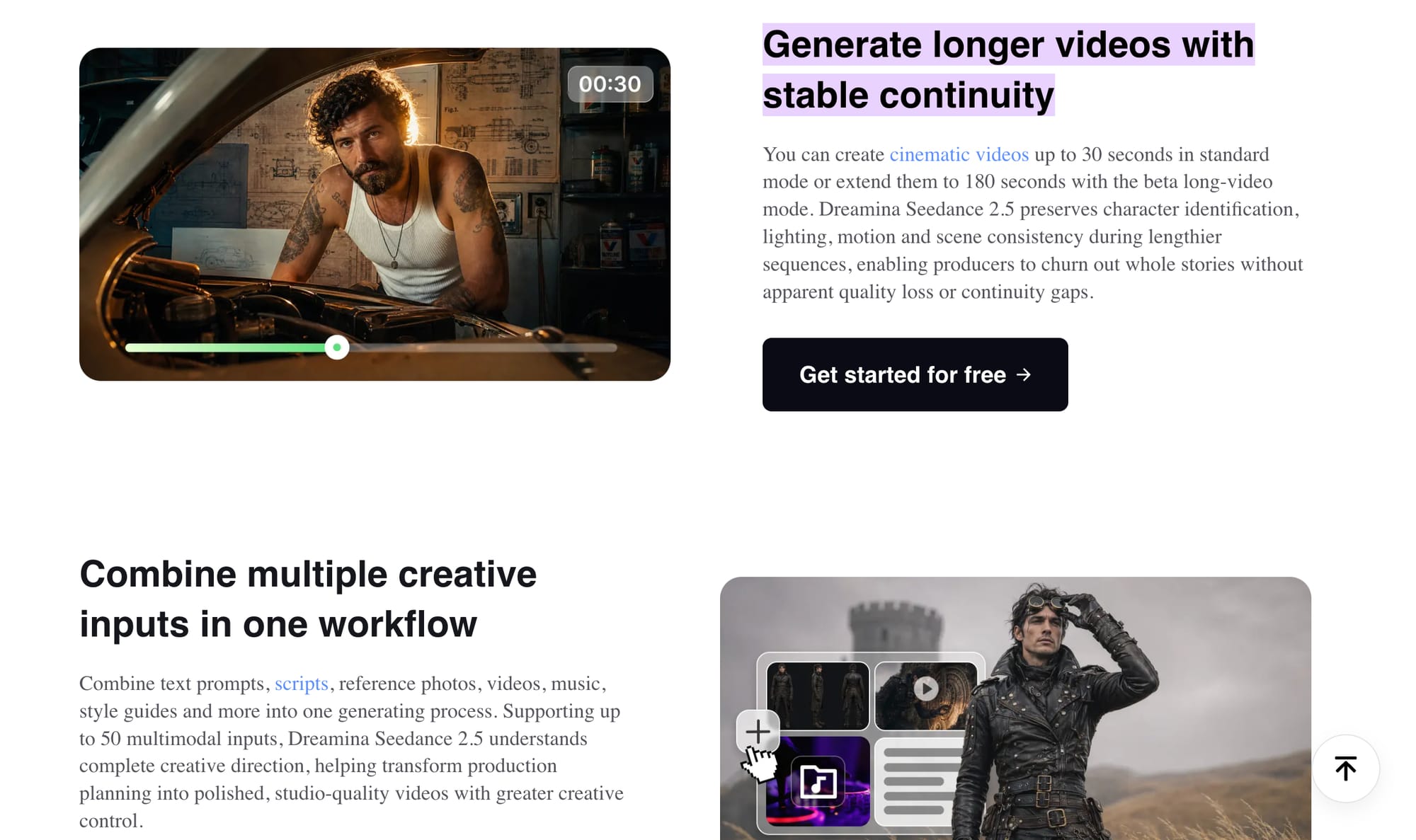
For creators, advertisers, anime editors, social video accounts, and AI filmmakers, this transforms Seedance from a short-shot generator to a tool for longer sequences. Possible locations are within partner apps that use Dreamina’s Seedance workflow, CapCut’s Creator Tools, and ByteDance’s Model Access. The evidence seems to come from publicly available product pages and platform copy, but the July 9th timing remains rumor-level until ByteDance posts a dated release notice.
The company behind this model is ByteDance, which has connected AI video to its creator ecosystem through Dreamina, CapCut, TikTok-adjacent production flows, and API distribution. Seedance 2.0 is still centered around motion stability, multimodal reference, and audio-video generation, and BytePlus lists a duration of 4 to 15 seconds. Seedance 2.5 will push its strategy towards longer-term commercial storytelling and creator workflows, but Google’s Veo and Gemini Omni remain the most obvious competitive pressures after OpenAI retires its Sora web and app products on April 26, 2026.
sauce


