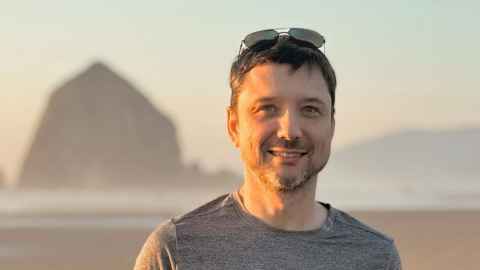
Alexei Dunaev has spent much of his life working on the concept of creating a world where computers can naturally understand humans in the same way humans understand each other. It’s an idea he’s been thinking about since he was a child.
“Voice recognition was always thought to be five years away, but voice is such a fundamental way that we communicate. For technology to be truly useful, it needs to meet us there,” he says.
That belief led to a career that took him from Oakland University to Seattle and Microsoft, where he served as a technical program manager on the AI Superintelligence team. Along the way, he has worked on Amazon’s Alexa as well as Google’s AI and DeepMind.
It’s not just technology that drives him, but what it enables. When computers can understand and respond to human speech, he says, it opens up access to information, eliminates friction and changes the way people interact with the digital world.
Alexei’s path into that world began at the University of Auckland, where he studied commerce and was part of the founding team of the Center for Innovation and Entrepreneurship Velocity program (then called Spark). The goal was not only to start a business competition, but also to build a culture of innovation on campus.
“A big part of it was getting students excited about entrepreneurship and teaching them how to build something useful,” he says.
The idea of being useful is a guiding principle for Alexei. After earning his MBA from Stanford University, he co-founded TranscribeMe, a startup focused on improving speech recognition. By combining artificial intelligence and human annotation of data, the company pushed the boundaries of what was possible, surpassing what IBM and Microsoft were offering in automatic speech recognition at the time.
Now, at Microsoft, Alexei’s work spans a broader range of AI systems, but underlying it is the same core challenge: enabling machines to understand and communicate with humans.
Alexei has a clear eye for what AI is and is not. Much of the public conversation is shaped by misconceptions, he says.
It’s important to understand that.
“It’s like the world’s most advanced autocorrect. It doesn’t see things the way humans do. It just calculates the most likely path through a sea of data.
“When you realize that AI is based on mathematics and not magic, the results become more, not less, impressive,” says Alexei.
That down-to-earth mindset is something Alexei associates strongly with New Zealand. Alexei, who was born in Ukraine and moved here when he was 14, believes Kiwis bring a resourceful and adaptable approach to innovation, which is shaped by working in smaller markets.
“We are being forced to become more versatile, and that adaptability and can-do spirit is a huge asset, especially in a field as rapidly changing as AI.”
This is a perspective that continues to influence his work even today, as he operates at the global forefront of technology. During a recent trip home, he saw how quickly the future he had imagined was becoming a reality. He taught his parents and grandparents how to use the voice-enabled AI assistant on their phones, and within minutes they were asking questions and exploring ideas on a variety of topics.
“It was as easy as holding down a button,” he says. “A world that didn’t exist 10 years ago is now closer to being there for everyone.”
Alexei’s advice to those considering a future in the AI field is to build a strong technical computer science foundation and apply it to areas of genuine interest, such as science, law, and policy.
“The real impact happens at the intersection of disciplines.”
As AI continues to evolve, Alexei sees the current moment as both initial and consequential. Although this technology has already proven its value in a variety of industries, its potential has not yet been fully realized.
“Although we are still at the first stage, I believe we will soon arrive at a world with superhuman speech recognition quality, where computers can understand speech even in complex and noisy environments. I feel it is meaningful to be involved in its development, rather than just watching from the sidelines.”