
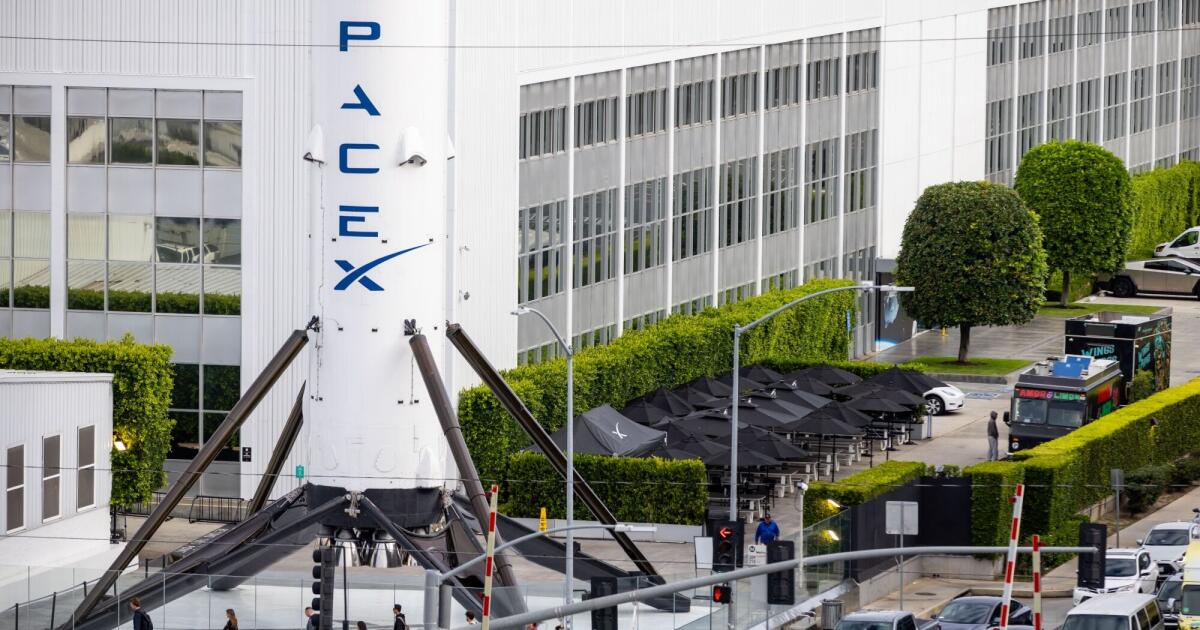
SpaceX is aiming to raise $75 billion in its biggest initial public offering in history, as Elon Musk’s rocket, satellite and artificial intelligence company aims for a historic debut that paves the way for even bigger public offerings.
The Starbase, Texas-based company plans to sell about 555.6 million shares at a price of $135 per share, according to a filing with the U.S. Securities and Exchange Commission on Wednesday. At that price, SpaceX’s market value, based on outstanding shares in the filing, would be nearly $1.77 trillion.
Mr. Musk’s decision to offer shares at a fixed price ahead of orders is almost unprecedented in large IPOs in the United States, unlike in Europe and Asia. Most companies typically announce a price range before selling their stock in an investor presentation, but only a handful of smaller companies skip the opportunity to gauge demand and may build excitement by pricing above the high.
SpaceX’s $75 billion IPO will easily surpass Aramco’s record $29.4 billion public offering in 2019, opening the door for the debuts of OpenAI and Anthropic PBC. If both companies move forward with plans to go public by the end of the year, they are expected to capture investors’ seemingly unquenchable appetite for AI themes and aim for double-digit IPOs of their own.
Factoring in employee stock options and restricted stock units, the company’s fully diluted value would be at least $1.8 trillion. This compares to the $1.25 trillion valuation the company, formally known as Space Exploration Technologies Corp., reached when it acquired Musk’s AI business xAI in February, Bloomberg News reported.
SpaceX’s $1.8 trillion value makes it larger than all but six companies in the S&P 500 index and larger than Musk’s own Tesla Inc.
high goals
The stock sale is scheduled for June 11, and SpaceX plans to begin trading the next day, according to deal terms seen by Bloomberg News. The filing sets the stage for the company to begin the formal marketing process for an IPO on Thursday, in which Mr. Musk and executives will make a formal pitch to investors that will derail SpaceX’s grand plans not only for so-called on-orbit AI mass computing, but also to build a direct cell radio business, ramp up Tesla and AI semiconductor production, and ultimately build a base on the moon and a colony on Mars.
Challenges remain between SpaceX’s lofty goals and its recent history. The company posted a net loss of $4.94 billion on revenue of $18.7 billion last year, compared with a net loss of $791 million on revenue of $14 billion in 2024, according to the filing.
According to filings, SpaceX has a $1.25 billion per month contract with Anthropic to provide AI computing, which could help offset the company’s large capital needs. The companies can terminate the deal with 90 days’ notice, and Musk said on X on May 28 that SpaceX hasn’t committed to leasing computing for years, but “it’s a possibility.”
Musk, the world’s richest person according to the Bloomberg Billionaires Index, is expected to maintain tight control over the company. He will have 84.4% of the voting power after the IPO, but 85% of the Class B shares, compared to 10 votes each for the Class A shares currently. Because Musk owns 93.6% of Class B stock, he can elect 51% of the board of directors and decide to remove him from leadership positions, effectively protecting him from being removed against his will.
Critics of the IPO object to Mr. Musk’s near-unlimited control over the company, and Texas law requires certain disputes to be handled in state business courts or arbitration. The Shareholder Value Protection Alliance, a coalition representing multiple nonprofit organizations, called the company’s governance policies in a May 26 statement a “serious attempt to subvert shareholder protections in novel and reckless ways while giving SpaceX leadership near-total executive authority.”
A SpaceX spokesperson did not immediately respond to a request for comment on criticism of Mr. Musk’s control.
Almost a trillionaire
The offering price would put Musk’s net worth at about $988 billion, putting him on the verge of becoming the first trillionaire, according to calculations by the Bloomberg Billionaires Index. Still, given that the stock can sell for a higher price and that IPOs are typically profitable on the first day, he could hit the mark later next week, when the stock is expected to go public.
Valor Equity Partners holds 6.7% of the Class A shares, down from 7.3% prior to the listing, and will remain the company’s second-largest publicly traded stakeholder. Antonio Gracias, Valor’s founder and longtime Musk ally, is a board member and has supported the rocket company for more than a decade.
Approximately 7.8 billion shares, including all of Musk’s holdings, are subject to a post-IPO lockup that extends beyond the usual six months, according to the filing. All of Musk’s shares will be locked up for 366 days after the IPO, and none of his 6.4 billion shares will be eligible for early release, according to the filing.
Other shareholders will be subject to a phased release schedule rather than a single lockup expiration date. As many as 911.5 million shares were sold within two full business days of the company’s first earnings report, with additional releases tied to specific dates and future earnings reports, and in some cases contingent on the stock trading at least 30% above its IPO price.
Mr. Musk’s company pioneered reusable rockets that land on Earth after launch, and built the Starlink satellite internet division into SpaceX’s largest revenue-generating unit. SpaceX is currently pitching its $28.5 trillion addressable market to public market investors, mostly focused on the AI infrastructure opportunity the company aims to conquer with initiatives like putting data centers in space, a technology that doesn’t yet exist.
SpaceX plans to use the proceeds for purposes such as funding AI, rocket launches and satellite infrastructure expansion, according to the filing. The company must repay at least a portion of its $20 billion bridge loan within six months using certain debt financings and proceeds from the IPO, according to the filing. Much of the loan was used to finance high-interest junk loans to Musk’s social media and AI companies.
The filing reveals details about how SpaceX plans to repay debt related to its approximately $20 billion purchase of radio spectrum from EchoStar Corp. in 2025. The deal will allow SpaceX to expand its ability to connect Starlink satellites to smartphones on Earth. Under the agreement, SpaceX will pay $1.2 billion in 2026 and $828 million in 2027 if the deal is completed by November 30, 2027.
Goldman Sachs Group Inc., Morgan Stanley, Bank of America, Citigroup and JPMorgan Chase & Co. are leading the deal, with 18 other banks participating. The company plans to list on Nasdaq and Nasdaq Texas under the symbol SPCX.
Lipschultz writes for Bloomberg.


