
The history of artificial intelligence (AI) is primarily a digital history. Even the generative and agentic AI boom is largely limited to text, code, and media content.
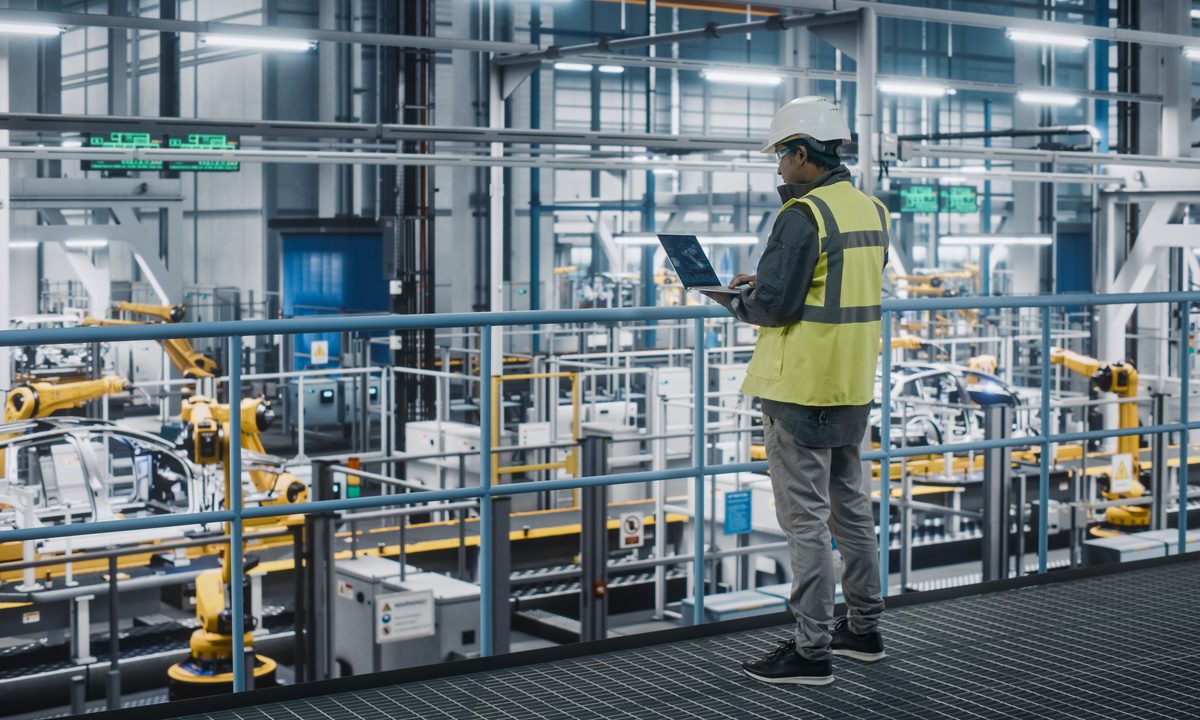
But Amazon founder Jeff Bezos is betting that AI can be brought to life in the physical environment of manufacturing. In the manufacturing sector, digital transformation is evolving more slowly, constrained by physical assets, complex supply chains, and entrenched processes.
He’s raising $100 billion for it. But the plan to use that capital to acquire manufacturing companies and modernize them with AI is notable more for its timing than its size. This proposal arrives at a moment when industrial capabilities, geopolitical priorities, and technological capabilities are converging in ways not seen for generations.
Bezos’ strategy appears to be based on the belief that these capabilities have reached a tipping point. Rather than building new factories, the plan focuses on acquiring existing factories and upgrading them using AI to increase production, reduce downtime, and lower costs.
It’s a bet on AI as infrastructure.
See also: CES focuses on B2B technologies powering the next industrial era
Advertisement: SCROLL TO CONTINUE
From digital optimization to physical transformation
Unlike software businesses, factories cannot scale at near-zero marginal cost. It requires machinery, labor, logistics and energy. But they also generate vast amounts of operational data, much of which is underutilized.
A core premise of Bezos’ funding plan is that AI can transform these environments into continuously optimized systems. Production lines will become adaptive, supply chains will become predictive, and maintenance will become autonomous. In fact, factories are beginning to resemble software platforms that are iterative, data-driven, and increasingly capable of self-correction.
Observers familiar with Bezos’ career will notice a familiar pattern. Amazon didn’t invent retail, logistics, or cloud computing. We captured, reorganized, and expanded them by relentlessly applying technology and data.
Bezos isn’t just investing in factories. He is trying to standardize and systemize them, similar to Amazon’s standardized fulfillment. This initiative is more of an industry roll-up than a venture capital one, and will be executed with technological advantages. The result is a form of “algorithmic acquisition” where value creation is driven not only by financial restructuring but also by technological transformation at the process level.
JPMorgan Chase announced in December that Mr. Bezos would join a 12-member external advisory board for the bank’s initiative, which aims to help companies accelerate growth, innovation and manufacturing, primarily in the United States.

We want to be your favorite news source.
Add us to your preferred sources list to see our news, data, and interviews in your feed. thank you!
It comes at a time when Jeff Wilk, former CEO of Amazon’s Worldwide Consumer Business and current chairman and co-founder of Re:Build, is pushing to bring manufacturing back to the United States.
Mr. Wilk is rebuilding America’s industrial base, and Mr. Bezos is reinventing its operating system. Once the alignment between the companies’ two efforts becomes fully clear, it could suggest that the next stage of globalization will not be where labor is cheapest, but where production systems are smartest.
After all, the allure of a $100 billion bet is further amplified by the current state of manufacturing. Many companies face overlapping pressures such as aging equipment, rising labor costs, supply chain disruptions, and the need to adapt to more localized production models. At the same time, advances in AI and automation technologies have reached a level of maturity where large-scale implementation becomes realistic.
See also: Smart manufacturers redesign factories to take full advantage of AI
A new kind of industrial environment
The industries most likely to benefit from AI-driven manufacturing, such as semiconductors, aerospace, and defense, are among the most strategically important. Governments are already taking steps to support domestic production in these sectors through subsidies and trade policies.
If Bezos’ vision comes to fruition, it would sit at the intersection of private capital and public interest.
If this strategy gains traction, its impact could extend beyond the companies directly involved. Competitors may be forced to adopt similar technologies to survive. Suppliers need to integrate with more advanced systems. Investors may move capital to companies that can demonstrate modernization capabilities.
PYMNTS previously covered how companies are reinventing their sourcing strategies by integrating AI and predictive analytics into procurement and logistics software. These tools facilitate proactive, data-driven decision-making by dynamically assessing a supplier’s risk profile, predicting material shortages, and recommending mitigation strategies before problems become apparent.
The broader implication is that manufacturing, long seen as stable but slow-moving, may be entering an era of more rapid change.
Of course, there is a risk that manufacturing environments are much more complex and less standardized than digital systems. Integrating AI into traditional operations at scale can challenge the limits of applying software-centric thinking to complex and capital-intensive environments.


