

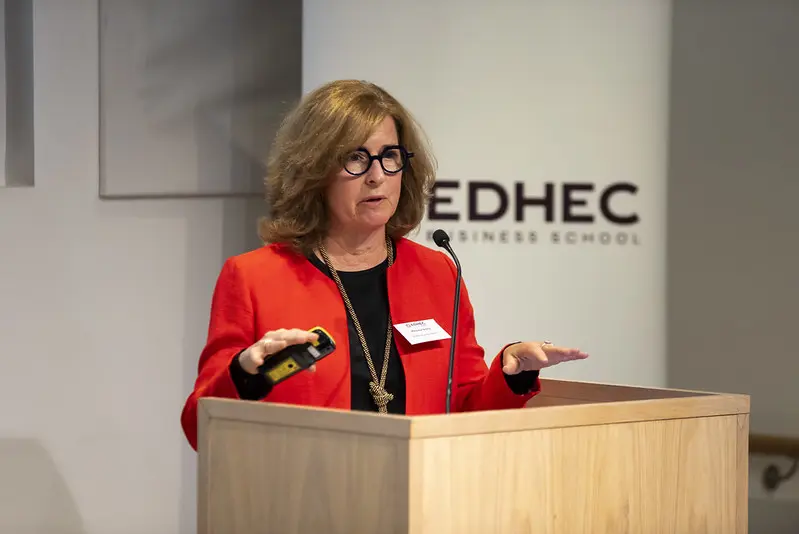
EDHEC AI Center Director Michel Sisto will lead a panel discussion on AI and the future of work in London and give a keynote address on how AI is already reshaping human cognition.
In the amphitheater of France’s EDHEC business school, 350 students sat mostly silent, writing homework for a class on artificial intelligence. With most assignments and meetings now taking place on a screen, the sound of pen scratching paper has startled even veteran professors.
“All the professors were like, ‘Wow, that’s never going to happen,'” says Michel Sisto, the school’s founder and director. EDHEC’s Artificial Intelligence Center.
In January, EDHEC launched the Me, Myself and AI Bootcamp for all 700 pre-master’s students to help them stop and think without technology. Fourteen instructors from a variety of disciplines taught the course, teaching students to reflect and keep journals about how they learn, how they use AI, and where technology can help or hurt learning.
Sisto called the first silence a moment of grace and a window into how EDHEC is approaching one of the biggest changes in business education. As schools race to add AI courses, tools, tracks, and certificates, EDHEC is building AI across the institution without making it the center of the institution.
“AI needs to be understood and integrated into business strategies, but its use must be human-centered and value-driven,” says Sisto, associate professor of AI and decision sciences and EDHEC associate dean.
That certainly means focusing on tools and implementation. But it also focuses on why and when to use AI and its impact on learning and human interaction.
More simply: “Instead of just asking what can be done, let’s ask what should be done.”
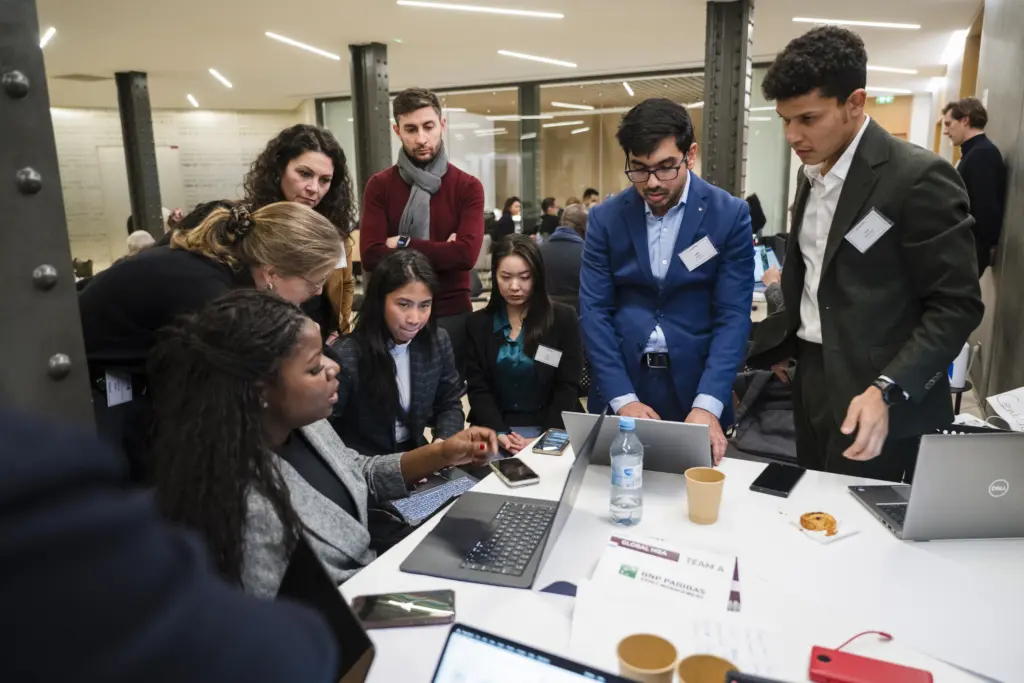
Global MBA students collaborate on live corporate challenges and present their solutions directly to corporate partners during EDHEC’s annual business hackathon. The school has added AI-related questions to its hackathons, courses, and other curricular experiences as part of a broader effort to empower students to apply technology with human judgment.
add a human touch
Sisto’s background is in mathematics and computer science. She researched expert systems, an early approach to AI, in the 1980s, decades before ChatGPT was released to the public in late 2022. As soon as she started experimenting with ChatGPT, she recognized the impact it had on business and business education.
“I thought, ‘This is going to make a big difference in what we do,'” Sisto told the assembled alumni and MBAs during a panel discussion at the EDHEC Alumni Association in London in April. Replace or reinvent? How AI is redefining skills, jobs, and careers.
“I wanted to be part of that movement.”
Syst founded the EDHEC AI Center in 2024. The center is organized around three pillars. Integrating AI throughout EDHEC’s curriculum. Studying its impact on education, work, and human cognition. Building outreach, community, and thought leadership inside and outside of school.
The school has since added an AI and innovation track to its established program. Added AI courses and embedded content for every level from BA to PhD. The school is collaborating with other institutions to improve the skills of teachers and support responsible implementation.
At the heart of our work are big questions that are difficult to answer. For example, what kind of judgment is required when handing over decision-making to an AI assistant or agent? Not just students, but also faculty, industry leaders, and governments.
“The big aspect that we really want to focus on is human agency. AI is getting better every day in cognitive tasks, creative tasks, and now you can even use agent AI to make decisions and take actions,” Sisto says.
“Now we’re talking a lot about how to put guardrails in place and where to involve humans.”
EDHEC’s AI curriculum
One of the AI Center’s first missions was to integrate AI across EDHEC’s curriculum. it is, AI competency framework Map the skills needed for AI citizens (including students) and AI solution architects (people working with AI). And the leader of AI. The work was inspired by the following frameworks: UNESCO AI Competencies for Students AI Skills for Business from the Alan Turing Institute.
In 2025, the school redesigned its digital innovation track. Global MBA A complete focus on AI and its continued transformation of business, work, and society. of tracking Designed to help students move from basic AI literacy to applied AI leadership, it offers courses on digital transformation, practical AI applications, and industry projects from business partners.
EDHEC’s new products AI-enhanced leadership and performance track It is scheduled to launch in October for Executive MBAs.
All 700 EDHEC grandes écoles students attend the course. Me, me, AI, In this seminar, you will be asked to put pen to paper to reflect on your own judgment, ethics, and agency in your AI efforts. Built around the LEAD framework (Learning, Ethics, Accuracy, Development), it uses ethical case studies and rapid engineering workshops to move students from basic queries to more advanced use of large-scale language models.
The school also offers the following services: MSc in Data Analytics and Artificial Intelligence similarly Data Science and AI Track for Business For that MiM. BBA students participate in AI hackathons, specialized tracks, and “Learn by Doing” projects.
The bigger challenge is teaching students to lead with judgment.
“We are still a very people-centered MBA,” says Inge De Clippeleer, associate professor and dean and head of the Department of Business and Humanities at EDHEC. “I think that’s our value proposition in the market.”
De Clippeleer, poets and poems Best MBA Professors Under 40 2024developed the EDHEC signature Lead360 Program For MBA personal and career development. She says AI leadership is about more than just knowing which tools to use. It’s about knowing how to use them in a way that expands your thinking rather than narrowing it.
That includes teaching students to write prompts that “promote divergent rather than convergent thinking,” de Klippeler said.
Leaders are already adapting to a fast-paced, unpredictable environment, and AI only adds to the complexity. That makes change management even more central to the MBA, she says.
AI skill improvement department
As quickly as AI is changing business and business schools, it is also changing the jobs of business professors.
A major challenge is building formal programs based on established courses. Some of them currently have expiration dates of only a few months.
“Two years ago, Prompto Engineering was very cutting edge,” Sisto says. “After six months, it feels like it’s already outdated.”
EDHEC’s response is to create structures for experimentation and sharing, instead of issuing policies or sending teachers to one-off training sessions. Faculty members are forming learning communities to expand how they use AI in their fields, research, and classrooms. The school’s AI for Research and Education Initiative meets approximately every three weeks, and another group meets every Friday, where faculty and staff gather to exchange use cases, experiments, and lessons from the week.
“Instead of being scared, falling behind, or losing, I feel like we’re building each other’s skills,” Sisto says.
EDHEC’s Institute for Educational Innovation (PiLab) supports professors with instructional design, video, data analysis, and classroom technology.
“What we do at PiLab is to support all professors,” says Claudia Carrone, an EDHEC MBA graduate who manages PiLab at the Nice campus. “If you’re an expert, we’ll adapt to your expertise. If you’re scared or don’t know what’s going on, we’ll take your hand and walk you through it.”
Some professors are already building assistants, testing avatars as course instructors, and redesigning assessments. Even now that students can input AI into ChatGPT, some are still trying to figure out what AI means for the cases they’ve been teaching for five years. Carone believes PiLab’s job is to help both groups navigate without the hype and fear.

EDHEC’s campus in Nice, France is the home of the Global MBA.
Human cost of research and speed
The AI Center is also building a research agenda around the myriad questions that AI raises. The AI for Research and Education (AIRE) Forum disseminates innovations and challenges facing teachers across disciplines.
Sisto is particularly interested in the cognitive effects of AI, such as whether students lose confidence when machines appear faster or more capable than them.
She is also interested in what managers need to lead hybrid human-AI teams, how agent AI is being adopted within enterprises, and where AI implementations are stalling.
EDHEC leaders are not naive about the pace of AI development and the limitations of business schools managing it. The same technologies that help students build assistants, personalize learning, and executives map their companies’ use cases also raise unanswered questions about accountability, bias, regulation, and human agency.
One of the clearest examples is agent AI, which can operate with increased levels of autonomy. In business, these tools will soon be able to manage workflows, process customer information, perform analytics, communicate with other systems, and make recommendations that impact real people.
“How do you audit the behavior of these agent AI workflows?” Syst says. “Where is the accountability? Who is in charge?”
Questions like these are too big for one school to answer alone, which is why EDHEC’s AI Center has made outreach and partnerships one of its three pillars. is a founding member of Responsible AI Consortiumas well as Lewis Business School in Rome, Imperial College Business School in London, and QS.
We are also members of the Digital Education Council, a global network promoting sustainable innovation and AI adoption in education and workforce development, and of the FOME Alliance, a partnership with Imperial, John’s Hopkins, LUISS, ESMT, Vlerick and others to explore the use of generated AI by students.
“We recognize that this is a systemic and widespread social and institutional challenge,” she says. “It’s not a problem that we can solve individually.”
Don’t miss: EDHEC Executive MBA launches new AI track for senior leaders, will it replace or reinvent? B-schools face uncertainty around AI, jobs and the MBA pipeline
© Copyright 2026 Poets & Quants. All rights reserved. This article may not be republished, rewritten, or otherwise distributed without written permission. To reprint or license this article or any content from Poets & Quants, please submit your request here.

