
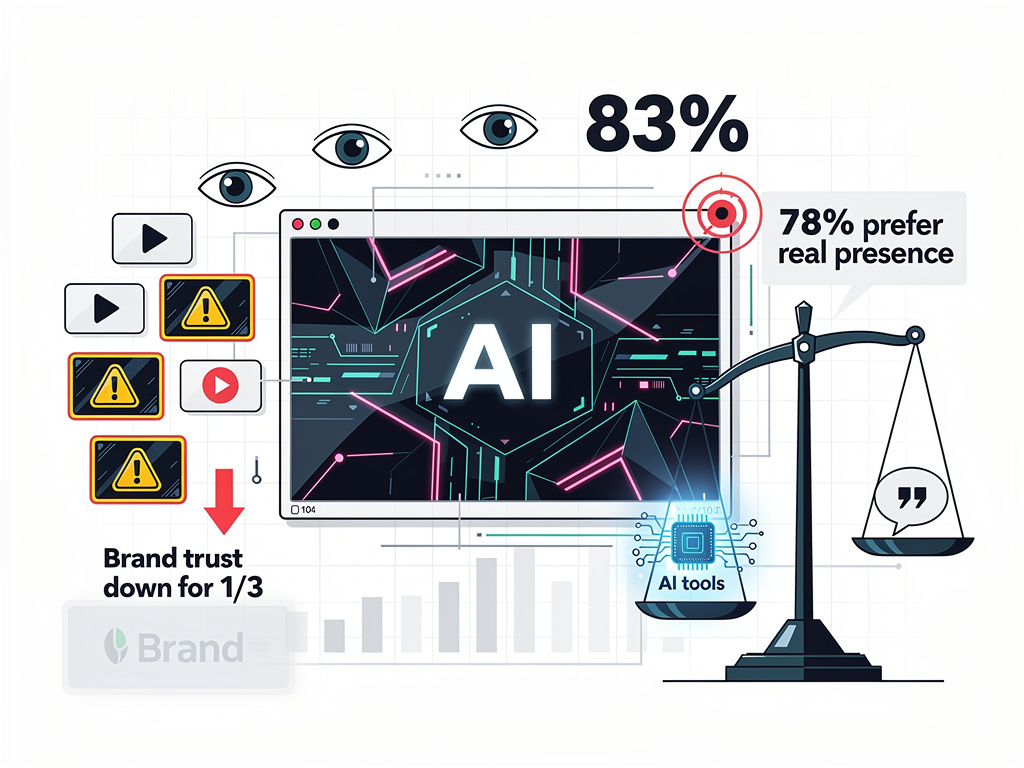
Consumers are increasingly finding what appears to be artificial intelligence in online videos, and as a result, trust in the brands behind them is plummeting. A September 2025 study by video platform Animoto found that 82.6% of U.S. consumers have encountered a video they suspect was generated by AI, and more than a third reported that the video made their view of a brand decrease. This perception persists even when the content is created by humans, with viewers applying a “synthesis penalty” based on telltale signs such as robotic gestures or monotonous emotion.
An Animoto survey of 460 participants familiar with AI tools like ChatGPT and video generators revealed a strong preference for authenticity. 77.9% trust videos featuring real people much more than alternative videos without faces or voices. “The data is clear: Consumers are interested in AI, but they have confidence in humans,” said Beth Forrester, CEO of Animoto. “Generative AI can speed up and scale up video creation, but it’s no substitute for reliability.”
Meanwhile, marketers are embracing AI for efficiency, with 84% using AI in video production, while 90% heavily edit the output to inject brand personality, according to Animoto’s State of Video 2026 report, featured by Quartz. This hybrid approach aims to counter consumer wariness of tools like OpenAI’s Sora that routinely create hyper-realistic clips.
Consumer detection fuels backlash of mistrust
According to Animoto, viewers identify the AI through unnatural clues. According to Animoto, 67% noted robot movements, 55% noted strange voices, and 51% noted lack of emotional depth. Survey respondent Olga Mirković described this as something that “doesn’t fit into the real-life context.” Aaliyah Miller added that AI videos have a “look and feel that tells you they’re AI” and lack the appeal of fresh human content.
This scrutiny goes beyond the video. A Forbes analysis of Nielsen’s 2024 study found that 55% are uncomfortable with AI-heavy sites and 48% don’t trust the brands that advertise there. Among Black respondents, 55% cited concerns about bias, while 56% of Native Americans avoid such advertisers. Nielsen’s Patricia Ratulangi said it was important to “prioritize transparency and cultural relevance.”
Broader public opinion polling also reflects this. According to Sprout Social data from an eMarketer report on Billion Dollar Boy’s Muse Two survey of 4,000 consumers, 52% are concerned about brands’ undisclosed AI. Negative views of AI in creative work have doubled to 32% since 2023.
Trust penalties hit marketing hard
Even the label hurts: A 2025 Nuremberg Institute study cited in KO Insights showed that AI-tagged ads are seen as less natural, significantly reducing research and purchase intent. Deloitte’s 2024 survey found that 70% are concerned about being deceived by AI content. A June-July 2025 Gartner survey of 377 consumers found that 53% do not trust AI search summaries and 61% would like to switch options.
Brands are facing a full-blown recession. McDonald’s in the Netherlands has withdrawn its AI Christmas ad after a backlash that labeled it an “AI failure” that “ruined my Christmas spirit”. Coca-Cola’s AI holiday promotion drew similar complaints about its contraption. “AI produces output that is statistically likely…but it is not truly meaningful,” Kate O’Neill writes in KO Insights. Consumers sense the gap and prefer human technology in an emotional context.
YouGov’s December 2025 survey showed that only 5% of people fully trust AI recommendations, and 41% have no complete trust. iHeartMedia found that the entertainment sector is most opposed to AI, despite 70% using it. On X, users like @DejaRu22 warned that AI videos would undermine the credibility of the videos and foreshadowed requests for verification.
Marketers focus on balance between humans and AI
Animoto users like Chelly Wood shun AI voices as “pre-recorded messages,” undermining trust. Roya Safarian argued that “AI can enhance storytelling as long as brands remain human.” Marketers agree. 95% want AI output to reflect their brand, and 99% want it to be injected with personality.
Quartz quoted Animoto’s Lucas Kilcoyne as saying: “If you just generate and post videos, it’s like seeing the trees and missing the forest…We didn’t form those connections.” The company moved AI to the bottleneck and maintained human control. Another study shows that 88% value brand trust, such as price and quality. 75% require disclosure of AI.
Farooq Kamran emphasized the power of video to “share emotions and connect with people.” As AI floods our feeds, brands that put people first (68% say a real face builds trust) stand out in the “trust economy.”
Future regulatory and technological changes
According to the Nuremberg Institute, EU rules require AI to be labeled. According to a Pew survey (September 2025), most Americans want identification tools but question detection skills. X posts predict that KYC will skyrocket due to the death of “seeing is believing”. @AstasiaMyers pointed out that 90% indistinguishability collapses persuasion costs, but increases skepticism.
The impact is far-reaching: 82% say videos are the most memorable. 83% will buy after viewing. However, synthetic fibers are perceived as cheapening the brand. In the IAB’s 2025 survey, 37% were concerned about distrust of AI advertising. A 2025 poll of 3,000 people by Checkr links AI/deepfakes to generational trust rifts.
Success requires a hybrid model. We need AI for scripts (55%), we need AI for editing (55%), we need humans for ideas (63%), and we need humans for soul. Forrester advised finding a balance that resonates. As 2026 approaches, brands that ignore this risk being left out in an authentic market.


