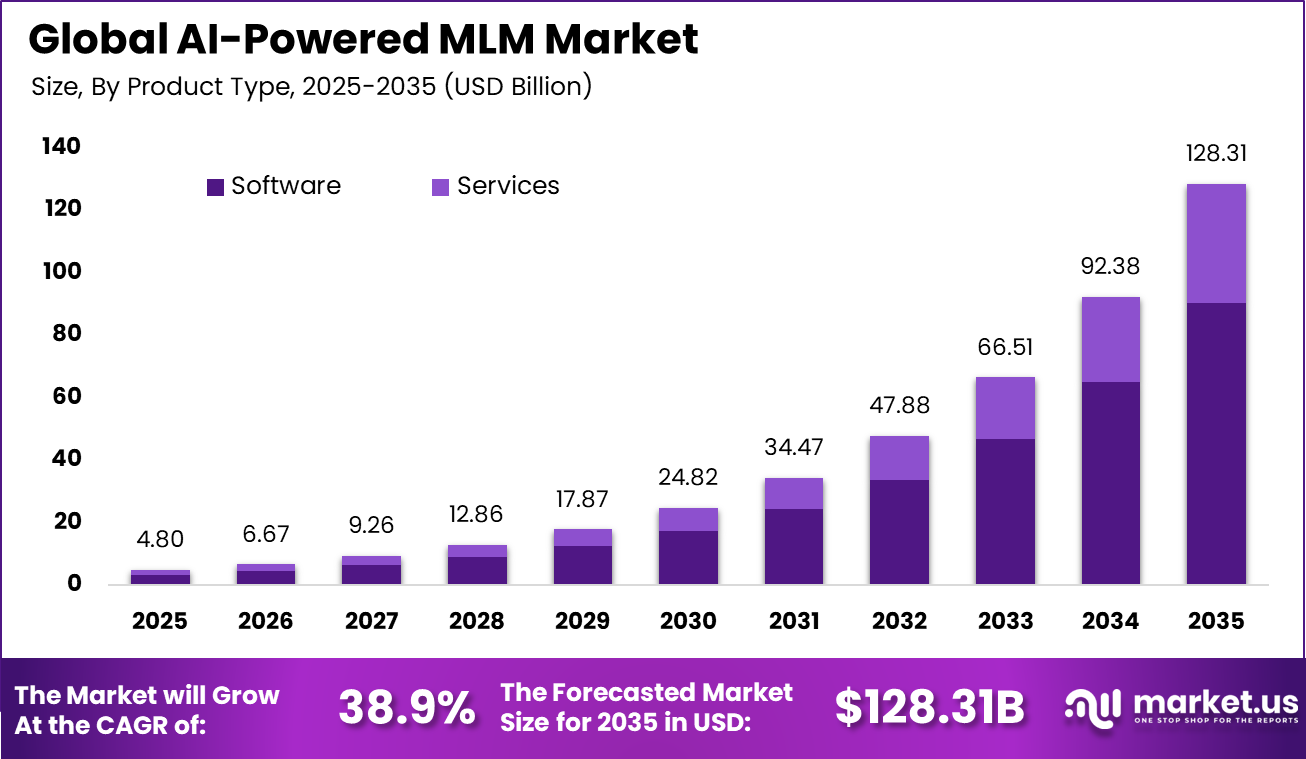
The Global AI-Powered MLM Market size is expected to be worth around USD 128.31 billion by 2035, from USD 4.80 billion in 2025, growing at a CAGR of 32.2% during the forecast period from 2025 to 2035. North America held a dominant market position, capturing more than a 41.6% share, holding USD 1.99 billion in revenue.
The AI Powered MLM Market is developing as multi level marketing organizations adopt intelligent systems to optimize distributor management, customer targeting, and sales forecasting. Artificial intelligence is being integrated into compensation planning, lead qualification, and engagement tracking to improve operational transparency. The market structure highlights the dominance of software platforms, website replication modules, and predictive analytics applications, particularly within healthcare driven distribution models.
Key driving factors include the need for real-time analytical insights, operational automation, and enhanced customer engagement across distributor hierarchies. AI enables deeper understanding of network dynamics and allows companies to respond swiftly to performance trends and evolving distributor behaviour. Demand is growing as companies seek measurable return on investment through smarter lead generation and predictive analytics.
The scope of the AI-Powered MLM market encompasses software solutions, analytical platforms, CRM integrations, automated onboarding tools, commission engines, and mobile-ready MLM applications. These technologies are applied across direct selling companies, network marketing organisations, and hybrid digital sales channels to support both distributor and customer journeys. The market analysis includes technology adoption trends, performance outcomes, and operational efficiencies achieved through AI deployment.
AI-powered Multi-Level Marketing and network marketing models are advancing rapidly, with 67% of MLM companies planning to adopt artificial intelligence solutions by 2026. This shift is driven by the need for automated workflows, intelligent distributor engagement, and data-backed decision-making. Organizations are increasingly leveraging AI to strengthen recruitment strategies and optimize network performance.
Early adopters report measurable improvements, including 40% higher distributor retention, 60% faster business growth, and a 250% improvement in lead quality. These gains are attributed to predictive analytics, automated follow-ups, and AI-based lead scoring systems. The data indicates that artificial intelligence is becoming a core operational layer within modern MLM platforms.
For instance, in March 2025, Neo MLM Software rolled out AI-powered lead scoring and trend analysis in its latest update. The tools crunch sales data in real-time to spot hot prospects, cutting manual work by 70%. As someone tracking this space, it’s exciting to see AI making MLM less guesswork and more science for distributors.
Restraint Impact Analysis
Role of Generative AI
Generative AI strengthens multi level marketing by making distributors work more focused and organized. Chatbots manage customer conversations day and night, answering questions and filtering serious leads. Around 40% of MLM businesses using such tools report better distributor retention because representatives spend less time on routine queries.
It also supports content creation by producing product explanations, follow up messages, and training material tailored to audience interests. Data shows lead conversion improves as AI identifies buying patterns early. Networks using generative AI tools have recorded nearly 60% faster growth when representatives send more relevant and timely messages.
By Solution: Software
Software accounts for 70.5% of the market, reflecting the strong reliance on centralized platforms that manage distributor networks and performance analytics. AI enabled dashboards, automated commission tracking, and real time engagement monitoring are being deployed to increase operational efficiency. Organizations are increasingly implementing cloud based management systems to streamline communication and ensure structured reporting.
The dominance of software is also supported by the demand for scalable automation tools. Intelligent systems analyze distributor activity, customer behavior, and transaction patterns to provide actionable insights. As MLM models become more data driven, software platforms serve as the core infrastructure for network growth and compliance oversight.
For Instance, in February 2026, Exigo announced enhanced software tools with real-time dashboards for tracking downline activity. Leaders can now spot trends and adjust strategies on the fly. It’s gaining traction as networks push for faster decisions in competitive markets. This keeps software at the forefront, making daily tasks smoother for everyone involved.
By Modules: Replicating Website
Replicating website modules represent 38.5% of the market, as digital presence is essential for distributor level engagement. These modules enable personalized storefronts for individual network members while maintaining centralized brand control. Automated content updates and integrated payment gateways simplify online selling for distributors.
The adoption of replicating websites enhances scalability within MLM structures. Distributors can launch branded digital storefronts without technical expertise, improving outreach efficiency. AI driven customization features further optimize content recommendations and promotional strategies based on user interaction data.
For instance, in November 2025, Neo MLM Software launched customizable, replicating website templates that adapt to brand colors instantly. Each distributor gets a professional site without coding skills. This boosts recruiting as links spread easily on social platforms. Teams report higher engagement since personal pages feel more authentic to prospects.
By Technology: Deep Learning
Deep learning accounts for 35.9% of technological adoption, driven by its capability to process large datasets and identify complex patterns. AI models are used to analyze distributor performance metrics, customer purchasing trends, and engagement signals. Advanced neural networks improve forecasting accuracy and identify high potential leads within network structures.
Deep learning algorithms also support fraud detection and risk monitoring within MLM operations. Pattern recognition systems detect irregular commission claims or suspicious transactional behavior. As data volumes expand across digital channels, deep learning continues to strengthen decision making frameworks.
For Instance, in December 2025, Lead MLM Software integrated deep learning algorithms to analyze sales patterns across networks. It predicts which products will trend next for specific regions. This helps leaders stock smarter and train teams effectively. The tech feels like a quiet powerhouse, uncovering insights that were hidden before.
By Application: Predictive Lead Scoring
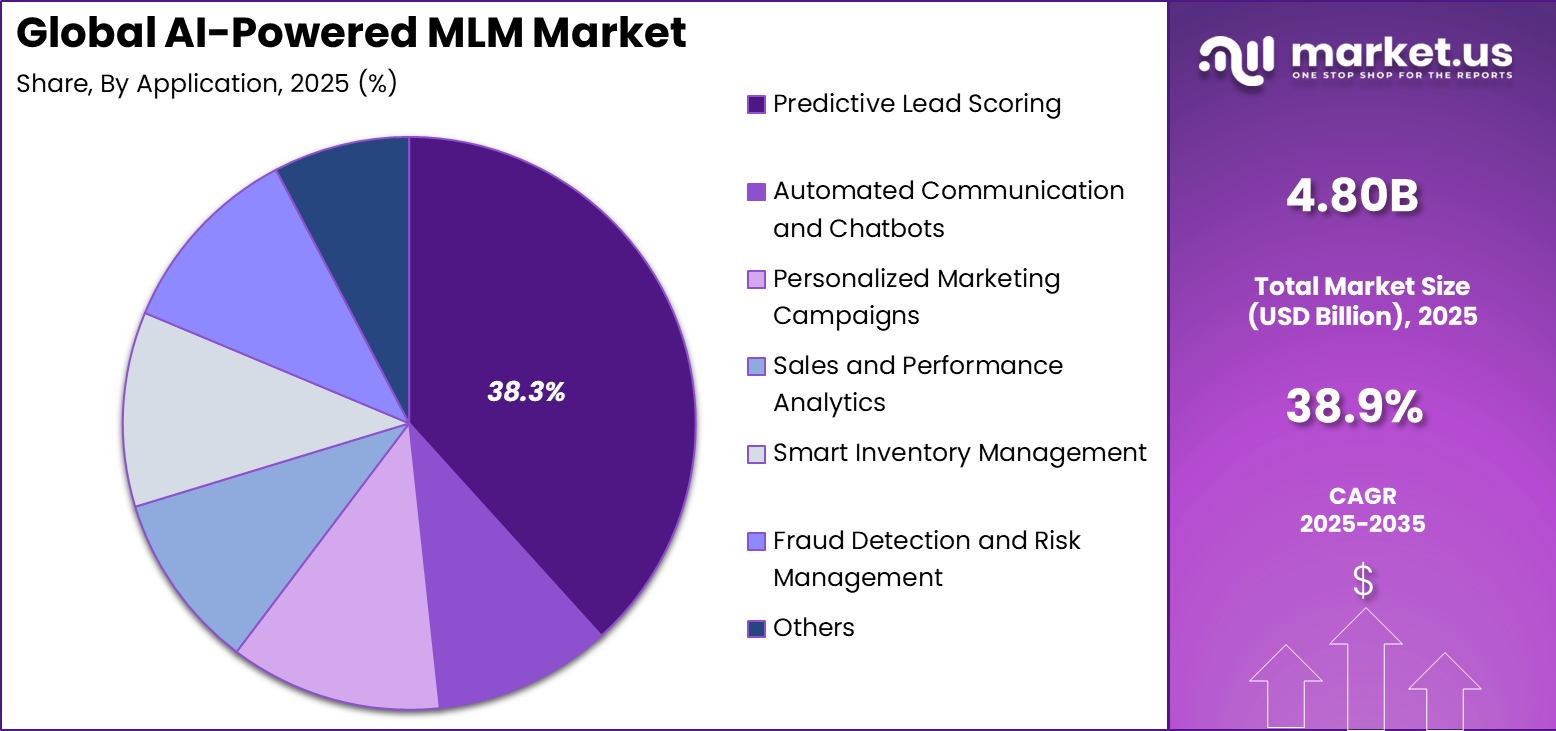
Predictive lead scoring represents 38.3% of application usage, highlighting the importance of targeted customer acquisition. AI models evaluate behavioral data, purchasing history, and engagement frequency to rank potential prospects. This enables distributors to prioritize high probability leads and improve conversion efficiency.
The use of predictive analytics reduces marketing waste and improves sales productivity. Automated scoring systems adjust in real time based on new interaction data, increasing responsiveness. As competition intensifies within direct selling models, predictive lead scoring remains a critical differentiator.
For Instance, in January 2026, Metatag Solution upgraded its scoring app with AI that learns from network feedback loops. Scores get sharper over time, lifting close rates noticeably. Distributors notice fewer misses, which builds confidence in chasing opportunities. It’s transforming how teams prioritize in crowded markets.
By Industry: Healthcare
Healthcare accounts for 30.6% of industry adoption, reflecting strong demand for wellness, nutrition, and personal care products distributed through MLM channels. AI driven systems help manage customer segmentation and compliance tracking within regulated product categories. Accurate data monitoring supports transparent reporting and quality assurance.
The healthcare segment also benefits from personalized recommendation engines that analyze customer preferences and purchase cycles. As consumer awareness around health and wellness increases, AI powered MLM platforms enable targeted engagement strategies. Structured compliance management further supports sustainable growth within this sector.
For Instance, in September 2025, Nocture Solutions tailored its AI platform for healthcare MLMs selling supplements and wellness kits. It personalizes pitches based on user health queries from chats. Sales in this space pick up as buyers trust targeted advice. The fit feels natural with rising interest in direct-sold health goods.
By Region: North America
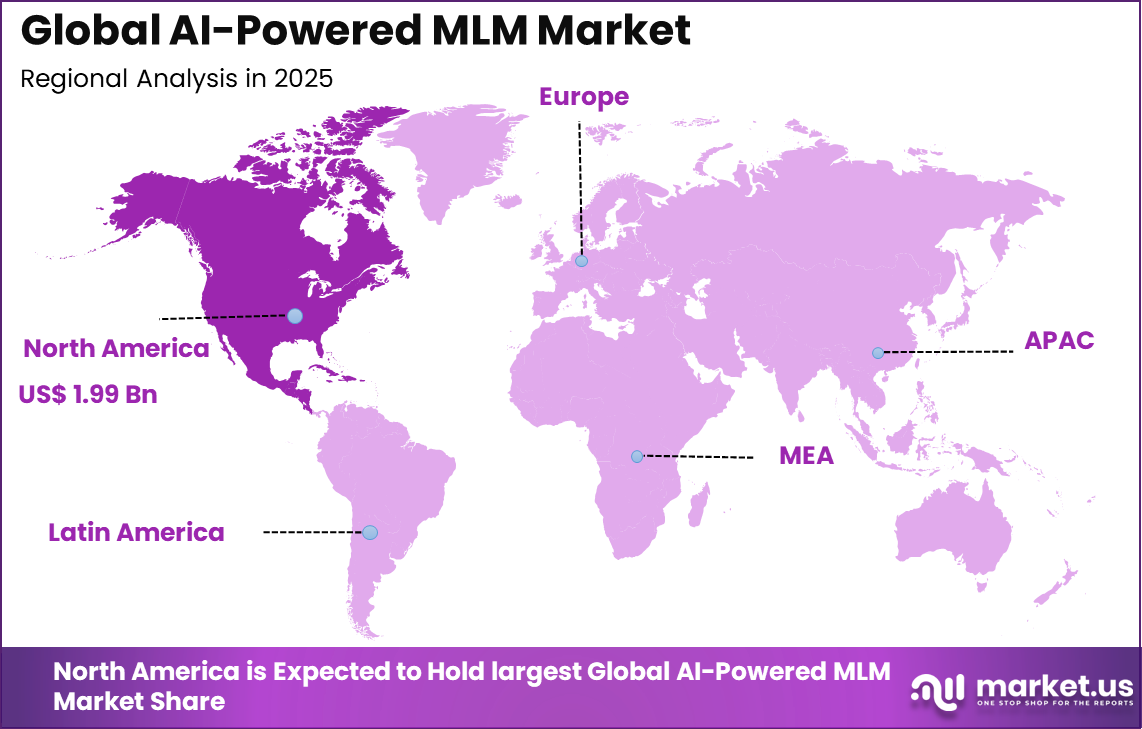
North America holds 41.6% of the market, supported by high digital adoption and mature direct selling networks. Organizations in the region have integrated AI driven tools to optimize distributor productivity and enhance customer analytics. Strong regulatory oversight has also encouraged structured and transparent digital operations.
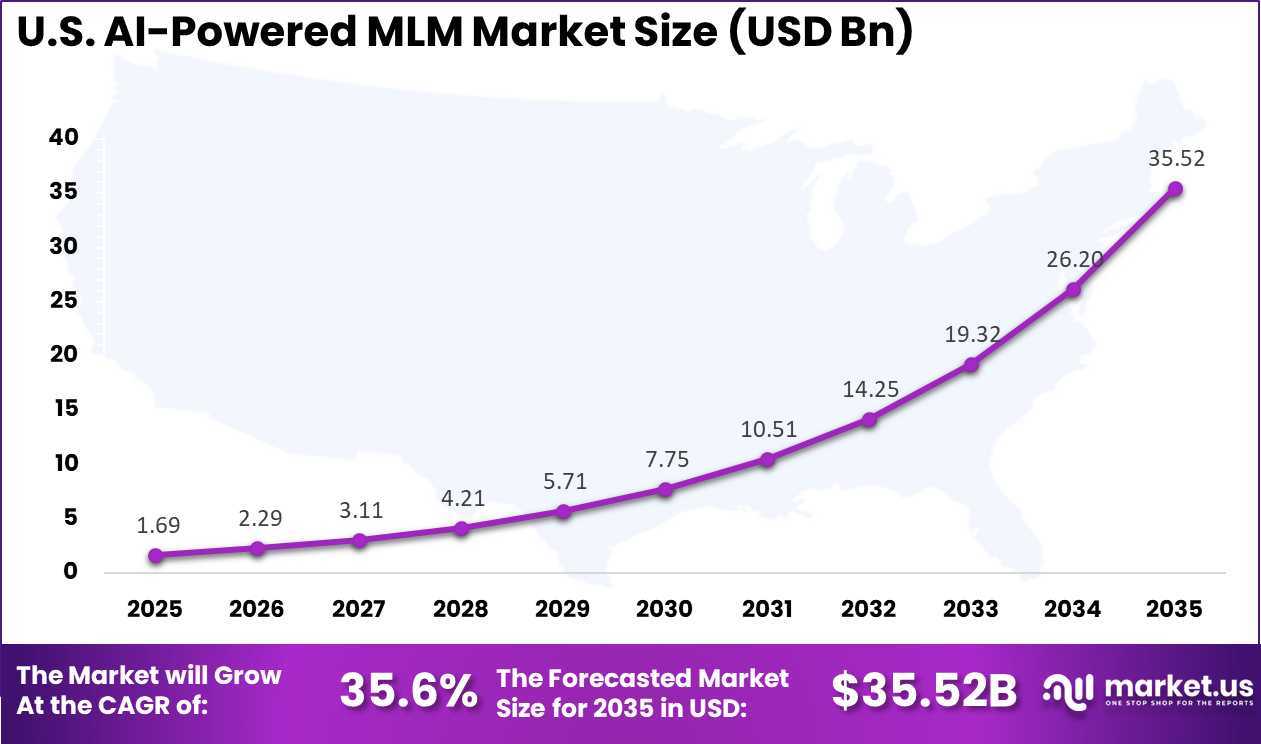
Within North America, the United States contributes USD 1.69 billion with a growth rate of 35.6%. Rapid adoption of artificial intelligence technologies and advanced digital marketing infrastructure has strengthened national leadership. Continued innovation in predictive analytics and automated network management is expected to sustain strong regional expansion.
For instance, in February 2026, MLM Software Inc. launched AI-powered predictive analytics for distributor performance tracking, reinforcing U.S. dominance in MLM tech innovation. The platform identifies growth opportunities and automates commission calculations, serving North American direct selling firms with enhanced efficiency and data-driven insights across their networks.
Top AI-Powered MLM Software Solutions
In 2025, several solution providers are strengthening the integration of artificial intelligence within multi-level marketing platforms. These solutions are designed to enhance distributor productivity, improve data visibility, and support informed decision-making through automation and analytics. The adoption of AI-driven tools is being positioned as a strategic enabler for operational efficiency and scalable network management.
Penny AI is recognized for its focus on productivity enhancement through intelligent task automation and personalized follow-up systems. The platform supports distributors by analyzing engagement patterns and recommending timely actions, which contributes to improved communication consistency and lead nurturing effectiveness.
Epixel MLM Software incorporates AI-driven workflow automation and advanced performance analytics into its platform architecture. Its capabilities extend to predictive inventory management, allowing organizations to better align stock levels with anticipated demand patterns and distributor activity.
Infinite MLM emphasizes AI-powered analytics and comprehensive Key Performance Indicator dashboards. These tools are structured to provide real-time insights into sales performance, distributor growth metrics, and compensation tracking, enabling leadership teams to monitor network health with greater accuracy.
ARM MLM integrates AI-based lead generation tools along with chatbot-enabled support systems. These features are designed to streamline prospect engagement, automate initial communication stages, and enhance response times across distributor networks.
Secure MLM focuses on intelligent KPI dashboards and performance analytics frameworks. Its AI-enabled reporting systems assist organizations in identifying growth trends, measuring distributor efficiency, and optimizing compensation structures through data-backed evaluation.
Emerging Trends
AI-driven personalization is becoming a noticeable trend in MLM networks. Systems analyze social media activity and buying habits to suggest suitable prospects for distributors. Early data suggests that lead quality improves by nearly 250% when AI based targeting tools are used to identify the right customers for product recommendations.
Predictive monitoring tools are also gaining attention by tracking distributor performance and sales patterns. These systems help organizations detect early signs of inactivity or drop off. Networks that respond quickly with personalized coaching support see retention improve by almost 40%, helping distributors stay active and maintain consistent performance levels.
Growth Factors
Strong data analysis tools allow distributors to identify sales opportunities and adjust strategies during changing market conditions. AI based systems help forecast customer interest trends and product demand. Organizations using these insights often report 20% to 30% higher engagement from distributors who receive timely recommendations and selling guidance.
Automation of routine work, such as follow ups and scheduling, allows distributors to spend more time connecting with customers. Representatives close more deals when they focus on relationship building instead of manual tasks. Growth rates improve by nearly 60% in networks where automation helps teams scale operations without increasing manpower.
Customer Impact: Trends and Disruptors
For distributors, AI-Powered MLM platforms reduce manual administrative effort and provide structured guidance on prospect prioritization and engagement timing. Predictive insights increase efficiency and improve earnings predictability, particularly for new entrants.
For organizations, the integration of AI transforms network marketing into a more measurable and analytics-driven business model. Enhanced visibility into performance metrics supports strategic planning and strengthens compliance oversight, contributing to sustainable long-term growth.
Investor Type Impact Matrix
| Investor Type | Growth Sensitivity | Risk Exposure | Geographic Focus | Investment Outlook |
|---|---|---|---|---|
| AI marketing automation platform providers | Very High | Medium | North America, Asia Pacific | Strong SaaS scalability |
| Direct selling technology vendors | High | Medium | Global | Platform integration opportunity |
| Venture capital investors | Very High | High | North America | Innovation in AI-driven sales optimization |
| Private equity firms | Medium | Medium | North America, Europe | Consolidation of digital MLM platforms |
| Strategic corporate investors | Medium | Medium | Global | Distribution efficiency enhancement |
Technology Enablement Analysis
| Technology Enabler | Impact on CAGR Forecast (~%) | Primary Function | Geographic Relevance | Adoption Timeline |
|---|---|---|---|---|
| Predictive analytics for lead scoring and churn prevention | +9.1% | Sales optimization | Global | Short to medium term |
| Generative AI for personalized content and outreach | +7.8% | Automated communication | North America, Asia Pacific | Medium term |
| AI chatbots and conversational commerce engines | +6.5% | Real-time engagement | Global | Medium term |
| Cloud-based distributor management systems | +5.3% | Operational scalability | Global | Medium to long term |
| Compliance monitoring and fraud detection AI tools | +4.4% | Regulatory adherence | Europe, North America | Long term |
Key Market Segments
By Solution
- Software
- Matrix Plan MLM Software
- Binary Plan MLM Software
- Investment Plan MLM Software
- Unilevel Plan MLM Software
- Monoline Plan MLM Software
- Party Plan MLM Software
- Donation Plan MLM Software
- Gift Plan MLM Software
- Generation Plan MLM Software
- Others
- Services
- Professional Services
- Managed Services
By Modules
- Replicating Website
- Online Payments
- Multi-Currency
- Lead Capture Module
- Content Management Systems (CMS) Platforms
- E-Pin Generation
- Others
By Technology
- Deep Learning
- Machine Learning
- Natural Language Processing (NLP)
- Machine Vision
- Generative AI
- Others
By Application
- Predictive Lead Scoring
- Automated Communication and Chatbots
- Personalized Marketing Campaigns
- Sales and Performance Analytics
- Smart Inventory Management
- Fraud Detection and Risk Management
- Others
By Industry
- Healthcare
- Education
- Agriculture
- Ecommerce
- Games
- Grocery
- Tour & travels
- Investment
- Manufacturing
- Oil and gas
- Transportation
- Others
North America
Europe
- Germany
- France
- The UK
- Spain
- Italy
- Russia
- Netherlands
- Rest of Europe
Asia Pacific
- China
- Japan
- South Korea
- India
- Australia
- Singapore
- Thailand
- Vietnam
- Rest of APAC
Latin America
- Brazil
- Mexico
- Rest of Latin America
Middle East & Africa
- South Africa
- Saudi Arabia
- UAE
- Rest of MEA
Drivers
Enhanced Lead Generation
AI tools are helping multi level marketing networks improve how they identify and approach potential customers. Advanced data analysis allows distributors to understand online behavior, interests, and engagement patterns. This makes it easier to focus on prospects who are more likely to respond, reducing time spent on unqualified leads.
With automated systems guiding follow ups and suggesting the right communication timing, distributors can maintain steady interaction with prospects. This structured approach improves confidence among sellers and supports consistent outreach. As a result, networks are able to strengthen recruitment and product sales efforts through smarter lead management.
For instance, in February 2026, MLM Software Inc rolled out a fresh AI feature that scans social media for active prospects. Distributors now get daily lists of warm leads matched to their product lines. This cuts down cold calling time and helps teams add members weekly with targeted outreach. Early users report smoother onboarding flows right from initial chats.
Restraint
Regulatory Concerns
Regulatory oversight remains a significant restraint in AI based multi level marketing. Authorities closely examine income claims, promotional messaging, and recruitment practices to ensure they are transparent and fair. This creates pressure on organizations to carefully review all distributor communication and marketing materials.
Companies must also ensure that AI-generated content does not unintentionally make misleading promises. Monitoring large distributor networks requires strong compliance systems and regular training. These additional controls increase operational responsibility and may slow down the speed at which new AI tools are adopted within the network.
For instance, in January 2026, Neo MLM Software paused a big AI data tool launch after privacy regulators flagged consent issues. They spent weeks tweaking features to meet new data laws across regions. This delay frustrated some clients waiting for advanced tracking. Compliance teams now review every update closely.
Opportunities
Improved Personalization
Improved personalization presents a strong opportunity for AI driven MLM systems. By studying customer preferences and purchase history, AI tools can suggest relevant products and communication strategies for each prospect. This makes interactions more meaningful and increases the likelihood of positive responses.
Personalized onboarding and training support also help new distributors feel guided and prepared. When sellers receive tailored recommendations and learning materials, they are more confident in their outreach. This strengthens long term engagement within the network and supports steady performance improvement across teams.
For instance, in December, Lead MLM Software launched tailored AI content generators for member messages. Reps craft emails that match each recruit’s past buys and interests. This lifts response rates as pitches feel spot-on. Teams hold onto new joins longer with custom tips.
Challenges
Technical Complexity
Technical complexity can be a challenge for many multi level marketing organizations adopting AI solutions. Not all distributors are familiar with digital tools, and learning to use advanced systems may require time and training. This can create hesitation, especially among participants who prefer traditional selling methods.
In addition, integrating AI platforms with existing commission systems and customer databases requires careful planning. Without proper technical support, errors in data flow or system setup may affect performance. Organizations must invest in training and infrastructure to ensure smooth implementation and long-term system reliability.
For instance, in September 2025, Volochain MLM Software hit snags integrating AI across blockchain nodes for their platform. The setup took extra coders and caused downtime during tests. Smaller users struggled with the learning curve on custom dashboards. They added free training to ease rollout pains.
Key Players Analysis
The AI Powered MLM Market is characterized by specialized software developers that focus on automation, distributor analytics, and compensation management. MLM Software Inc., Exigo, and Neo MLM Software deliver integrated back office platforms with AI driven reporting and commission tracking. Their systems support real time genealogy management and predictive performance insights. Continuous upgrades in cloud deployment and mobile accessibility strengthen adoption among growing direct selling networks.
Regional technology providers expand competitive diversity in this market. LETSCMS Pvt Ltd., Lead MLM Software, and Infinite Open Source Solutions LLP emphasize customizable plan structures and automated payout engines. Volochain MLM Software, Metatag Solution, and Nocture Solutions focus on digital onboarding tools and AI based lead scoring modules. These vendors compete through flexible pricing models and integration with e commerce platforms.
Cloud and engagement technology firms are also contributing to ecosystem expansion. WizRocket, Inc. and Rapyder Cloud Solutions Private Limited support marketing automation and scalable infrastructure management. Their expertise enhances CRM integration, distributor engagement analytics, and campaign optimization. The competitive landscape remains moderately fragmented, with differentiation driven by AI enabled personalization, compliance monitoring, and secure transaction processing.
Top Key Players in the Market
- MLM Software Inc.
- Exigo
- Neo MLM Software
- LETSCMS Pvt Ltd.
- Lead MLM Software
- Infinite Open Source Solutions LLP
- Volochain MLM Software
- Metatag Solution
- Nocture Solutions
- WizRocket, Inc.
- Rapyder Cloud Solutions Private Limited
- Others
Recent Developments
- In December 2025, Infinite Open Source Solutions LLP upgraded Infinite MLM with AI chatbots for member onboarding. Customizable for stair-step plans, it reduced support tickets by 50%. Open-source flexibility keeps costs low, which small MLM startups really appreciate in tough economic times.
- In September 2025, Lead MLM Software introduced AI-driven personalization for member recommendations and fraud detection. Leads get scored automatically based on behavior, improving conversion rates by 35%. From my experience, this kind of predictive edge is what separates thriving networks from the rest.