

“There are some things that AI can’t do, like carrying an amp on stage.”
Please support our coverage
West Michigan music scene
“AI will not create the next Billie Eilish, Kurt Cobain or Johnny Cash.”
Amid the noise, stalemate, and industry upheaval surrounding the emergence of artificial intelligence (AI) in music, a simple and obvious counterproposal is emerging. The idea is that the creative process and human interaction in live music production cannot be replicated.
A recent press release by an Alabama music executive and former South by Southwest marketing director states, “To make a live music concert happen, you not only need real musicians, but you also need real people to do the sound checks, create the light show, transport the equipment, etc….The need for real people to bring the magic of a concert to life is irreplaceable.”
The same is true when musicians work together in a recording studio or collaborate on songs. We bounce ideas off each other and create something truly unique.
Indeed, recording engineers say AI can be a valuable tool in many ways to aid that process and help artists market their work, but keep in mind the following: Always be wary of the slippery slope of AI. Not only is it too easy to create fully produced songs, aka “low-hanging fruit,” some mainstream artists are already complaining that AI interlopers are copying their work and releasing “fake” songs under their names on places like Spotify.
In Part 4 of our series on “The AI Revolution in Music,” we asked three West Michigan recording experts for their thoughts on this emerging technology. Joel Fergusonowner of Planet Sunday Studios in Rockford. Josh Kaufmanowner of Local Legend Recording in Grand Rapids. and austin roosterferan engineer at River City Studios in Grand Rapids. Check out the rest of the series on Local Spins.
question: What is your current assessment of AI and what is the biggest impact or most obvious change this technology is already having on the music business?
Kaufman: AI in music technology is just the culmination of all music tools, from sheet music to AutoTune. At the end of the day, AI is just an acceleration of what already exists. Since I’m not on the cutting edge of technology every day, I’m more interested in artist-level inspiration and how the industry can accommodate creators at all levels.
Ferguson: I think it can be very helpful for certain things, especially for beginners. Very useful for asking for mic positioning ideas and getting information on best practices such as gain staging. Of course, it’s obviously better to have some knowledge so you can know if it’s wrong.
Rustorfer: One of the biggest impacts or obvious changes that AI technology has brought to the music business is the massive democratization of professional-quality music production through “smart plugins,” automated AI-powered mixing and mastering services, and applications like SUNO, Splice, and LANDR, without the human interaction and processes previously required. Songwriting is also affected, as artificial intelligence can be used to write and compose lyrics, chords, melodies, arrangements, and complete compositions without any prior knowledge, musical training, or skill set. But it is missing a key element of the whole Ball of Wax: the shared human experience, the sensory memory of human experience, the ideas, the dreams.

Josh Kaufman attends Local Legends recording (Photo/Local Spin)
question: Has the advent of AI changed your job as a studio engineer/producer?
Ferguson: It’s not a completely unexpected and radical method. It just became another tool in the kit.
Kaufman: I only use my computer as a capture device and am actively trying to find ways to not access it. The clients I work with don’t have a strong need for AI as a creation tool, but all business elements such as promotions, bookings, and emails could be replaced by AI, which could be a little helpful for clients without an agency. The organization on the business side is streamlined.
Rustorfer: There are some new tools available that are interesting to adopt and use as the need arises or a project calls for it, but I primarily produce, engineer, and mix as I always have. AI will not replace me or my work as a music producer. Many artists still need and utilize music producers to collaborate with them, just as they always have. This is similar to how professional athletes often rely on coaches and mentors to “nudge” them, rather than having them do all the work for them. I still use my instincts, knowledge of recording techniques, microphones, processing, personal preferences, and experience to create and enhance the art form of recorded music.
question: Are you worried about the future of studio recording and your business with the rapid emergence of AI?
Kaufman: I don’t worry about the studio business, but I do worry about inspiration. AI is a point on the trajectory that makes it easier to reach results. Magic is something between a spark and fanning a flame, and AI is gasoline. I’ve seen how contemplative thinking, conflict, spontaneity, limitations, time, and interaction with other voices affect the spark of inspiration, but I’m worried that the pursuit of results, and increasingly playable results, may provide an uncanny valley where results may be enough for some.
Ferguson: I think it’s comparable to any new technology. Even if you don’t know much about music or theory, anyone can easily mix and master songs in no time. Maybe it’s a really good song. But the human element will always be a big part of moving music forward. I believe this is another tool at our disposal. When drum machines first started coming out, most drummers thought they were terrible, but it has become a tool that even the best drummers have learned not only to master, but to utilize to create loops and textures that weren’t possible before.
Rustorfer: People who utilize AI to manipulate systems to arrive at a satisfactory outcome with essentially no effort or resource expenditure, or who are on a journey to create a work of art, are not as common as they are generally not the kind of customers who would seek out a professionally equipped recording studio or staff of collaborators in the first place. I think the people who are motivated by the capabilities of AI in music are often the same types of people who aren’t necessarily interested in the art form of music or audio production in the first place. In the end, the results will be about the same. “There’s no steak, just sizzling noise.”
question: Should consumers and listeners be concerned and wary about the music they listen to and accept in this new environment?
Kaufman: Yes, I worry and think very strongly about where my music comes from.
Rustorfer: I don’t know if they should be concerned or not, but people in general want to be moved or feel something emotionally from the music they listen to and like, so they’re definitely aware of that. People like to be impressed by the artists and the music they spend time with. There’s nothing impressive about AI-generated art and music. Plain and simple. It has always been an invisible contract between artist and fan/listener. In the transaction between an artist’s music and the listener’s experience, something needs to be exchanged. And when that human element is removed from the equation, when there are no humans behind the craft and experience of the trade, the relationship shared between artist and audience becomes like… even less. AI is here and it’s not going away. Ultimately society as a collective determines its place in art. Personally, I don’t think it will take up as much space as the tech companies developing this technology hope and predict. AI music and AI-assisted art are low-hanging fruits for now, and I think they’ll stay that way.
Ferguson: This reminds me of changing times, like when rock and roll came along and classical musicians started panicking because they started losing their jobs, or when grunge took over hair metal. There is always progress and we are always moving in new directions. I don’t think this is different. Please incorporate the parts that suit you. Give it a spin. Use it to create something no one has heard before. Someone will. That will definitely be part of the music going forward.
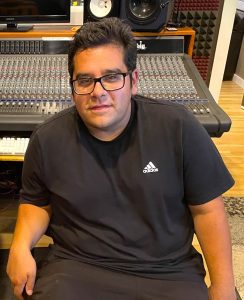
Austin Roostorfer (Photo/Local Spin)
question: How should musicians, songwriters, and creators approach this new reality and best compete in an already saturated market?
Rustorfer: The biggest thing for musicians, songwriters, performers, and producers to focus on right now is to go back to building a legitimate fan base and putting quality music out to a targeted audience rather than content and quantity. Getting a crazy number of views on a particular music video or having 100,000 followers on social media isn’t enough to build a career. Social media followers and YouTube views alone don’t reflect the real world. I personally know artists who have 300,000 followers, 1 million followers, and millions of views on their YouTube videos, but they can’t sell even 10,000 hard copies or downloads of their albums. You can’t sell out a 450-cap venue anywhere in the United States. They aren’t creating actual money or success. It’s all about attitude. Focus on cultivating 10,000 super fans around the world who will spend $100 a year supporting your music and career. Whether it’s an LP record, a CD, a ticket to a show to see a live performance, high-quality merchandise or a T-shirt, it’s a career that translates and means something in the real world for artists and fans.
Ferguson: Please continue to make music from your heart. The entire AI platform is built on what came before. Therefore, it is forever open to anything that can happen. The best artists are incredible dreamers who are creative and bring their own personality to their work.
Kaufman: Humanity is the commodity. Let’s tackle the first part.
question: Using AI is very appealing to musicians. To test it out, I recently used the Suno/AI Music site. While choosing different music styles/genres, I entered the lyrics and the basic melody played on the piano. Within minutes, a fully produced song was spit out. Have you tested any of these AI formats? If so, what are your impressions?
Kaufman: It sounds silly now, but it will soon become impressive. Tools are getting better and who uses them and why matters.
Ferguson: I haven’t personally done this, but I’ve heard a lot of results from others doing it. Sometimes it’s really fun, and sometimes it’s just frustrating. Again, I think there’s a use for mapping out what’s worked in the past, but it probably won’t create the next Billie Eilish, Kurt Cobain, or Johnny Cash. These are very personal artists, and this type of artist who shares their lived experiences as human beings will always deepen their connection with music lovers and outshine data miners any day of the week.
Rustorfer: I’ve had fun using some of the AI apps and products out there, but on a novelty level that held my interest for a few minutes, but nothing more. It was basically a variation of the same slop that came out the other side. It still sounded like a derivative of the trained model and the prompts I gave. To my experienced and trained ears, I still hear the creativity of the results below average and the predictability of the results. Will it change and get better? of course. Perhaps it has already happened since this interview. But again, it’s not something that comes down to me on a deeper level than what’s superficial.
Copyright 2025, Spins on Music LLC


