
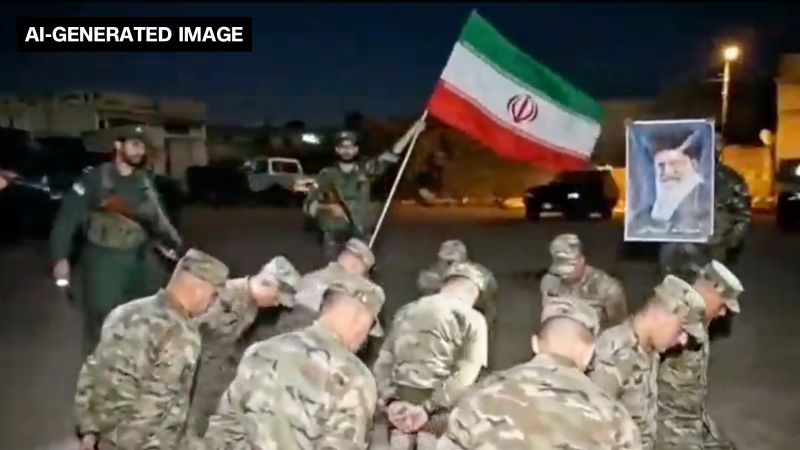
After Russia invaded Ukraine in 2022, social media was littered with crude fakes that were presented as fresh images of the war but were either Photoshopped or mislabeled clips culled from video games, movies, past events, and unrelated news reports.
These old hoaxes are being popularized again during the war with Iran. This time, they added a form of deception that was not readily available in 2022. It’s high-quality videos and still images custom created using easy-to-use artificial intelligence tools.
Hany Farid, a professor at the University of California, Berkeley who specializes in digital forensics, said 10 years ago: “There will be one or two fakes out there, but they will soon be debunked. … Now we’re seeing hundreds of fakes, and they’re really real.” Farid added: “It’s not just real, it’s landing. It’s landing hard. People believe in it and they’re amplifying it.”

“What has changed over the past year or so is that generative AI has become much more widely available,” said Shayan Sardarizadeh, a senior journalist at BBC Verify, known for exposing war-related fabrications. “We are now able to create highly believable videos and images that appear to show significant war incidents that are difficult to detect by the untrained eye or by the naked eye.”
Fake videos and images that experts like Sardarizadeh have identified as being created by AI have racked up tens of millions of views on social media platforms in the nearly two weeks since the Iran war began.
A fake video shows a fictitious barrage of Iranian missiles allegedly attacking Tel Aviv, Israel. A second fake video shows people panicking and running away from what appears to be an Iranian attack on Tel Aviv’s airport. A third fake video purports to show a captured US special forces member being held at gunpoint by Iranian forces.
Another fake video claims to show part of surveillance camera footage of an Iranian military facility being blown up. Three of the clips appear to be AI, but one is real but from last year. Yet another fake video shows a fictitious convoy of US troops on the ground in Iran. Another fake appears to be footage of a downed US military plane being paraded through Tehran.

Meanwhile, fake still images that appear to have been created by AI claim to depict a US military base in Iraq and the US embassy in Saudi Arabia in flames after an Iranian attack. Iranian Supreme Leader Ali Khamenei lies dead under rubble. And Iranians are mourning the deaths of civilians. A publication linked to the Iranian government even published fake satellite images purporting to show damage to US military bases in Bahrain.
And this is just a small portion of the Iran-related fakes in circulation.
Despite efforts by people like Sardarizadeh to expose daily lies, new fakes emerge far faster than they can be knocked down. They often look so real that it’s not immediately obvious to the average person scrolling through their feed that they’re fake.
Some widely circulated fakes were pushed as propaganda by pro-Iranian social media accounts. However, it is difficult to determine the motives behind the creation of many fakes. Maybe it’s just because it’s so easy for people to create, but also because of opinions on social media and the influence and money they sometimes bring.
Increasingly sophisticated schemes have thrown us into an environment where it is difficult to know the truth. Due to partisan polarization, media fragmentation, and the rise of social media algorithms, many Americans tend to primarily see content shared by like-minded people. And Farid pointed out that social media companies are turning their backs on aggressive moderation of content on their platforms.
“The content is more real, the volume is bigger, the penetration is deeper. This is our new reality. And it’s really troubling,” Farid said.
Social media platform X announced last week that it would take steps to combat wartime AI fakes. Product Director Nikita Beer posted that users who are compensated by Company X as content “creators” and spread AI-generated videos of armed conflict without disclosing that they were created by AI will be suspended from the payment program for 90 days, and further violations will result in permanent suspension.
Even if this policy were strictly enforced (Farid said he was skeptical), the vast majority of X users do not participate in the Creator Pays program. (Posts from other users are still subject to crowd-sourced “community notes” fact-checking, but that track record is spotty.) Social media companies TikTok and Meta, which own Facebook and Instagram, did not respond to CNN’s requests for comment on the spread of war-related fakes.
And Sardarizadeh has been pointing out for months that Grok, X’s own AI chatbot, is actively exacerbating the problem in some cases, falsely telling fact-checking users that numerous AI-generated images and videos, including one depicting the Iran war, are real.
To be fair, it’s hard to tell the real from the fake these days. Farid said the rapidly improving quality of AI work means tips from months ago on how to spot AI fakes are now useless. For example, it was previously useful for checking if a person in an image had extra fingers or misplaced limbs. The humans represented in current AI content tend not to make such comical mistakes.
Farid said the best way to stay informed is to choose to get your news from trusted news outlets rather than scrolling through posts from “random accounts” on social media. “In the midst of a global conflict, this is not the place to get information,” he said.
If you can’t avoid scrolling often, it would be wise to take a few seconds to search online and take a breather before believing or sharing sensational wartime videos and images.
Are you experiencing something strange, like audio not synchronizing with video or visual features not matching the real world? AI is constantly evolving, but it’s still imperfect. (And some AI works still contain watermarks that identify the software that created them.)
Has a famous debunker like Sardarizadeh, fact-checking media, or subject matter expert ever mentioned the veracity of the video or image? (If it’s fake, experts often point it out before it hits your feed.)
Does anyone express skepticism in posts or replies to community notes on X? (Average users can be fooled, but they can also ask good questions.)
What do free AI detection tools tell you? (They’re far from perfect, but they can sometimes be helpful.)
Sardarizadeh said people need to “train their eyes” to recognize AI materials as accurately as possible. But he also said that “AI-generated content is becoming very difficult to detect, and it looks like it’s on track to become even more difficult in the near future.”


