
image:
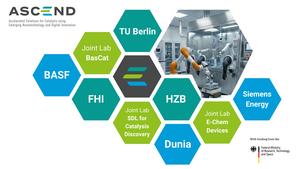
ASCEND Consortium: Helmholtz Zentrum Berlin, Fritz Haber Institute Max Planck-Gesellschaft, BASF, Dunia Innovations, Siemens Energy, Technical University Berlin / BasCat
view more
Credit: ASCEND
Six research and industrial partners, including Helmholtz Zentrum Berlin (HZB), the Max Planck Society Fritz Haber Institute (FHI), BASF, Dunia Innovations, Siemens Energy and the Technical University of Berlin, are launching a joint project to accelerate the discovery of catalysts. The German Federal Ministry for Science, Technology and Space (BMFTR) is funding ASCEND (Solutions for the Acceleration of Catalytic Reactions Using Emerging Nanotechnologies and Digital Innovations) to the tune of €30 million. This research initiative focuses on the chemical sector and aims to de-fossilise energy-intensive industries while protecting industrial competitiveness. A 5 year project starts on the 1stcent April 2026.
By integrating two breakthrough approaches: digital catalysis and thin film catalysis, ASCEND aims to accelerate the development of next-generation catalysts that are the foundation of sustainable chemical manufacturing. Digital Catalysis uses artificial intelligence (AI), simulation, and the Self-Driving Laboratory (SDL) to accelerate the discovery of high-performance materials, while thin film catalysts reduce material usage and increase efficiency. These catalysts combine with 3D structures to enhance surface area and reaction control, with the goal of providing sustainable synthetic fuels and base chemicals as drop-in replacements in industry.
AI-accelerated material discovery
At the heart of ASCEND’s approach is AI, working in conjunction with automation and robotics to enable SDL to accelerate scientific experiments. AI autonomously builds and updates digital twins of the systems being studied and makes design decisions based on these models. Design experiments that are run by an automated system in an iterative learning loop, with each result used to improve the next step. Although AI greatly speeds up planning and efficiency, humans are still essential to guide the overall approach and define the scientific questions.
The project builds on a long-standing and successful partnership between the Fritz Haber Institute and Helmholtz Zentrum Berlin to advance catalysis research.
Scientific project coordinators emphasize the strategic importance of funding. “ASCEND’s AI-driven approach allows us to explore vast material spaces that were previously inaccessible,” said project leader Karsten Reuter from Fuji Heavy Industries. His co-project leader, HZB’s Michelle Brown, added: “This will fundamentally change how quickly science can deliver solutions that the chemical industry urgently needs.”
The goal is to produce industrially reliable results, rather than voluntary experimentation for its own sake. With ASCEND, by combining AI with physical synthesis and stress testing under manufacturing-relevant conditions, Dunia accelerates learning while maintaining reliability at scale,” said Marcus Tze-Kiat Ng, Chief Technology Officer, Dunia Innovations.
From research to industrial application: strengthening technology leadership
ASCEND aims to accelerate the catalyst development cycle to achieve the performance breakthroughs needed for commercially viable large-scale deployment of green hydrogen and sustainable chemicals. This is an important prerequisite for the industry to become independent from coal and petroleum products.
“This project allows us to validate new catalytic materials at an early stage, which is of great importance for translating promising research into technological applications,” said Wolfram Stichert, Senior Vice President of BASF SE.
background
According to S&P Global Ratings, the chemical industry accounts for about 6% of global greenhouse gas emissions. This is equivalent to the annual emissions of the European Union (according to EDGAR – Emissions Database for Global Atmospheric Research). These emissions primarily occur during power generation in power plants where fossil fuels are burned. They are also produced during the production of plastics, fertilizers, and pharmaceuticals, which are primarily derived from fossil fuels.
Catalysts provide a solution. According to estimates, approximately 80% of all chemical products undergo a catalytic step in the manufacturing process. Innovation in the field of catalysts is therefore crucial for the industrial transformation aimed at achieving greenhouse gas-free production by 2050.
Rising red.
Disclaimer: AAAS and EurekAlert! We are not responsible for the accuracy of news releases posted on EurekAlert! Use of Information by Contributing Institutions or via the EurekAlert System.


