- AI transformations fail far more often due to organizational design choices than technology limitations.
- Organizations that are winning with AI are those that have most intentionally redesigned the way humans and machines work together.
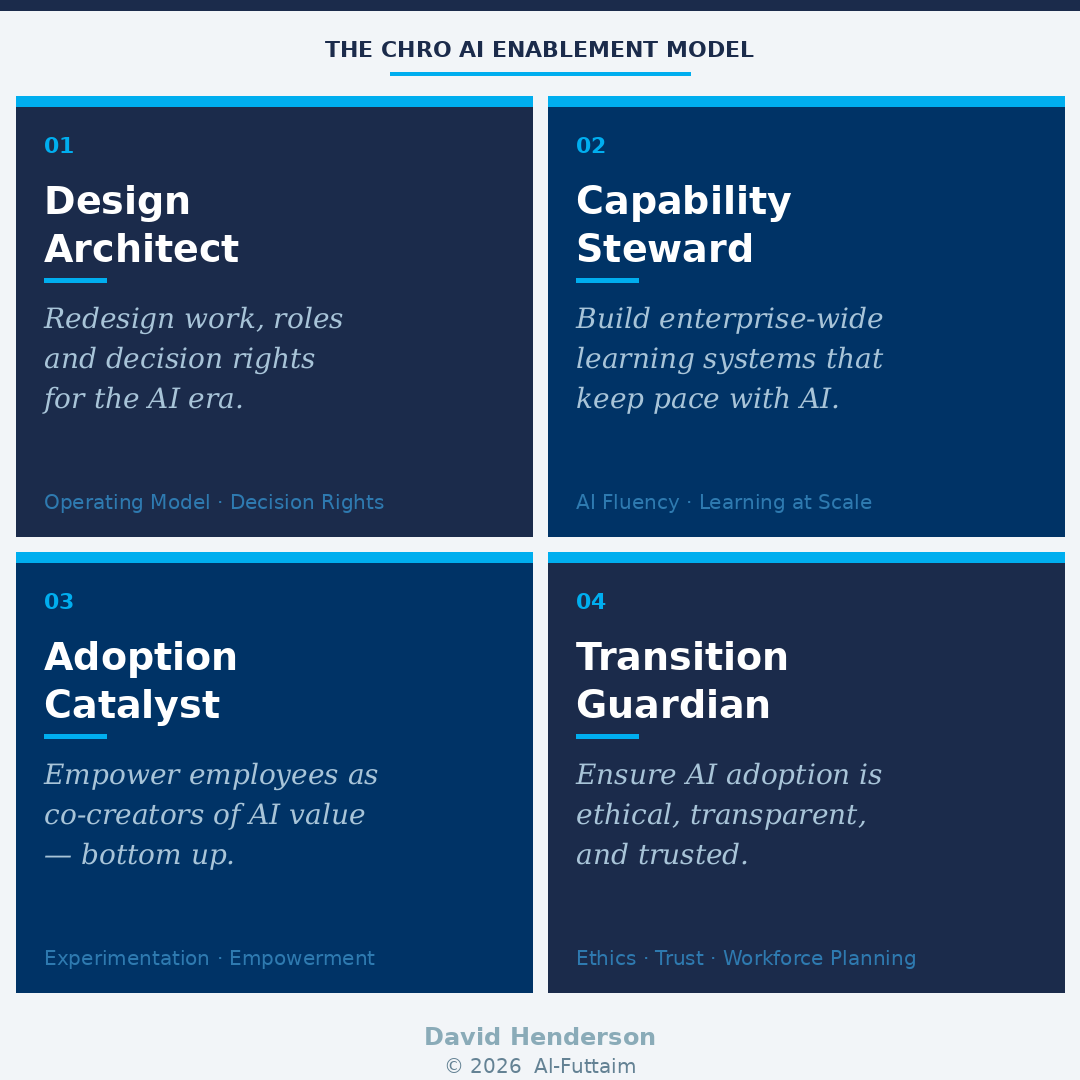
- HR leaders must play a central role in AI transformation as design architects, functional managers, adoption facilitators, and transition guardians.
The year after IBM’s Deep Blue defeated Garry Kasparov at chess in 1997, Kasparov did something unexpected.
Rather than retreat, he invented a new form of chess that combines human players and computers to see what they can produce together. The results were amazing. Even moderately skilled players equipped with standard machines were able to outperform both grandmasters and computers working alone. This combination was definitely better than either alone.
This lesson is directly relevant to organizations leveraging AI today. The instinct is to frame AI as a technology story. it’s not. AI is reshaping work, redistributing decision-making power, resetting operating models, and forcing organizations to rethink deeply embedded ways of working. Human questions arise as well as technical ones. And the organizations that are truly winning are not those with the most sophisticated technology, but those that have most intentionally redesigned the way humans and machines work together.
AI transformation is not a technology program that is rolled out. It is about being guided by human transformation.
AI requires a three-way partnership
The most effective AI transformations are driven by close three-way partnerships. That means companies setting the agenda and managing results, chief information officers (CIOs) providing the technology platform and governance, and chief human resources officers (CHROs) leading the human transformation that will determine whether AI delivers value at scale or stagnates.
Each is essential. None of these are sufficient on their own.
The human aspects of designing jobs and decision-making, building capabilities, managing trust, and coordinating recruitment are not downstream from technology. That is the main factor that makes it possible. That’s why CHROs must play a central and distinct role in this transformation through four interconnected roles:
The critical differentiator is not access to technology, but the ability to orchestrate human transformation around technology.
”
Four roles in the AI era
as design architectCHROs rethink how they get work done. AI transformations fail far more often due to organizational design choices than technology limitations. When companies implement AI without redesigning their operations, decision rights are blurred, accountability is undermined, and productivity gains stall. CHROs need to be clear about which decisions are still human-driven, which are supported by AI, where accountability lies, and build an operating model architecture that is dynamic enough to evolve as AI capabilities accelerate.
At Procter & Gamble, data scientists and AI engineers are embedded directly into business units and operational teams, rather than siled into centralized analytics functions, enabling real-time collaboration with supply chain, marketing, and commercial decision-making at scale, removing the information walls that have long constrained performance.
as competency managerCHROs build enterprise-wide learning systems that keep pace with AI. In the AI era, capabilities, not technology, will be the primary constraint to value creation. Traditional episodic training is structurally unsuited to the pace of change. CHROs need to build continuous, contextual learning built into daily workflows, develop AI fluency across the workforce, and maintain continuous insight into which capabilities are emerging and which are declining.
During our time at Zurich Insurance, we built an enterprise-wide ecosystem of AI capabilities that combined broad literacy with deep domain-specific learning. This has led to a deliberate focus on transferable skills and the ability to quickly redeploy talent as roles change.
as Adopted catalystCHROs ensure that the value of AI is not limited to the purview of a central team or leader. Scalable impact comes from the bottom up, from employees who understand their jobs and are empowered to apply AI where the deepest insights can be gained.
For example, at Al-Futtaim, the use cases supporting the Blue Loyalty platform were not centrally developed. These were built by a multidisciplinary front-line retail team in an agile action learning group, applying customer knowledge directly to develop personalized recommendations. AI has been incorporated into workflows by the people who understand it best, resulting in measurable revenue increases with use cases rooted in real interactions rather than boardroom hypotheticals.
as transitional guardianCHROs ensure that AI implementation is ethical, transparent, and aligned with employee value propositions. AI raises legitimate concerns about fairness, surveillance, bias, and employability that, if left unaddressed, will undermine the trust on which hiring depends. Today’s employees need to focus less on specific target jobs and more on building transferable skill profiles that will serve them well throughout a career that is sure to evolve rapidly. CHROs must make that path credible, not through reassurance, but through tangible reskilling and redeployment commitments. Trust is not a soft outcome of AI transformation. It’s an absolute prerequisite for scaling.
The critical differentiator is not access to technology, but the ability to orchestrate human transformation around technology.
AI: The defining leadership challenge of our time
Organizations that transform AI from experimentation to sustainable competitive advantage are those that redesign the way they work, continually build capabilities, empower employees as co-developers, and protect trust throughout the transition. CHROs who understand this and act with the same strategic weight as any technology investment will become one of the most important executives in their organization.
Kasparov’s advanced chess experiments showed a quarter of a century ago that the most powerful results come not from the solo efforts of humans or machines, but from their deliberate and skillful combinations. The CHRO’s mission is to make that combination work at enterprise scale and at pace, without losing the trust of those who depend on it.
This is a critical role that cannot be ignored by organizations looking to leverage AI.