Imagine a digital doppelganger. Clones that look, talk, and act just like you are created from deep within artificial intelligence to mirror your every quirk with eerily accurate accuracy. Sounds thrilling, what do you think?
Our research at the University of British Columbia shines a spotlight on just this question. Advances in deep learning technologies such as interactive deepfake applications, voice-translation, and virtual actors have made it possible to digitally replicate the appearance and behavior of individuals.
The mirror image of an individual created by this artificial intelligence is called an “AI clone”. Our research dives into the murky waters of how these AI clones may impact our self-perceptions, relationships and society. We identified three types of risks posed by AI replicas: doppelgängerphobia, identity fragmentation, and living memory.
AI cloning
We defined an AI clone as a digital representation of an individual designed to mirror some or more aspects of the real-world “source individual”.
Unlike fictional characters in the digital environment, these AI clones are based on existing people and may mimic their visual affinities, speech mannerisms, or behavioral patterns. The depth of replication varies widely, from replication of specific discrete functions to creation of near-perfect digital twins.
AI clones are also conversational technologies, designed to interpret user and environmental input, perform internal processing, and produce perceptible output. And importantly, these are AI-based technologies built on personal data.
As the amount of personal data we generate continues to grow, so does the fidelity of these AI clones that replicate our behavior.
Fear, Fragments, False Memories
We presented 20 participants with 8 hypothetical scenarios involving AI clones. Participants, of diverse ages and backgrounds, reflected on their emotions and their potential impact on self-perception and relationships.
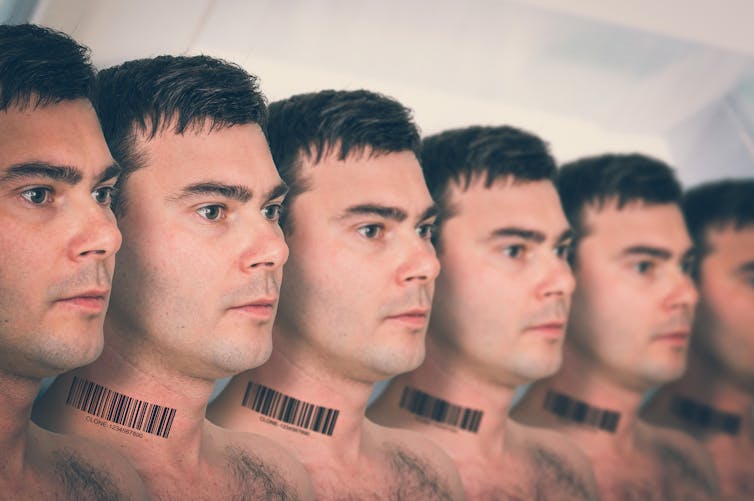
(Shutterstock)
First, it turns out that doppelgängerphobia is not only a fear of AI clones themselves, but also a fear of their potential exploits. Participants were concerned that their digital counterparts would abuse and replace their identities.
Second, there was the threat of identity fragmentation. The creation of replicas threatens the cloned person’s unique personality and disrupts the person’s coherent self-perception. In other words, people worry that they will lose some of their uniqueness or individuality in the process of replication.
Finally, participants expressed concerns about what we described as ‘living memories’. This is related to the dangers that arise when a person interacts with a clone of a person with an existing relationship. Participants worried that it might lead to misrepresentation of the individual, or that it might lead to an over-attachment to cloning, altering interpersonal dynamics.
protect human values
It is clear that the development and deployment of AI clones is having a significant impact. Our study not only provides valuable insights into a critical dialogue on ethical AI, but also proposes a new framework for AI clone design that prioritizes identity and trustworthiness.
The responsibility to navigate this uncharted territory responsibly rests with all stakeholders, including designers, developers, policy makers and end users. This includes carefully considering expiration strategies for moderation and user-generated data to prevent misuse and over-reliance.
Furthermore, it is imperative to recognize that the impact of AI cloning technology on individual identities and interpersonal relationships is just the tip of the iceberg. As we continue to tread the delicate path of this burgeoning field, our research results serve as a compass to guide us in prioritizing ethical considerations and human values above all else.