

news
April 20, 2026

Dan Taylor
technology editor
military embedded systems
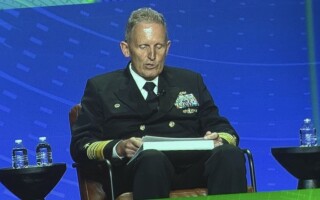
National Harbor, Maryland. The Navy is moving to incorporate artificial intelligence into its maritime operations center to create what one senior officer described as a “powerful human-machine team” that can predict enemy behavior and recommend courses of action to commanders in near real time, according to remarks at the Sea, Air, and Space Expo here.
Vice Adm. Mike Barnazza, commander of Naval Intelligence Command, told participants during a panel discussion Monday that the integration of AI into the MOC is the next big step in the Navy’s efforts to accelerate decision-making at the speed of modern combat operations.
“By integrating AI into the MOC, we will create a powerful human-machine team that can predict enemy behavior and recommend the best course of action for the joint force,” Vernazza said. “This strengthens commanders’ ability to make difficult strategic decisions at the speed of war.”
The MOC serves as the Navy’s primary operational command and control node and serves as a combat platform that aggregates and processes information across multiple domains. Vernazza said these centers are at the heart of the information warfare community’s contribution to fleet operations, and that they are already operating as active combat platforms rather than passive coordination hubs.
The AI-enabled decision support efforts come in tandem with the Navy’s simultaneous efforts to close training and readiness gaps across the information warfare community. Vernazza said Naval Intelligence has taken over the basic stages of training the ship’s information warfare capabilities, including electronic warfare, communications, cryptography, cyber and intelligence, and has used its management to drive measurable improvements in readiness.
The Navy has begun an effort to ensure that ships return from a maintenance period that is already prepared to begin operational training, which has doubled the command’s mission completion rate for ships returning from maintenance and shortened training schedules for certain electronic warfare and communications pipelines by 13 weeks, he said.
Vernazza also announced that the Naval Intelligence Corps will partner with the Naval Postgraduate School in June to launch an applied AI master’s program aimed at ensuring future naval leaders can utilize AI as a practical, rather than theoretical, combat tool.


