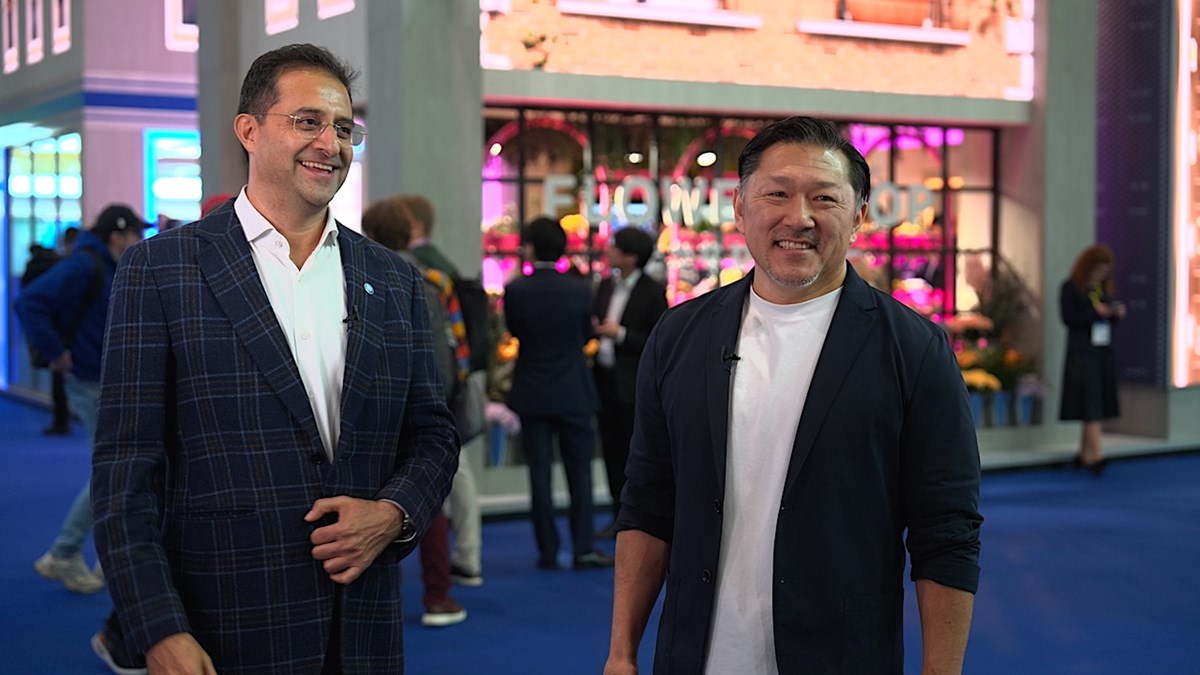
Hello. Welcome to Mobile World Congress 2026 in Barcelona. The big topic there is of course artificial intelligence, but we’re not here to discuss proofs of concept or pilots. We’re here to discuss what happens after the experiment and how AI will become core to how carriers operate, compete, and grow. So today we’re joined by industry leader Tatsuya Hamada, CEO of KDDI Digital Life, and Sanjay Kaur, Chief Revenue Officer of Circles. Thank you everyone for joining us.
Tatsuya Hamada, KDDI Digital Life (00:47):
Thank you, you too. thank you.
Charlotte Kang, TelecomTV (00:49):
In other words, you are all working together on what is called AI. This is a fundamentally different approach to how carriers operate. First of all, Mr. Hamada, as the industry as a whole is talking about the adoption of AI, can you tell us what you mean by AIization and why this extends far beyond innovation labs?
Tatsuya Hamada, KDDI Digital Life (01:09):
Thank you for asking this very important and trending question at MWC. It’s amazing to me that I’ve been here for years and have probably been to MWC close to 10 times, but 10 years ago I never would have predicted that I would be speaking about AI. I think AI is being talked about everywhere at MWC. A lot of booths, a lot of carriers, a lot of technology companies are talking about AI. However, when it comes to AI, I’m thinking about more than simply implementing AI or incorporating it into business. Similar to the structure and construction of an AI-native business model. That’s what I think about AI. And it’s not just a new implementation of AI. It is necessary to think about redesigning and rebuilding traditional and traditional business models themselves. Rather than implementing it there, redesign and reconsider business processes from scratch based on AI. I think that’s what AI means.
Charlotte Kang, TelecomTV (02:32):
Sanjay, your company, Circles, works with telecom companies all over the world. So, please tell us the differences in KDDI Digital Life’s approach.
Sanjay Kaur, Circle (02:41):
In other words, as Mr. Hamada said, AI was not a separate function or a higher-level tool. AI was integrated into the core thinking of business strategy. So what KDDI has actually done is they’ve brought AI to the core idea of creating what we call a “speedboat communications company.” And I think they’ve been very successful in doing that over the last four years. And there is a way forward. So, it’s not over yet, but it’s clear that AI will be incorporated into every aspect of the telecom business. Whether it’s the backend, whether it’s the customer experience, whether it’s hyper-personalization, whether it’s using AI capabilities to create offers. In other words, AI is at the heart of everything we do.
Charlotte Kang, TelecomTV (03:33):
Mr. Hamada, now let’s talk about the results. Please tell us what has actually changed with AI in KDDI Digital Life.
Tatsuya Hamada, KDDI Digital Life (03:40):
However, to be honest, even though we are talking about AI, my company still has a lot of traditional business processes and human ways of thinking. However, since last year, we have been gradually changing our business model process model. And then we started leveraging AI, for example, to develop product speed, marketing analytics, and advertising design for different types of business units. Although I said that it is being utilized, it is still at the RE stage before complete AI. Therefore, time savings, human resources savings, and efficiency have been greatly improved. The result was significant savings for the customer. Of course, if new products can be designed and developed faster with AI design, services can be brought to market faster, leading to revenue growth and generation. That’s why, again, what I want to say is that we are still in the RE stage before full AI, but we have already achieved efficiency, cost reduction, time reduction, and headcount reduction. And we will continue to grow step by step.
Charlotte Kang, TelecomTV (05:17):
Sanjay, you often value partnerships over traditional vendor models. Why is it important for AI?
Sanjay Kaur, Circle (05:23):
When you take a vendor approach, it becomes another toolbox to build on top of. And this is the fundamental flaw in making AI a core part of the enterprise. That’s why when these two partners come together, we see it as a technology partner for Mr. Hamada and KDDI. But we work like a collaborative team. We have the same ambition, the same spirit. Of course, not all AI is complete. As he said, it’s a journey, but we’re working on this together, thinking about the strategy and thinking about every step of execution. And I believe this is fundamental to making the most of AI for the benefit of our customers, to make it efficient and to truly realize the AI goals that you talked about. Therefore, partnership is the only way to achieve that and we will work together for the long term.
Charlotte Kang, TelecomTV (06:21):
Mr. Hamada, Japan is a truly unique market. So how relevant is this AI-enabled approach to everyone around the world?
Tatsuya Hamada, KDDI Digital Life (06:33):
My parent company is KDDI, and KDDI has been providing telecommunications services as a core competency business for many years. However, in addition to our core telecommunications business, we have gradually added a variety of businesses, including financial banking, content distribution, and even Microlon. Unlike single-industry business models, additional complications arise. And since we at KDDI Digital Life are a traditional telecommunications company and have a huge global system, we want to accelerate this even further. It takes a really long time to collaborate with people outside to improve, to develop new business, new models. Sustainability will always be a more important part. But for us, it’s like the speedboat you mentioned, right? As a speedboat, we will continue to take on more and more challenges while collaborating with people in various industries. In that sense, human work itself is insufficient. We cannot increase the number of human brains.
(07:54):
That’s why we need AI. We need AI. It is not limited to telecommunications business. Barriers to the types of new businesses we want to combine. For that, we need AI. That’s how we think.
Charlotte Kang, TelecomTV (08:12):
So, this isn’t just a Japan story.
Tatsuya Hamada, KDDI Digital Life (08:15):
Typically in Japan, we, our parent company KDDI, have had great success with that bundled business model, but we want to accelerate that, and this is not unique to Japan, but probably worldwide. It will happen.
Charlotte Kang, TelecomTV (08:32):
Looking ahead, Sanjay, how do you think AI will change competition among telcos?
Sanjay Kaur, Circle (08:40):
Mr. Telephone Company, you’ve been here for a few years now. I’ve been coming here for the past 20 years and every year there’s something new to talk about or talk about. I don’t think you’ll see the overall benefits of AI unless it’s part of the foundation of building a telco. Because if you adopt AI and bolt on three layers of legacy, you’ll never benefit from it. So I believe that the idea of AI was at the heart of what KDDI Group thought about to create the speedboat, and that we were the lucky partner to be a part of their journey. First, we started talking about digital. Now that digital has evolved into AI,
(09:27):
But certainly, whatever we do with AI, it’s going to be integrated into every part of our operations. And for me, if you have to set a vision for, say, two years, three years from now, you shouldn’t be asking people to come up with an offer. The AI needs to think about what new offers Charlotte needs based on what she needs and wants. Prices should be adjusted automatically. It should happen in the system itself. You need to define any new features or capabilities that need to be bolted to your offer. This means that it is a self-sustaining model that is becoming increasingly efficient. So I think fully implementing AI into a telco’s core enterprise architecture is a perfect fit. And that’s the real challenge. But their idea was to create a speedboat that was small and easy to manage. And for the group, it becomes a kind of role model to be emulated across all businesses.
Tatsuya Hamada, KDDI Digital Life (10:34):
Sanjay mentioned some really good points. Yeah. Initially, you were aiming to digitize the telecommunications business, but now you are stepping into AI-native Techco.
Sanjay Kaur, Circle (10:45):
absolutely.
Charlotte Kang, TelecomTV (10:46):
And finally, I have a question for you both. Why is now at MWC the perfect time to share this story?
Tatsuya Hamada, KDDI Digital Life (10:56):
oh. yes. I think a lot of people have been talking about the adoption of AI for a few years now, and I was here last year, and now, year after year, AI business models, AI native business models are being developed and evolved at a really rapid pace. That’s why we’re at a stage where we’re starting to talk about practical use cases, business model cases, not so much about what AI is, but about what business is, based on AI-native models. That’s why we’re talking about it now.
Sanjay Kaur, Circle (11:45):
I mean, look, for us, for me, I mean, obviously, how do we add new revenue every day? In other words, we are not looking inside the business. Like I said, the AI has to handle that. Therefore, we must have the ability to forge new partnerships. Now he is a carrier. He can incorporate anything that benefits from connectivity, whether it’s retail, fintech, media or rail. So you’re extending your AI framework to other partners who can benefit from it. That’s why I think now is the time. We are currently at a time in the telecommunications industry as a whole when ARPU is declining and capital investment is under threat. I believe that such systems and frameworks will serve as role models.
Charlotte Kang, TelecomTV (12:37):
Ladies and Gentlemen, I would like to thank both of you for a very compelling story and very valuable insight on AI. thank you.
Sanjay Kaur, Circle (12:46):
thank you very much.
Tatsuya Hamada, KDDI Digital Life (12:47):
thank you very much. thank you.
Please note that video transcripts are provided for reference only. Content may differ from the published video and may contain inaccuracies.