As companies race to incorporate AI into nearly every industry, some college students are reacting with outright hostility.
Subscribe to read this story without ads
Get unlimited access to ad-free articles and exclusive content.

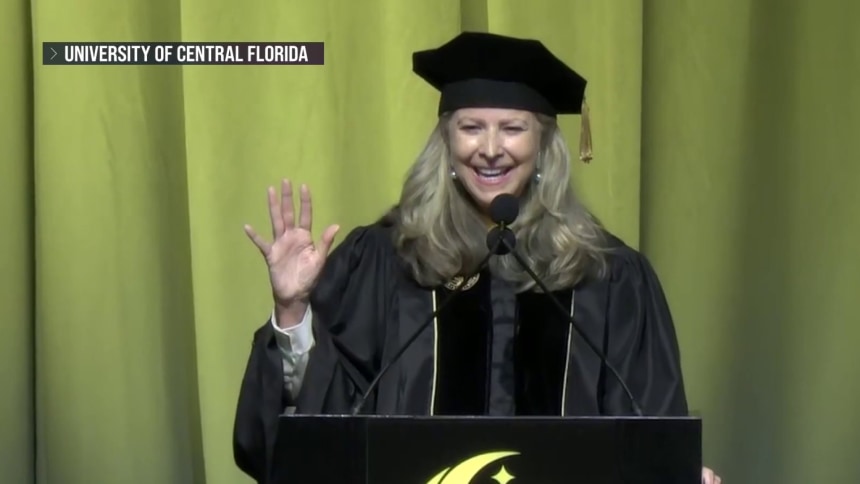
At at least three university graduation ceremonies this month, graduates loudly booed invited speakers who praised AI. On Thursday, Vice President J.D. Vance addressed the incident in a speech at the U.S. Air Force Academy, acknowledging the rise in anti-AI sentiment.
On at least five campuses, students have formed anti-AI groups and joined their peers to advocate for slowing the unchecked growth of technology.
The backlash reflects a growing disconnect between business leaders’ optimism about AI and students’ fears about its impact on work, creativity, and critical thinking.
01:18
Vance warns Air Force graduates of AI ‘age of war’
00:0000:00
“Part of the learning process is struggling to understand and break down content,” says Paul Webster, a rising sophomore studying computer science at the University of California, Berkeley. “Using AI to do that, which is what professors were encouraging their students to do, has a significant impact on real-world understanding.”
NBC News spoke to seven students at universities across the country, including Webster, who said they’ve seen their colleagues rely on AI to cut corners in their studies, sometimes at the urging of faculty.
A Gallup/Lumina Foundation poll of more than 3,500 college students in October found that 57% of U.S. college students use AI in class at least once a week, and 21% use AI every day. Students said they most often used AI to understand class content and check answers to homework assignments.
The explosion of AI in recent years has led some students to create their own campus groups to reject the advances. PauseAI US, a national organization dedicated to pausing the development of cutting-edge AI systems until they can be safely deployed, says it currently has five chapters at various universities.
Its executive director, Holly Elmore, said she was seeing growing sentiment among students that current AI developments were potentially dangerous and were moving too quickly. She said chapter leaders felt the school was putting “this kind of pressure on them to give up their sense of morality and honor about writing their own words and doing their own work.”
Elmore said students “feel like their lives have become really chaotic, their futures thrown into chaos, and they look to things that give them meaning, and that’s going to be suffocated by AI.”
The organization’s campus affiliates are setting their own rules and activities, including raising awareness about the risks posed by AI and continuing legislative efforts to regulate big AI companies.
Nicholas Spiliotopoulos, a rising fourth-year political science student at the University of California, Santa Barbara, who leads the campus chapter of PauseAI US, said his chapter values open and honest discussion about the impact of AI.
He said many members “don’t want AI to supersede academic processes, maybe political processes, maybe cognitive processes.”
“We want to make sure it’s regulated in a way that’s beneficial to everyone and doesn’t replace our critical thinking skills,” he said, adding that about a dozen students regularly participate in the club.
In addition to campus groups aiming to stop AI development, dozens of other groups have sprung up to help students discuss and engage in AI technical safety research, from Georgetown University in Washington, D.C., to the University of Washington.
Meanwhile, some of the nation’s largest AI companies have also set up footholds on campus. For example, Anthropic is funding a campus club that aims to raise awareness about Claude AI products and foster connections with “students who see AI as a tool to augment, rather than replace, human capabilities.”
In addition to the impact AI will have on the job market, many university students have expressed concerns that AI is hollowing out the meaning of their favorite hobbies. Regardless of their personal misgivings about AI, some say they still feel pressure to rely on the technology.
In a way, I feel like I have a compulsion to use AI, like there’s something hanging around my neck.
-Kimberly Aaron, 37, master’s student at Eastern University, Pennsylvania
“I feel like all of our general feelings about AI are being forced on us,” said Zoe Kaufman, who just graduated from Mary Baldwin College in Staunton, Virginia, with a degree in psychology. “We’re now encouraging schools to download and use different AIs. It feels like it’s coming to everyone’s work, just at a different pace.”
Kaufman also said some university officials seem troublingly bullish about the technology. Kaufman said that when she asked her university’s career center for help building a resume, she was advised to simply feed her information into ChatGPT.
Kaufman said her advisor told her, “A robot is going to be reading your application anyway, so just let the robot write it,” which she described as “perverse.”
Kimberly Aaron, a master’s student at Eastern University in Pennsylvania, expressed similar concerns about the mandatory nature of AI adoption in academia.
“In some ways, it feels like we have to use AI obsessively, as if there’s something hanging around our necks,” she says. “You need to know this, or you will be left behind,” she said.
Aaron, 37, said students were confused by the school’s policy of restricting the use of AI in classes while encouraging them to develop their expertise in AI. As a data analytics student, she said she worries that much of what she’s learning in Excel, SQL, Tableau and Python will be outdated by the time she enters the job market.
Daniel Riddle, associate professor of English at Western Kentucky University, teaches students from a variety of humanities and STEM majors. He said it’s “even more eye-opening” when AI is mentioned in class.
“I think many of my students sometimes get tired of talking to AI, and they are eager to learn what they signed up for in the first place: their discipline,” Riddle said.
But opinions on AI tend to fall into two extremes, with technology leaders touting it as a comprehensive solution and anti-AI camps burying their heads in their heads.
Jeffrey Kang, a recent graduate of the University of Southern California and now a software engineer at Meta, said he understands why people would want AI to fail, and that a world run by automation sounds “pretty depressing” even to him. But that ignores the benefits of leveraging technology in truly useful ways, he says.
“I think this is a pretty fatalistic way of thinking,” Kang said. “There’s no one at Meta who goes, ‘Oh, I’m not using AI. I’m not using Claude code or anything like that. It’s not useful.'” And I think that’s true at other big tech companies as well. ”
Spiliotopoulos, leader of UCSB’s PauseAI chapter, said that even some students who are skeptical of the technology recognize its potential to help society.
“What I’m seeing most is that artificial intelligence is being developed in an increasingly chaotic way, and there’s a growing feeling that people are taking issue with that,” he said. “It’s not all bad. It’s not all good. Like many things in life, there are nuances.”