As part of the 2026 Zhongguancun (ZGC) Forum Annual Conference being held in Beijing, two forums were held in parallel on Saturday to discuss AI applications, global science and technology governance, and establishing a strong legal framework to support the growth of AI technology.
During the Science and Technology Governance period of the Rule of Law Forum, typical cases of law-based governance in science and technology were presented, demonstrating practical achievements in the Chinese government’s efforts to integrate technology and the legal system.
Tian Yuanhe, a researcher at Beijing Zhongguancun Academy, highlighted the potential of AI to support the legislative process.
“When a particular law is implemented in society, we can leverage AI through social simulation to better tailor the detailed rules of the law. In fact, what everyone is most concerned about is the reliability of the output from large-scale models. We hope that in future work, we will all strive in this direction to jointly drive the development of trustworthy AI,” said Tian.
Meanwhile, at the Forum on the Development of International Science and Technology Organizations and Global Science and Technology Governance, experts emphasized the need for a stable legal environment to foster continuous innovation and facilitated in-depth discussions on innovations in the global governance system.
Dai Xin, vice dean of Peking University Law School, pointed out that the ultimate goal of governance is to balance development and stability.
“Governance is essentially about hoping that innovation in the development process of artificial intelligence is uninterrupted and that socially beneficial innovations continue to emerge. Everyone is trying to capture these advances within a visible, concrete and stable legal framework. The next goal is to establish concrete regulatory frameworks and tools for issues related to the AI industry,” Dai said.
The ongoing 2026 ZGC Forum, with the theme of “Full Integration of Technological Innovation and Industrial Innovation,” has held 60 simultaneous forums covering hot topics ranging from global science and technology governance to basic research and cutting-edge technology, and highlighted key industry achievements in multiple sessions.
The five-day forum from March 25th to 29th brought together industry experts, academics, and policy makers from around the world to exchange insights and share cutting-edge advances in the global technology and innovation sector.
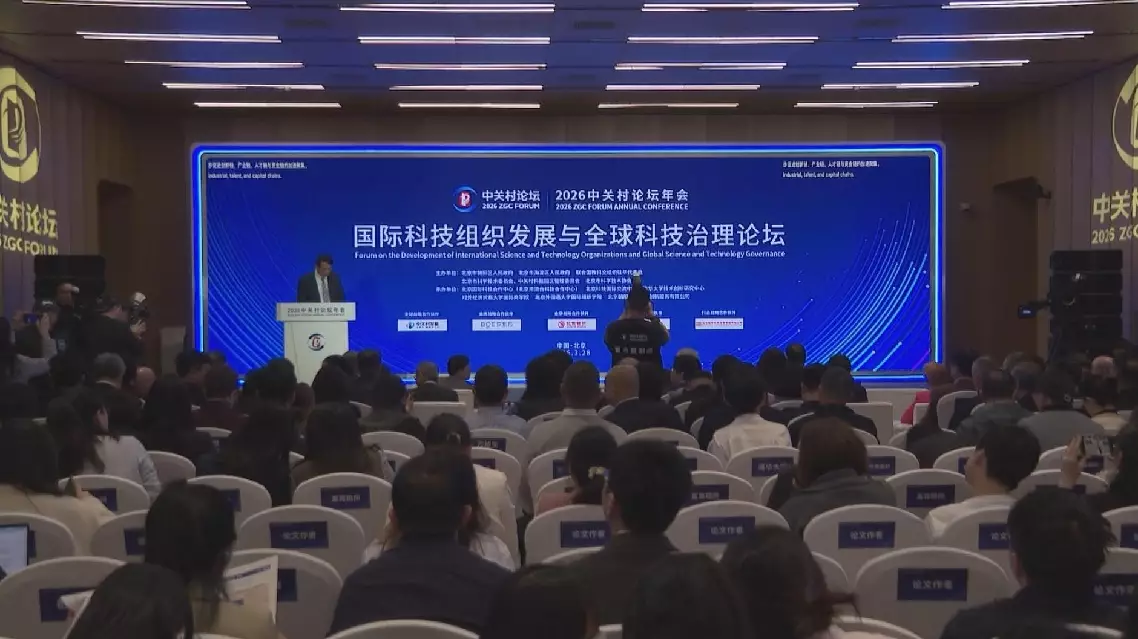
ZGC Forum focuses on AI applications, science and technology governance
China is accelerating the development of 6G mobile technology, with experts predicting commercial deployment by 2030 and emphasizing AI-native designs as a departure from 5G.
The prediction was made at the Zhongguancun Forum (ZGC Forum) annual conference, which concluded in Beijing on Sunday with the theme “Full integration of technological innovation and industrial innovation”. It featured 60 sessions on topics ranging from global science and technology governance to basic research, and was attended by experts, academics, and policy makers from around the world.
ID: 8472083 The Forum’s exhibition center also showcased more than 560 scientific and technological achievements, from robots capable of fine motor tasks to cutting-edge brain-computer interface solutions, as well as advances in intelligent manufacturing, commercial aerospace and regional cooperation.
As groundbreaking advances were unveiled at the forum, experts looked to the future of mobile communications and explained how 6G will be fundamentally different from 5G.
“If I had to describe 6G in a few keywords, the first one would be AI native. 6G networks are no longer just communication networks. They are deeply integrated with AI capabilities. AI computing power will be embedded in every network unit, such as base stations, terminals, and the core network. In other words, AI agents will not only reside in faraway data centers. They will be right next to you. They will be inside your mobile phone, the base stations you connect to, and even on the routing nodes,” Director Zhou said. Xu said. Department of Advanced Network Technology and Application Development, Computer Network Information Center, Chinese Academy of Sciences.
6G is the ground-centric transition from 5G and is designed as a fully integrated space, air, ground, and sea network. The satellites will be equipped with base stations and are expected to expand coverage to users in cities and at sea.
“China has already completed the first phase of testing 6G technology. More than 300 technologies have been validated in laboratories and test networks. The next step, from 2026 to 2028, will be to integrate these individual technologies into real devices. The first 6 A set of G standards is expected around 2029, with trial commercial deployment around 2030. By 2035, 6G smartphones will be in everyday use, including applications that were not possible before. 5G,” Chou said.
However, challenges still remain, such as intense competition for global standards, an immature supply chain for core components, and the much higher cost of building 6G networks compared to 5G. Despite these hurdles, China is pursuing innovation and cooperation in what officials describe as a more open and inclusive approach.
“The (6G) network needs to be AI-native because AI should not be solely dominated by the big powers. By building an open ecosystem, you actually have a platform on which different players can build capabilities, from the application layer to the device layer to the robot layer,” said Professor Tony Quek, Fellow at the Singapore Institute of Engineering.
If realized, 6G’s AI-native design and space-based infrastructure could redefine global connectivity and reshape the way people live and work.
Since its creation in 2007, the ZGC Forum has become the leading international event for promoting scientific and technological innovation.

China eyeing early commercialization of 6G by 2030 = expert