
The world’s AI superpowers differ on a key strategy: openness.
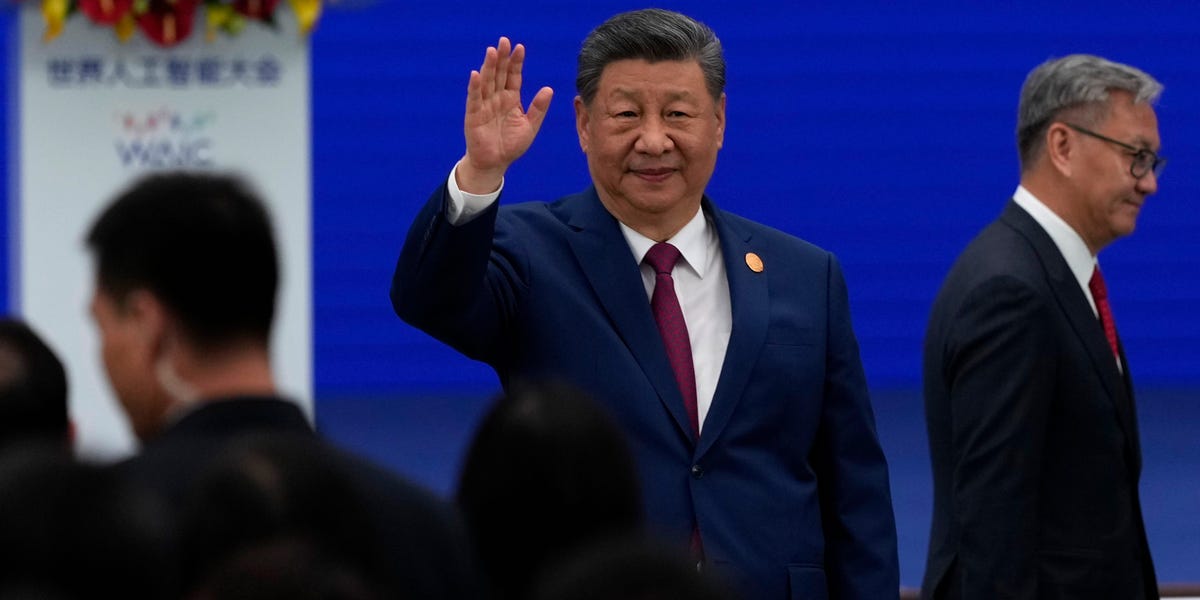
Chinese leader Xi Jinping shared his philosophy on AI at the World Artificial Intelligence Conference in Shanghai on Friday. He called for both more regulation and open sourcing of the technology.
President Xi listed four observations, first calling for the “principle of openness.”
“We should seize this rare and historic opportunity to promote open source, openness, collaboration and sharing,” Xi said.
Many of China’s biggest models are open source, including DeepSeek, a company that took Silicon Valley by surprise last year. Competing products that have been talked about recently (such as Kimi K3 and Z.ai’s GLM 5.2) are also open source.
On the other hand, American laboratories primarily operate a private, closed-source model. Meta has open sourced the popular Llama model, but not its own Muse Spark model. Despite its “open” name, OpenAI’s model is actually closed.
Anthropic’s model is also closed source. CEO Dario Amodei said in 2023 that the open source model is heading down a “dangerous path” because companies will not be able to adjust usage or revoke access.
However, President Xi had a different opinion. “China is ready to be more open, take more pragmatic action and take a more forward-looking perspective,” he said in his speech.
His second opinion called for global regulation of AI, from “technical oversight” to “early response systems.” He also harshly criticized U.S. AI protectionism.
“We should jointly oppose overextending the concept of national security and prioritizing one country’s security over another’s in the fight over AI,” Xi said.
Indeed, U.S. leaders have long been wary of China’s advances. President Donald Trump postponed one of his executive orders because he believed it could reduce the lead American companies have over China in the AI race.
China has not always been willing to share. For example, the Chinese government ordered Meta to withdraw its acquisition of the Chinese company Manus. An AI agent startup that moved its base to Singapore.
President Xi also said that AI should be used to “enhance understanding, tolerance, exchange and sharing.”
Mr. Xi began his speech by asking a series of big questions that needed answers. One question: How do we “deliver AI for all” as inequality continues to widen?
He appears to have responded with a fourth observation that the world should “insist on solidarity and improve global governance.”
“We must carry out wide-ranging international cooperation and help countries in the Global South build their capacity to bridge the AI and digital divide,” Xi said.
He pledged to provide 5,000 AI training and seminar opportunities to countries with less advanced AI technology.