
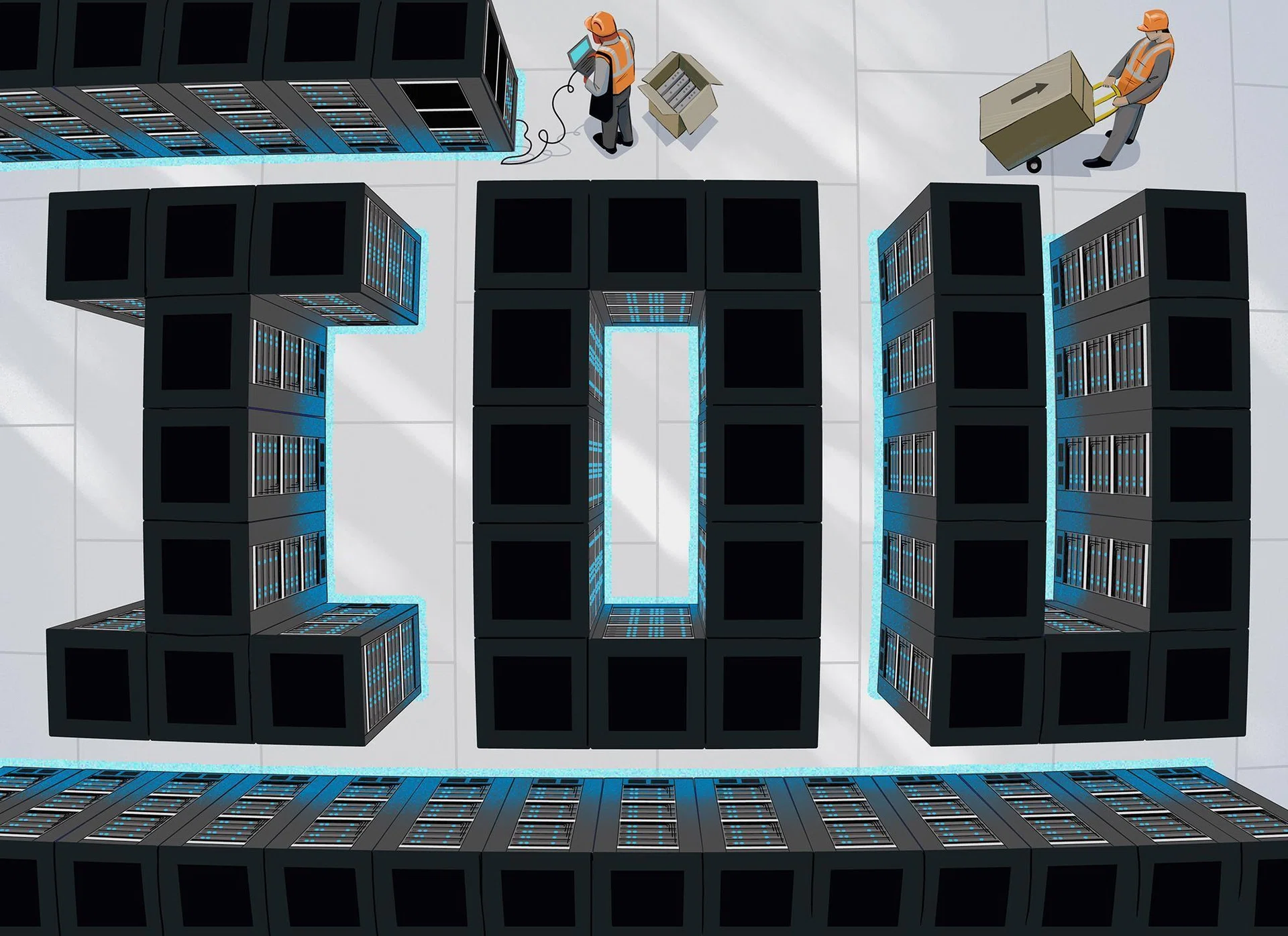
Big tech companies need to rely on bond markets to finance data centers, increasing risk
Larry Ellison’s wealth at Oracle, the giant technology company he founded, has enabled him and his son David to become media moguls.
Thanks to Ellison’s billions in Oracle backing, the scion has taken control of Paramount and is currently in a fierce $111 billion bid to buy Warner Bros. Discovery. They are building a media behemoth that would house two major movie studios, multiple streaming services, and news networks CNN and CBS News all under one giant corporate roof.
The battle for the Oracle-funded empire has understandably grabbed a lot of headlines.
But what has received less attention is another important development: the downgrade of Oracle debt. It is currently just one notch above junk bond status. That was on July 9, when S&P Global announced that Oracle’s financials were deteriorating. Oracle has also been hit hard in the stock market, with the value of Larry Ellison’s holdings reduced by about $230 billion since September, according to my calculations based on FactSet data.
Damaging Oracle’s debt rating and disrupting its finances is an elephant stomping across financial markets: massive spending on artificial intelligence.
Data centers and other AI infrastructure cost staggering amounts of money. This AI-driven cascade of funds has enriched various sectors of the stock market, from semiconductor manufacturers to engineering companies to utilities and energy production companies.
JPMorgan Asset Management estimates that AI money supports the entire US economy, contributing perhaps 1.1 percent to US economic growth.
But where does that money come from? The main sources of funding at the moment are companies like Oracle, which is spending heavily on AI data centers and increasingly selling bonds to raise funds.
It’s not just Oracle. Alphabet, Microsoft, Amazon, and Meta are also big investors in data centers. (The industry term is “hyperscaler.”)
Related items
But their underlying finances are stronger than Oracle’s, and their spending hasn’t put them into the same level of trouble in the marketplace.
For example, Microsoft has a triple-A credit rating, which is better than the U.S. government. It remains to be seen whether the company can maintain its reputation after splurging on AI data centers.
“Microsoft is starting from a much better place financially than Oracle,” Mariya Entina, portfolio manager at asset management firm DoubleLine, said in an interview. “It’s important to have enough information to differentiate.”
Together, these five companies have poured more than $800 billion into AI investments this year and plan to add more than $1.2 trillion in AI investments by 2027, according to Morgan Stanley.
To put this into context, Robert Armstrong said: financial times The Congressional Budget Office notes that the US military budget request for 2027 is lower, at US$961 billion.
Few people outside the market are paying attention to what is happening behind the financial curtain of AI. These large companies can classify that money as an investment, or capital investment, rather than an expense. Therefore, under current accounting rules, most of the expenses still do not count as fancy income.
This has helped propel stock markets to new heights under the rosy assumption that AI will transform the world and the companies behind it will profit.
With the exception of Oracle, which has borrowed aggressively over the past few years, most of these companies generate significant amounts of cash from their core operations, and until recently, spending on AI data centers had little pressure on stock price performance or underlying financial health.
But this year proved to be different.
AI data centers are increasingly being operated using borrowed funds. The problem goes far beyond Oracle.
hungry for money
Massive spending on AI infrastructure is outpacing profit growth.
Total capital spending at Oracle, Alphabet, Microsoft, Amazon and Meta exceeds free cash flow, according to Bank of America. It is money that their business generates in excess of what is needed for future operations and investment.
The thirst for cash could grow even more. Bank of America noted that while these big tech companies used to operate with relatively little investment capital, they are now as capital-intensive as legacy fossil fuel companies such as ExxonMobil and Chevron.
So tech companies are moving into capital markets, primarily debt markets, and are starting to charge a premium for what they see as increased risk.
Oracle and Amazon bond prices have been hit hard. The same goes for one issued by SpaceX, which is building an AI data center. The company’s bonds are rated investment grade, but like junk bonds, they trade at fire prices.
One of the problems is that the revenue expectations for data centers are inconsistent. Many of these involve AI startups like OpenAI and Anthropic, which themselves rely on borrowed capital and speculative investments from venture capitalists and private equity funds.
Oracle’s heavy reliance on OpenAI makes it particularly vulnerable, S&P Global said.
Savita Subramanian, Bank of America’s chief equity strategist, drew parallels to the dot-com era of the late 1990s and early 2000s in a press presentation this month. The big “hyperscalers” have much stronger business models than many older internet companies, but their huge borrowing demands are “a little nerve-wracking,” he said.
These companies may not be in an enviable position if returns from their AI investments are poor, or if rising debt rates make borrowing costs a burden. He said there would be questions about whether the stock price was “appropriate” given the company’s “leverage and capital intensity.”
great selection
There are signs that the market may be starting to pull back from some of the more extravagant AI bets. Four of the five largest data center companies have underperformed the S&P 500 this year. Oracle led the way, down more than 35% by Friday (July 17).
Alphabet, on the other hand, led the market with a 10.8% share price increase. Bonds are also doing well. Gemini AI models may not only be highly regarded.
The company’s financials are more solid than Oracle’s. The company plans to raise further funds through debt, but also through additional stock sales that will dilute the value of its existing stock. The stock market is ignoring these developments for now.
SpaceX became a public company on June 8 and is using borrowed money to build a massive AI data center.
Even though the company is not making a profit, its stock price is at an unprecedented level. The consensus forecast is that the company will continue to generate some earnings next year, but the company trades at a price-to-earnings ratio of only 182 times based on the current stock price, according to FactSet.
This number, which represents stock prices relative to corporate earnings, remains an order of magnitude. This is six times the average valuation of an S&P 500 company.
SpaceX stock fell below its public offering price for the first time this week, a move I’ve been suggesting is justified.
The day before, IBM’s stock price fell 25.2%. This is the largest daily decline since the 1960s and was caused by a revenue shortfall that CEO Arvind Krishna said was due in part to spending on AI data centers.
“We did not anticipate that the re-prioritization of capital expenditures would be this large,” Krishna said in a letter to investors. He said other companies were spending so much money building AI infrastructure that software services companies like IBM weren’t left with as much cash as they had hoped.
It’s still early days.
There is no doubt that AI is an important technology. Huge wealth has already been accumulated. But I’m also sure there are plenty of 19th century railroads and early internet companies from the dot-com era, just as there were huge infrastructure investments in emerging technologies in the other two episodes.
Well-run, diversified, and well-funded companies are more likely to survive in times like these than companies that take excessive risks in capital investments.
Still, the future champion may not be any of the early giants.
The big win is coming, but smart investors will accept that they can’t know in advance who the winners and losers will be. new york times


