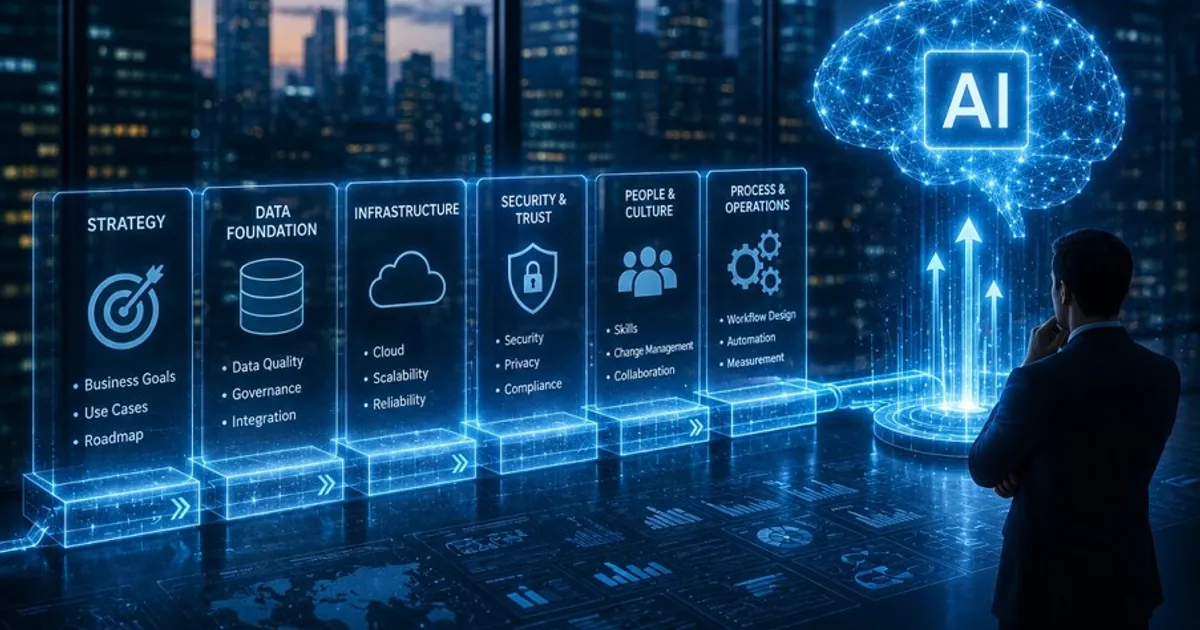
Artificial intelligence has become the defining technology story of this decade.
Every industry is exploring how machine learning, automation and generative AI can improve productivity, accelerate innovation and create new business opportunities. New models appear almost weekly, promising greater efficiency and increasingly sophisticated capabilities.
The excitement is understandable.
Yet behind many successful AI initiatives lies a quieter story that receives far less attention.
Before organisations can unlock meaningful value from artificial intelligence, they must first build the digital foundations that make intelligent systems effective.
Reliable data.
Modern infrastructure.
Cybersecurity.
Cloud architecture.
Governance.
Digital skills.
These capabilities rarely generate headlines, but they increasingly determine whether AI projects succeed or struggle.
Technology leaders are beginning to recognise that artificial intelligence is not the starting point of digital transformation.
It is often the result of it.
The organisations creating lasting competitive advantage are investing not only in AI itself but also in the invisible capabilities that allow AI to deliver consistent business value.
Digital Foundations Are Becoming Strategic Assets
Technology investment has evolved significantly over the past decade.
Early digital transformation programmes focused primarily on digitising manual processes and migrating infrastructure to the cloud.
Those initiatives remain important, but many organisations have now moved beyond adoption towards optimisation.
Instead of asking which technology to implement next, they increasingly ask whether their existing digital environment is prepared to support intelligent systems.
Do data platforms provide reliable information?
Can applications communicate efficiently?
Are cybersecurity controls sufficiently mature?
Do employees possess the necessary digital skills?
The World Bank’s Digital Progress and Trends Report 2025 highlights that successful AI adoption depends upon strong digital foundations, including connectivity, computing capacity, data and workforce capability. (World Bank)
Artificial intelligence performs best when supported by a well-prepared digital ecosystem.
Data Quality Determines AI Quality
Artificial intelligence depends entirely upon information.
Machine learning models identify patterns from data.
Predictive analytics generate forecasts from data.
Generative AI produces responses based upon data.
This simple reality explains why businesses increasingly prioritise information quality before expanding AI initiatives.
Poorly governed information creates inconsistent outputs.
Disconnected databases reduce visibility.
Duplicate records weaken confidence.
Strong data governance produces the opposite effect.
Reliable information improves forecasting.
Enhances customer experiences.
Supports better strategic planning.
Increases confidence in automated decision-making.
Businesses are therefore investing as much effort in organising information as they are in acquiring new AI capabilities.
Infrastructure Quietly Shapes Innovation
Modern technology increasingly operates behind the scenes.
Customers rarely think about cloud infrastructure when using digital services.
Employees seldom consider network architecture while collaborating online.
Artificial intelligence users rarely see the computing environments processing complex workloads.
Yet these invisible systems determine performance.
Reliable infrastructure enables scalability.
Cloud platforms provide flexibility.
Modern networks reduce latency.
Secure environments strengthen resilience.
Technology leaders increasingly understand that infrastructure is no longer simply an operational requirement.
It has become a strategic business asset.
Organisations capable of scaling digital services confidently often possess strong infrastructure long before customers notice the results.
Integration Is Becoming More Important Than Expansion
Many organisations already operate extensive technology environments.
Enterprise software.
Cloud platforms.
Analytics tools.
Customer relationship management systems.
Cybersecurity platforms.
Artificial intelligence applications.
Adding more technology rarely guarantees better outcomes.
Integration increasingly creates greater value.
Connected systems allow information to move efficiently throughout the organisation.
Employees access consistent information.
Leadership gains broader visibility.
Artificial intelligence analyses richer datasets.
Operational processes become more efficient.
The OECD has found that organisations achieve stronger productivity gains from AI when technology investments are supported by complementary capabilities such as digital infrastructure, workforce skills and effective management. (Wikipedia)
Technology ecosystems increasingly outperform isolated technology projects.
Cybersecurity Has Become a Business Capability
Digital transformation has expanded organisational opportunity.
It has also increased responsibility.
Businesses now protect larger volumes of customer information, financial records, intellectual property and operational data than ever before.
Cybersecurity therefore influences far more than technology departments.
It affects customer confidence.
Investor trust.
Operational resilience.
Regulatory compliance.
Business continuity.
Modern organisations increasingly embed cybersecurity directly into technology strategy rather than treating it as an independent technical function.
Identity management.
Continuous monitoring.
Zero-trust architecture.
Security awareness.
These capabilities strengthen resilience while enabling innovation to continue safely.
Human Expertise Remains the Competitive Difference
Artificial intelligence continues becoming more capable.
Automation handles increasingly complex tasks.
Analytics process information at remarkable speed.
Despite these advances, organisations continue relying upon human judgement.
Employees interpret context.
Leaders make strategic decisions.
Specialists evaluate ethical considerations.
Teams build relationships with customers.
The International Monetary Fund has emphasised that AI can significantly improve productivity while stressing that governance, skills and responsible implementation remain essential for achieving long-term benefits. (theguardian.com)
Technology therefore amplifies human capability rather than replacing it.
I’ll continue the article seamlessly from Part 1.
Digital Leadership Is Moving Beyond Technology Adoption
Technology leadership is undergoing a quiet transformation.
In the past, digital success was often measured by the speed with which organisations adopted new platforms or deployed emerging technologies. Today, leadership is increasingly defined by the ability to align technology investments with broader business objectives.
Boards are asking different questions.
How does artificial intelligence improve customer outcomes?
How does cloud infrastructure strengthen resilience?
How can data governance support better strategic decisions?
How should emerging technologies be governed responsibly?
These discussions demonstrate that technology has become a business discipline rather than a standalone technical function.
Successful digital leaders increasingly combine commercial understanding with technological insight, ensuring that innovation creates measurable business value rather than simply introducing new capabilities.
Responsible AI Is Becoming a Competitive Advantage
Artificial intelligence continues evolving rapidly, but so do expectations surrounding its responsible use.
Customers increasingly expect transparency regarding automated decisions.
Regulators expect accountability.
Employees seek confidence that AI supports rather than replaces thoughtful decision-making.
Organisations are responding by strengthening governance frameworks around artificial intelligence.
Human oversight remains central.
Data quality receives greater executive attention.
Model validation becomes increasingly important.
Ethical guidelines help organisations manage emerging risks while maintaining confidence in automated systems.
Responsible AI is therefore becoming more than a compliance requirement.
It is becoming an important source of competitive differentiation.
Businesses that deploy intelligent technologies responsibly are often better positioned to build lasting trust with customers, employees and investors.
Enterprise Resilience Begins with Strong Digital Architecture
Digital resilience has become one of the defining characteristics of modern organisations.
Business operations increasingly depend upon cloud services, interconnected applications and real-time information.
As reliance on technology grows, so does the importance of ensuring that digital systems remain reliable under changing conditions.
Organisations are investing in resilient infrastructure, automated monitoring, disaster recovery capabilities and scalable cloud environments.
These investments often remain invisible to customers.
Their value becomes evident when services continue operating without interruption.
Operational resilience therefore supports both business continuity and customer confidence.
The strongest organisations increasingly view resilience as a permanent capability rather than an emergency response.
Sustainability Is Becoming a Technology Objective
Technology is also contributing to broader sustainability priorities.
Modern cloud infrastructure often improves resource efficiency compared with fragmented legacy environments.
Artificial intelligence optimises logistics, manufacturing and energy management.
Digital workflows reduce paper-intensive processes.
Data analytics improve visibility into environmental performance.
These developments allow businesses to strengthen operational efficiency while supporting sustainability goals.
Technology planning increasingly considers commercial performance alongside environmental impact.
The World Economic Forum has highlighted the growing role of digital technologies in improving resource efficiency, supporting more sustainable operations and strengthening long-term organisational resilience. https://www.weforum.org
Digital transformation is increasingly delivering value across financial, operational and environmental dimensions.
The Next Technology Leaders Will Build Before They Scale
Artificial intelligence will continue advancing.
Automation will become increasingly capable.
Enterprise software will become more intelligent.
Cloud platforms will continue evolving.
Yet organisations creating the greatest long-term value are unlikely to focus exclusively on adopting the newest technologies.
Instead, they will strengthen the capabilities supporting every future innovation.
Reliable information.
Integrated systems.
Cyber resilience.
Responsible governance.
Skilled employees.
Scalable infrastructure.
These foundations enable organisations to adopt future technologies with confidence while avoiding the limitations of fragmented digital environments.
Technology leadership increasingly depends upon preparation rather than speed alone.
Conclusion
The conversation surrounding enterprise technology often focuses on visible innovation.
Artificial intelligence.
Automation.
Cloud computing.
Advanced analytics.
These developments are transforming business at remarkable speed.
Yet beneath these technologies lies another transformation that may prove equally important.
Strong digital foundations.
Reliable information.
Modern infrastructure.
Responsible governance.
Cyber resilience.
Human expertise.
These capabilities rarely receive the same attention as breakthrough innovations, but they determine whether innovation creates lasting value.
Artificial intelligence cannot consistently outperform weak data.
Automation cannot compensate for fragmented systems.
Cloud platforms cannot replace thoughtful leadership.
Technology succeeds when the environment supporting it is equally strong.
The organisations leading the next phase of digital transformation are therefore investing not only in emerging technologies but also in the invisible capabilities that make those technologies work.
In the years ahead, the greatest technology advantage may belong not to the companies adopting AI first, but to those that prepared their digital foundations long before artificial intelligence became the headline.