
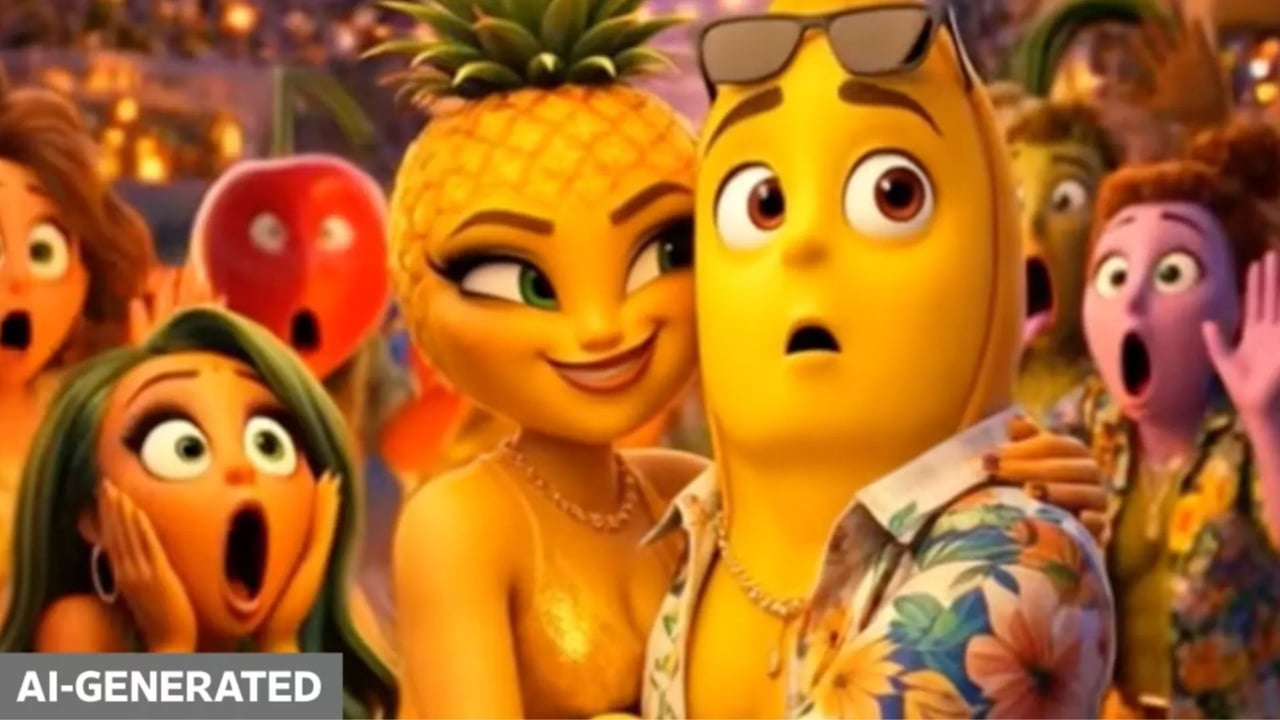
If you’ve spent a lot of time on TikTok lately, you may have noticed that a strange new type of AI brain rot is prevalent: fruit drama.
These AI-generated short dramas feature strange-looking anthropomorphic fruit characters performing a variety of ethically questionable actions. For example, many stories feature infidelity, racist attitudes, and sexual assault of female characters.
Taken at face value, this video is so bizarre and grotesque that it may be difficult to take it seriously. That is, until you realize they’re racking up hundreds of millions of views. The account ai.cinema021 launched a parody series called Fruit Love Island and has over 3 million followers.

AI-generated: At face value, the video is so bizarre and grotesque that it may be difficult to take it seriously. Supplied
This content is, at best, a gross insult to the art of animation, and at worst, actively promotes the normalization of racism and misogyny. So why does it have so many fans?
Use the brain’s reward system
These videos tap into core characteristics of human psychology. Combined with addictive platform features (like infinite scrolling), it creates an endless stream of content that keeps our attention, even if the message is immoral or just plain stupid.
Short-form video feeds such as TikTok and Instagram Reels work on a similar principle to those used in gambling systems. The human brain is highly sensitive to novelty and unpredictability, both of which are linked to dopamine signaling in reward learning.
When a reward is provided unexpectedly, the behavior becomes more persistent. This pattern, known as “variable reinforcement,” has long been shown to maintain repetitive behavior even when rewards are inconsistent.
AI slop videos quickly provide visual novelty and unexpected emotional changes. You never know whether your next work will be absurd, funny, tragic, or strangely compelling.
Video also compresses a huge emotional experience. A single clip can go from betrayal to sadness to revenge to humor in seconds. This creates emotional instability, increases arousal, and sustains attention.
Research shows that emotional content is more likely to capture attention than neutral content, especially if it’s negative or surprising.
The charm of things that feel “something different”
Many viewers said they found these videos “off-putting.” The characters are expressive, but often completely inconsistent. The story resembles a human drama, but lacks internal logic.
This is related to the idea of the uncanny valley, where near-human expressions cause discomfort. Importantly, these videos are rarely disturbing enough to cause avoidance. Instead, they sit in the middle zone. They’re strange enough to pique your curiosity, but not so unpleasant that you stop looking.
This creates cognitive tension. According to cognitive dissonance theory, people are motivated to resolve such discrepancies. And the way to resolve tension in this case is to keep looking for closure. The mind keeps asking, “What is this? Where is this going?”
They are also more likely to ignore unethical messages because of their format. The characters are highly composited. This makes the scenario feel fictional, even though it reflects real-life social behavior.
Research on moral disengagement shows that people tend to relax their ethical judgments when harm appears abstract or indirect. Fruit videos with themes of betrayal, humiliation, and assault can be watched without the discomfort that would occur if real humans were involved.
Effects of many small interactions
Similar to AI failures, social media algorithms do not prioritize meaning or quality. They prioritize content that grabs our attention.
Recommendation systems are driven by metrics such as “view time,” “completion rate,” and “interactions.” High engagement increases visibility, encourages the creation of more similar content, and creates a feedback loop.
From an AI governance perspective, these videos highlight risks that are often overlooked. In other words, generation systems do more than just generate content. They gradually shape our behavior, often without us even realizing it. This is consistent with broader concerns in AI ethics about behavioral effects and manipulative design that work at scale.
regain time and attention
For many people, avoiding social media completely is not realistic. But small changes can reduce the effects of AI-induced brain rot.
One approach is to introduce a pause before scrolling to the next video. Even a small interruption weakens the reward loop in your brain, making it easier to let go of your phone. The perfect time to stop is when you find yourself thinking, “This feels pointless,” or “This isn’t right.” In some cases, a digital detox may be helpful.
You can also retrain the algorithm. Quickly skip videos you don’t want to watch or choose “Not Interested” to replace passive scrolling with intentional viewing that seeks out specific content.
Finally, it creates friction. This may include disabling autoplay, disabling app notifications to limit access to your feed, or removing the app from your home screen.
The AI Fruit video may seem trivial and silly, but it reveals something important about the digital landscape. As generative systems scale up, they will become better at capturing and directing our attention. Understanding the psychology behind this is the first step to resisting it.
Niusha Shafiabady is Professor of Computational Intelligence at Australian Catholic University. Teresa Dicke, Professor, Institute of Positive Psychology and Education, Australian Catholic University.
-From RNZ


