An international research consortium announced on June 29 that it has experimentally confirmed two previously unknown superconductors — the first materials ever identified from scratch by a machine-learning-guided pipeline, synthesized, and verified to work. The result is not just two new compounds but a validated method that researchers say could eventually screen billions of candidate materials and meaningfully accelerate the century-old search for room-temperature superconductivity.
The two materials — yttrium-ruthenium-boride (YRu₃B₂) and lutetium-ruthenium-boride (LuRu₃B₂) — were published in Physical Review Research on June 17, 2026, by a team spanning Aalto University in Finland, Rice University, Princeton University, Ruhr University Bochum, and the Donostia International Physics Center in Spain. Both compounds share a crystal architecture called the kagome lattice and both become superconducting at temperatures just below 1 K — far from room temperature, and entirely beside the point. The point is that the algorithm predicted them before a single sample existed.
How the Pipeline Actually Works
Conventional superconductor discovery has relied on what researchers call serendipity. Of the roughly 7,000 superconductors identified over the past 115 years, fewer than 20 were theoretically predicted before anyone made them in a laboratory. The rest were found by making a material and hoping for a quantum surprise. That paradigm has a fundamental problem: the number of possible elemental combinations that might, in principle, be superconductors is enormous — easily in the billions — and density functional theory (DFT), the computational method most capable of predicting superconducting behavior with physical accuracy, is too computationally expensive to run across that entire space.
The SuperC consortium’s pipeline addresses this with a three-stage architecture. First, a machine learning model trained on the properties of known superconductors screens a target materials family — in this case, the entire class of compounds with a 1:3:2 kagome structure (denoted RRu₃B₂, where R is a rare-earth or similar element). The model rapidly flags candidates likely to superconduct based on elemental and structural descriptors, doing in seconds what would otherwise take prohibitive compute. Second, only those flagged candidates go to full DFT calculation, including a phonon spectrum computation and application of the Allen-Dynes formula — an equation derived from BCS theory — to estimate the critical temperature (Tc) at which superconductivity should emerge. Third, the highest-confidence candidates move to laboratory synthesis: arc-melting of high-purity raw elements in argon atmosphere at Rice University, followed by powder X-ray diffraction, SQUID magnetometry down to millikelvin temperatures, specific-heat measurements, and electrical transport verification.
Three independent measurement modalities — magnetization, specific heat, and resistivity — all confirmed superconductivity in both compounds, with bulk superconducting volume fractions of approximately 100% for YRu₃B₂ and 90% for LuRu₃B₂. That triple confirmation is significant: several high-profile recent superconductor claims collapsed precisely because they rested on a single measurement signal that turned out to have a mundane explanation, as the LK-99 debunking demonstrated.
“Our method uses machine-learning-based pre-screening followed by targeted calculations on the promising candidates,” said Prof. Päivi Törmä of Aalto University, who leads the SuperC consortium. “This approach will greatly speed up superconductor discovery in the future. With machine learning, we may be able to push the number of materials we can process into the billions.”
There is an important caveat in that figure: processing “billions” remains a researcher’s stated ambition, not a demonstrated output. What is demonstrated is that the method correctly identified two new superconductors out of a manageable-sized family — and that the integrated prediction-synthesis-verification pipeline works as designed.
What Kagome Geometry Provides: And What It Does Not
The kagome lattice is a two-dimensional arrangement of corner-sharing triangles — its name comes from a traditional Japanese basket-weaving pattern, and the term entered physics vocabulary in a 1951 paper by Japanese physicist Kôdi Husimi. In crystalline metals, kagome networks of atoms produce a distinctive electronic band structure: three energy bands, one of which is unusually flat, meaning electrons in that band have very little kinetic energy and can barely move. Flat bands matter to superconductivity because when electron motion slows down, quantum mechanical interactions between electrons can dominate — potentially making it easier for them to form the bound pairs (Cooper pairs, in BCS theory language) that carry supercurrent with zero resistance.
This is why kagome metals have attracted intense theoretical interest as candidates for superconductivity above conventional BCS temperatures. The theoretical argument is that flat-band physics, amplified by quantum geometry — specifically, what physicists call the quantum geometric tensor — could push Tc meaningfully higher than conventional electron-phonon coupling alone would predict.
YRu₃B₂ and LuRu₃B₂ crystallize in the hexagonal CeCo₃B₂-type structure (space group P6/mmm), with ruthenium atoms forming the planar kagome network. They do superconduct: Tc = 0.81 K for the yttrium compound and Tc = 0.95 K for the lutetium compound, confirmed through specific-heat measurements at temperatures down to 60 mK. But the paper’s own analysis reaches an important conclusion about why: in these specific compounds, conventional contributions — ordinary electron-phonon coupling — dominate over quantum geometric effects, because the flat band sits slightly away from the Fermi level and is more dispersive than the pure-flat-band theoretical ideal. The electron-phonon coupling constant (λ) measures out to 0.44 for YRu₃B₂ and 0.41 for LuRu₃B₂, placing both firmly in the “weakly coupled conventional BCS” category.
In other words: the pipeline found two real kagome superconductors. It did not yet find kagome superconductors where the flat-band quantum geometry enhancement is fully operative. That harder problem — identifying kagome materials where Tc is substantially elevated by quantum geometric effects rather than by ordinary phonon physics — remains open. These compounds are proof that the search engine works. They are not yet proof that the search engine can find what the theory says should be findable in this materials class.
The DFT calculations predicted Tc values of 3.37 K for YRu₃B₂ and 1.88 K for LuRu₃B₂ — roughly four times and twice the measured values, respectively. That overestimation is not a failure; it is a known limitation of Allen-Dynes-based prediction and the gap between theory and experiment is small enough to confirm the material is worth making. But it does signal that quantitative Tc forecasting remains a work in progress even within the conventional BCS regime. One additional nuance: LuRu₃B₂ was initially overlooked by the high-throughput predictions because its computed phonon spectrum showed weakly imaginary modes, suggesting a possible dynamical instability. It was subsequently investigated by analogy with the yttrium compound and confirmed as a bonafide superconductor. The pipeline can miss candidates; domain expertise remains essential alongside the algorithm, as the SuperC research consortium documents in its ongoing work.
From Basket Weave to Bench: Confirming the Prediction
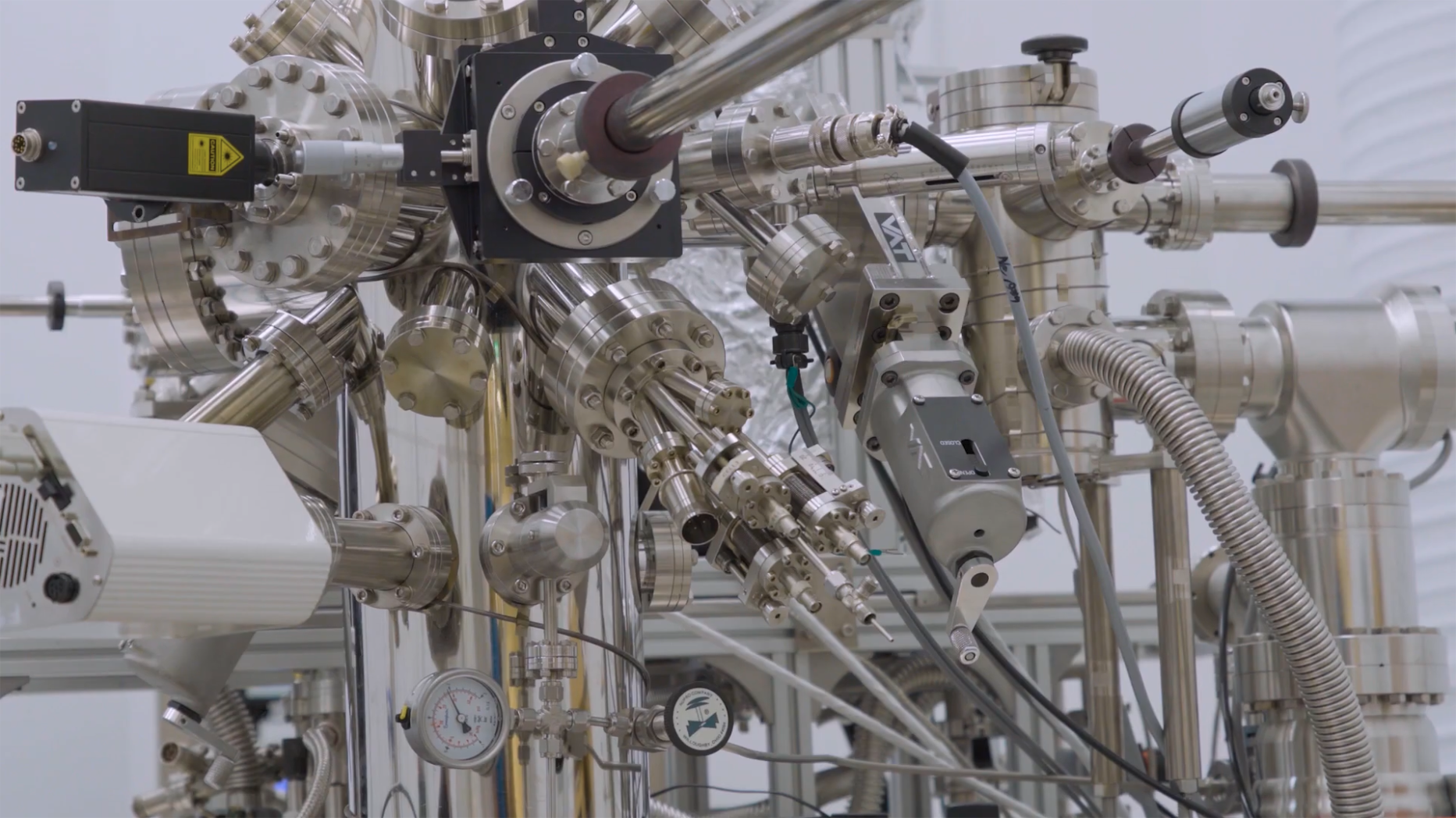
The synthesis and verification work was led by Prof. Emilia Morosan at Rice University’s Center for Quantum Materials. Her team arc-melted stoichiometric quantities of high-purity yttrium (99.99%), ruthenium (99.99%), and boron (99.99%) in argon atmosphere, then verified crystal structure using a Bruker D8 Advance powder X-ray diffractometer with Rietveld refinement. Superconducting transitions were confirmed in a Quantum Design MPMS (SQUID magnetometry) and a PPMS with dilution refrigerator, allowing measurements down to 60 millikelvin, as detailed in Physical Review Research.
The lattice parameters — a = 5.475 Å and c = 3.027 Å for YRu₃B₂; a = 5.448 Å and c = 3.014 Å for LuRu₃B₂ — match the CeCo₃B₂-type structure expected for this materials family, and the measured London penetration depths (~32 nm for both compounds) agree with theoretical predictions from DFT superfluid weight calculations to within the margin of measurement. That level of internal consistency between theory and experiment across multiple independent observables is what distinguishes a robust superconductor confirmation from the kind of single-signal claims that have produced retractions in this field.
The paper itself was submitted to Physical Review Research in December 2025, underwent review through May 2026, and was published June 17. It carries co-authorship from B. Andrei Bernevig at Princeton — a leading theorist in topological materials — and Miguel A.L. Marques at Ruhr University Bochum, who developed the ML screening methodology used here. The SuperC consortium is funded by the Kavli Foundation, Klaus Tschira Stiftung, and Finnish foundations including Jane and Aatos Erkko, Neste and Fortum.
Why Every Superconductor Hunt Has a Credibility Problem
Superconductivity is a field with a well-documented vulnerability to wishful measurement. Two major retractions in 2022 and 2023 involved room-temperature superconductor claims that could not be reproduced, and a University of Rochester investigation found research misconduct in at least one case. The LK-99 episode of July 2023, in which internet-amplified excitement over a claimed ambient-pressure room-temperature superconductor collapsed within weeks when independent labs showed the levitation signal came from a copper-sulfide impurity, illustrated how quickly single-measurement claims can unravel.
The SuperC paper’s rigor is its most meaningful feature in this context. Three separate measurement methods — magnetization, specific heat, and transport — independently confirm the phase transition in both compounds. The measured Tc values agree with the zero-field specific heat and the resistivity drop to within fractions of a degree. Bulk superconducting fractions near 100% rule out the impurity-phase explanations that felled LK-99. Independent replication by outside laboratories has not yet been published, as the paper is two weeks old — but the multi-modal internal confirmation substantially reduces the risk of an impurity artifact.
What Room Temperature Requires From Here
The SuperC consortium was founded in 2023 with a specific and ambitious target: find a room-temperature superconductor by 2033. Room temperature is approximately 300 K. The two newly confirmed compounds superconduct at below 1 K. The gap between those numbers — roughly 299 K — is not primarily an engineering problem. It is a fundamental physics problem about the mechanism of superconductivity.
In conventional BCS superconductors, Tc is set by how strongly electrons couple to lattice vibrations (phonons). The McMillan-Allen-Dynes formula that governs this coupling has a practical ceiling of around 40 K for phonon-mediated superconductors at ambient pressure. Getting from 1 K to 300 K within the conventional BCS framework is not a plausible roadmap; the only conventional materials near or above the liquid-nitrogen threshold are under extreme pressure or belong to exotic material classes such as hydrides. The theoretical argument for kagome lattices was precisely that quantum geometry could amplify supercurrent in flat-band conditions and push Tc above what conventional phonon coupling allows — but as noted, neither YRu₃B₂ nor LuRu₃B₂ actually operates in that flat-band-dominated regime.
What the SuperC pipeline has validated is the ability to find new BCS superconductors in kagome structures efficiently. Finding kagome superconductors where the quantum geometric enhancement is actually the dominant driver — and where that enhancement pushes Tc toward temperatures accessible without cryogenic equipment — requires the pipeline to succeed at a harder version of the same problem. Törmä’s framing is honest about this: the confirmed compounds are “a step toward this future,” not a proof that the future is near. The Aalto University research will be part of its Designs for a Cooler Planet exhibition from September 1 through October 30, 2026, in Greater Helsinki.
What room-temperature superconductivity would enable is not in dispute. A material that transmits electricity with zero resistance at ordinary temperatures, without liquid helium cooling, would reduce global energy waste in transmission grids, data centers, and computing infrastructure by percentages that Törmä and others characterize as transformative. Superconductors already power quantum computers, MRI machines, fusion reactor magnets, and maglev trains — in each case, the value is real and the constraint is the refrigeration overhead. Removing that constraint is a technology-changing proposition. Whether the kagome flat-band route can get there by 2033 depends on what the SuperC pipeline finds in its next round of screening — with two confirmed starting compounds and a validated method in hand, that search is now substantively more directed than it was a year ago.
Frequently Asked Questions
How does AI actually find a new superconductor — what does the algorithm do?
The machine learning model in the SuperC pipeline is trained on the properties of known superconductors — elemental composition, crystal structure geometry, electronic characteristics derived from materials databases. When the team applied it to the full 1:3:2 kagome lattice family, the model rapidly ranked each candidate by predicted likelihood of superconductivity, flagging the ones worth running expensive density functional theory calculations on. Those DFT calculations then computed the phonon spectrum and estimated Tc using an equation called the Allen-Dynes formula. Only the candidates that survived both filters went to the laboratory for synthesis and experimental confirmation. The value of the method is that it inverts the traditional workflow: instead of making materials and measuring them, researchers now measure computationally first and make materials only when the model says it is worth it.
Why do the confirmed compounds superconduct at such low temperatures if the kagome flat band is supposed to help?
In YRu₃B₂ and LuRu₃B₂, the flat band is present but sits away from the Fermi level — the energy surface where electrons available for superconducting pairing actually reside — and is more dispersive (less flat) than the theoretical ideal. This means conventional electron-phonon coupling, which produces only modest Tc values, drives superconductivity in these compounds rather than the quantum geometric enhancement that flat bands can provide. The measured electron-phonon coupling constant (λ ≈ 0.41–0.44) confirms they are weakly coupled BCS superconductors. Finding kagome materials where the flat band sits precisely at the Fermi level and where quantum geometry dominates is the harder next step — these compounds prove the search method works, not that the theoretical prize is already in hand.
When will room-temperature superconductors be available, and do these results change that timeline?
The SuperC consortium has set 2033 as its internal target. Room temperature is approximately 300 K; both new compounds superconduct below 1 K. No result from this paper changes the fundamental physics gap between those numbers. What these results do change is the efficiency of the search: the ML pipeline is now experimentally validated, meaning researchers can screen far more candidate families with greater confidence than before. Whether that acceleration translates into a room-temperature discovery by 2033 depends on whether the quantum geometric flat-band enhancement the theory predicts for kagome materials can be activated in a compound the pipeline identifies. That question remains open.
What would a room-temperature superconductor actually change?
Materials that transmit electricity with zero resistance at ordinary temperatures — without liquid helium cooling — would reduce energy losses in power grids, data centers, and computing hardware, where resistance-driven heat is a significant and growing cost. Superconductors already power MRI machines, particle accelerators, quantum computers, and experimental fusion reactors, but in each case they require refrigeration infrastructure that is expensive and limits deployment. Removing that constraint would make superconducting magnets, cables, and quantum computing components far more practical to deploy at scale, potentially affecting the economics of the electrical grid, medical imaging, and next-generation computing.