
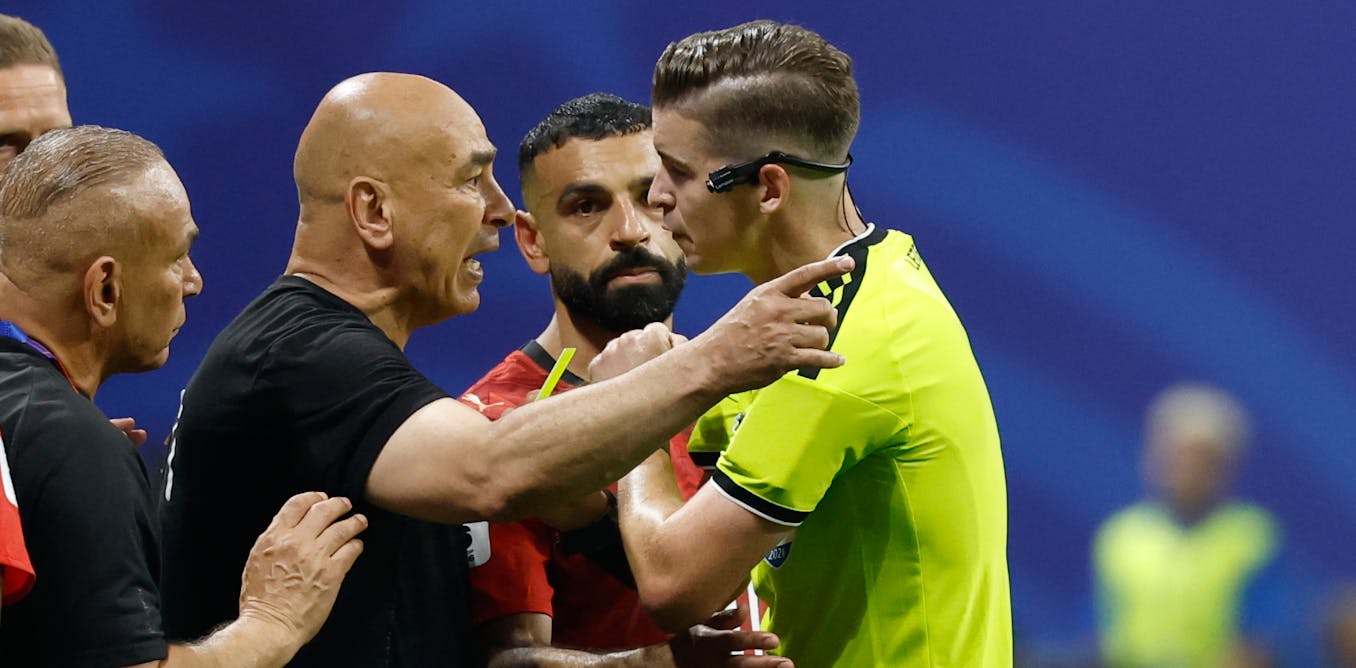
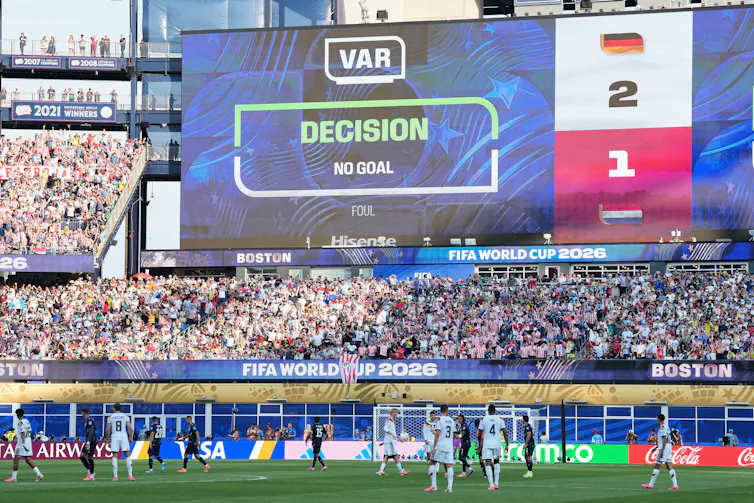
Anyone who watched the 2026 FIFA World Cup will have seen the now-familiar ritual. There’s a goal, a celebration, and the referee touches his earphones while fans and players wait for a decision from the Video Assistant Referee (VAR).
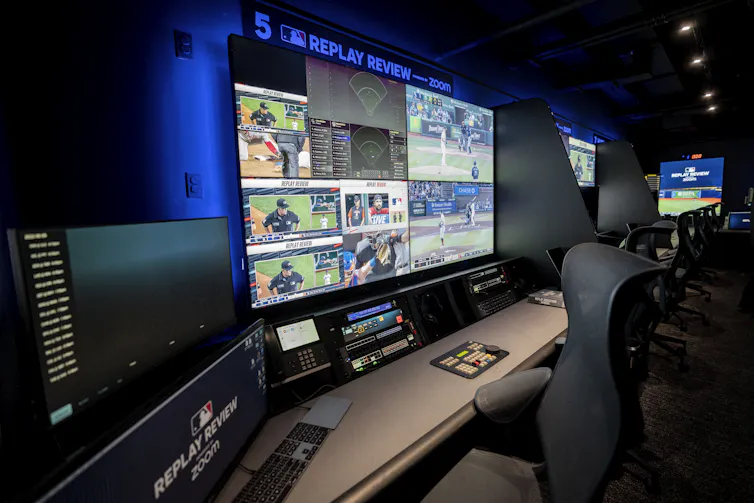
The ritual is not limited to soccer. Baseball has a replay center in New York, and other sports are moving what used to be human calls to review systems.
My hope is simple. It’s about using better technology to make better calls.
Soccer authorities expected more cameras, replay angles and tracking data to reduce refereeing errors, limit subjectivity and enhance perceptions of fairness. However, VAR has sparked a new debate among players, coaches, fans and commentators: “Should VAR have intervened?” Were the same standards consistently applied for when to intervene? Did you feel the process itself was fair?
Watching the World Cup as a decision-making researcher, I couldn’t help but think that VAR is more than just an officiating tool. This looked like a case study in technology-enabled decision-making, alongside the growing use of AI in organizational decision-making.
VAR has created a series of mismatches between what the technology promises and how people experience it. It disappointed fans and sparked new controversy over judgment, process, and trust. These tensions provide a useful lens through which to understand AI adoption more broadly.
AP Photo/Martin Meissner
Better measurements do not lead to better decisions
Some decisions have measurement issues: Was the player offside? Did the ball cross the line? Has contact occurred? Technology is better at answering these questions because cameras, sensors, and data reduce mistakes caused by people not seeing clearly.
However, many decisions involve poor judgment. Was that contact enough to warrant a penalty? Was the tackle reckless? Was the referee’s initial decision clearly wrong? These questions include interpretation, context, and criteria. Cameras can indicate that contact has occurred. You cannot decide how that contact should be judged.
The same issue arises when organizations use AI to support decision-making. AI can process data, predict patterns, and classify cases. But doctors, managers, judges, and teachers need to decide what that outcome means, how much weight to give it, and what values are at stake. Research on human-AI collaboration makes similar points. AI is often most powerful when combined with human judgment, rather than as a complete replacement for it.
Subjectivity does not disappear, but moves.
Before VAR, the debate centered around what the referee saw. After VAR, discussions often focus on how the process works. When does VAR intervene? How far back can authorities review a play? What is “clear and unambiguous” video evidence?
Subjectivity still remains. The focus has shifted from the eyes of the auditor to the rules, thresholds, and governance of the screening system. A similar pattern can be seen in baseball. Replays do not remove decisions from matches. We’ve changed which plays can be reviewed, how challenges work, and where decisions come into the process.
AP Photo/John Minchillo
AI systems create similar changes. Organizations often imagine AI as a way to remove human discretion. In practice, discretion re-emerges in new places, such as deciding which models to use, what data to train on, what error rates are acceptable, and who is responsible if the system fails.
Increasing precision can reduce confidence
Many people believe that greater accuracy means greater trust. Sometimes it happens. But it can increase expectations faster than it reduces ambiguity. If technology allows offside calls to be measured to the centimeter, fans may expect all calls to feel equally certain. People can get irritated if there is a lot of debate over penalty calls or red cards.
A study of why people avoid using algorithms found something similar. Even if the algorithm performs well overall, seeing it make mistakes can cause people to lose confidence in the algorithm. Accuracy alone does not guarantee validity.
This discovery is important for AI decision-making systems. Companies could use AI to make hiring and performance evaluations more objective. However, if applicants or employees view the system as inconsistent, biased, or unfair, trust can decrease rather than increase. When organizations frame AI as a silver bullet, they raise expectations that technology cannot necessarily meet. The result can be further frustration and a rapid loss of trust.
Vision House/Getty Images
Where technology ends and judgment begins
Management research shows that deploying AI today is not a simple choice between humans and machines. A better question is: Should decision-making be automated, scaled, or left to human judgment?
Measurement problems are the best candidates for automation. AI can scan documents, detect patterns, classify cases, and flag anomalies more quickly and consistently than humans. Interpretation problems require cooperation between humans and AI. AI can provide information, options, and recommendations, but humans still need to think about the context of decisions, how much uncertainty there is, and the possible consequences of decisions. And some decisions remain deeply human. Questions of fairness, accountability, values, or meaning cannot be handed over to technology without changing the nature of decision-making itself, from human judgment to algorithmic evaluation.
VAR makes this boundary visible in sports. AI is now forcing organizations to face the same boundaries in high-stakes decisions. The key question in AI deployment is not simply “Can AI make this decision?” The question is, “Which parts should be judged by AI and which parts should be left to human judgment?”


