I. The frictional unemployment that AI, advanced automation, and robotics will create
Since 2020, the impact of the transition to an economy driven by artificial intelligence (AI), advanced automation, and robotics has gone from being a futuristic promise to becoming one of the pillars of contemporary industrial production. Historically, large-scale industrial growth brought with it a clear social dividend: the increase in the volume of production implied the proportional hiring of hundreds of thousands of workers, assembly technicians and support personnel.
If in previous industrial revolutions machines replaced human physical strength without destroying the global capacity to absorb labor, the current cycle poses new challenges to the labor market. There is no shortage of tech companies demonstrating that these technologies serve to increase productivity; several global companies have announced significant staff cuts, explicitly justifying them with efficiency gains or reallocation of resources to AI. Thus far, the epicenter of this debate is focused on frictional or structural unemployment due to direct layoffs (e.g., the direct replacement of workers by AI, automation, and robots).
A. General unemployment forecasts due to AI, advanced automation or robotics and impact on the labor market
Several expert analysts – from Anthropic, Microsoft, JP Morgan – have been pointing out that it is very likely that the development of AI, its widespread use and its progressive integration into the labor market will lead to more unemployment.
Whilst some admit that the total balance of jobs may be positive in the long term, the estimated layoff of workers in the short and medium term is significant.
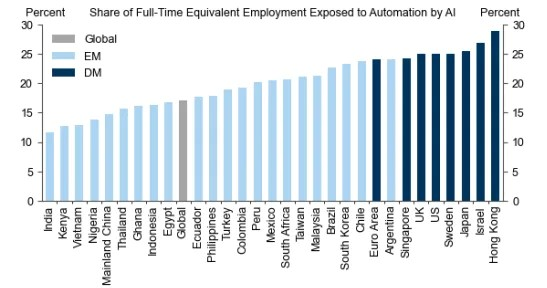
- The International Monetary Fund (IMF) estimates that about 40% of the world’s jobs are exposed to AI. In advanced economies, that number rises to 60%, where technology can both boost productivity and replace entire functions.
- According to a 2023 report by Goldman Sachs Research (GSR), in a 10-year period (2023~2033), AI and automation could replace the equivalent of 300 million full-time jobs, and could replace 18~25% of work tasks in the US and Europe, although it could also generate new jobs and a significant increase in productivity.
The report also predicts that 2/3 of jobs in the U.S. and Europe “will be exposed to some degree of automation by AI”.
In addition, GSR estimates that AI could generate a 7% increase in the total annual value of goods and services produced globally in that period.
- Forbes, also in 2023, reported, citing a report by MIT and Boston University, that AI would replace up to two million manufacturing workers by 2026.
- A study by the McKinsey Global Institute said that by 2030, at least 14% of employees worldwide may need to change careers due to digitalization, robotics, and advances in AI.
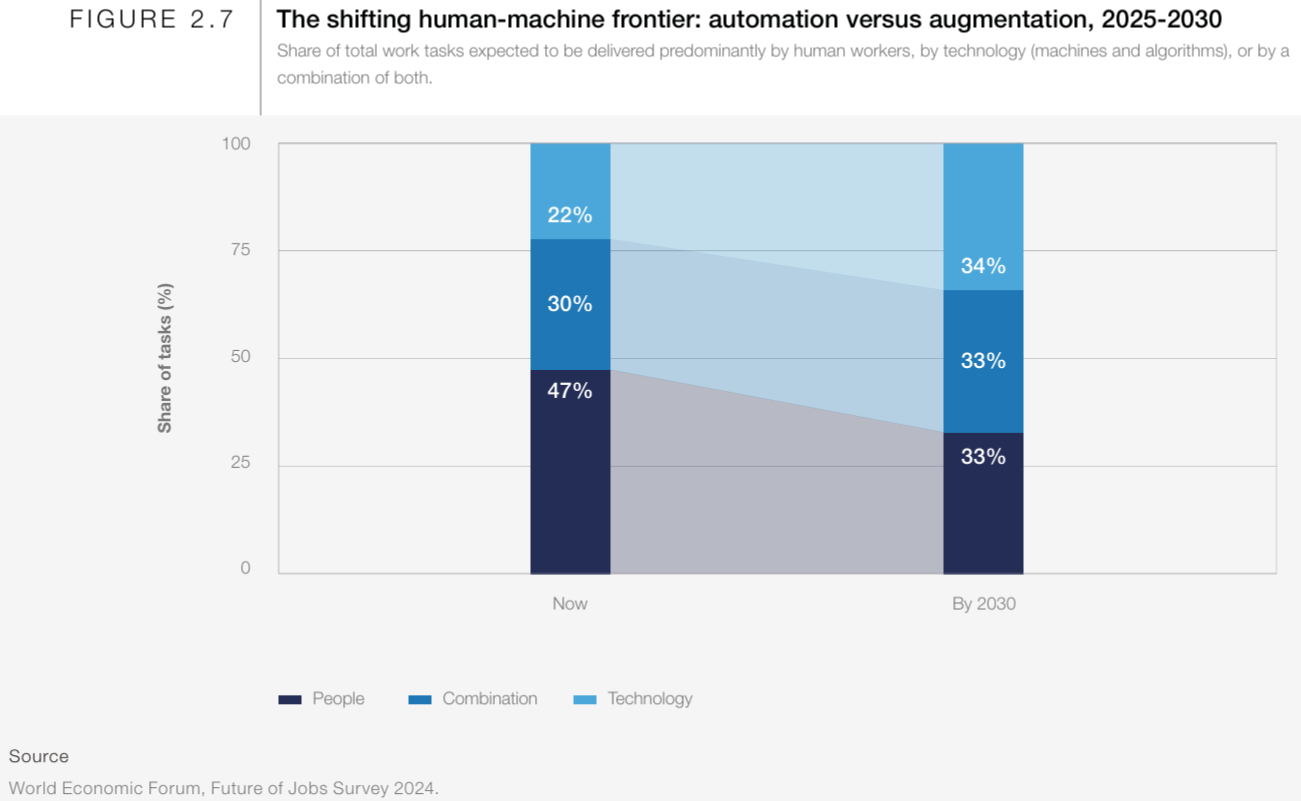
- “Elimination” vs. “creation”: The World Economic Forum’s (WEF) Future of Jobs Report 2025 projects that, by 2030, AI could eliminate 92 million jobs, but estimates that it will compensate with the creation of 170 million new roles – e.g., Big Data specialists, Fintech engineers, AI specialists and Machine learning, software and application developers, autonomous and electric vehicle specialists, environmental engineers and renewable energy engineers.
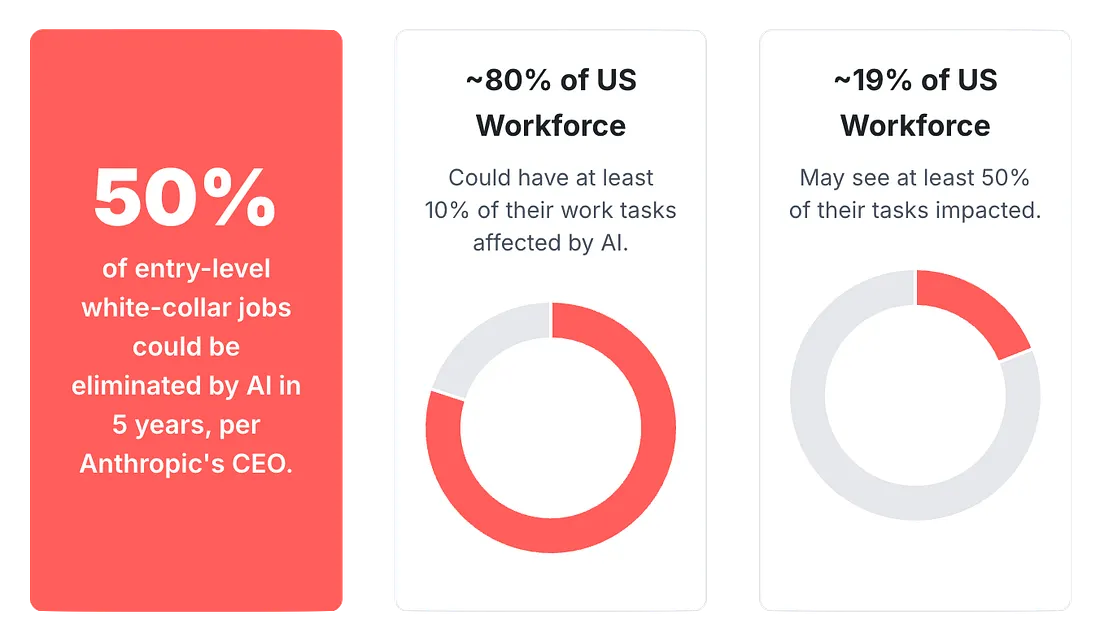
- Heads of companies, including big tech companies developing AI, have assumed the loss of many jobs now performed by human beings. Dario Amodei – CEO of Anthropic, one of the most powerful AI creators in the world – issued a scary warning in 2025: AI could cause the possible mass elimination of jobs in technology, finance, law, consulting, and other white-collar professions, especially entry-level jobs, increasing unemployment to 10% to 20%, in the next 5 years.
- Natural friction and white-collar: Unlike previous industrial revolutions, AI affects more cognitive work (“white-collar”). Studies by Stanford (2025) indicate that many companies are opting for natural friction: instead of mass layoffs, the vacancies of those who leave are not filled, and the tasks are absorbed by automated systems and AI.
- According to Daron Acemoglu (Professor at MIT, Nobel Prize in Economic Sciences in 2024 and author of several books), AI is likely to have a small net negative impact on labor over the next five years and a larger negative impact over the longer term unless the industry directs more investment toward advances that complement, rather than replace, workers.
B. Unemployment data in the US due to AI, advanced automation, and robotics (2023 – 2026)
Between January 2023 and July 2026 alone, according to AI Layoffs Tracker of DisplaceIndex, approximately 374,000 jobs will have been eliminated [primarily in the US] due to AI, in relevant companies, including: (i) Oracle (21,000 jobs); (ii) Amazon (14,000 enterprise and AWS jobs + 16,000 jobs in distribution and logistics centers); (iii) Microsoft (9,000); (iv) Meta (8,000); (v) HP (5,000); (vi) Salesforce (4,000); (vii) Cisco (4,000); (viii) UPS (20,000); (ix) IKEA (10,000); (x) IBM (2,700); (xi) Paypal (4,760); (xii) Block (4,000).
Similar calculations should be made regarding the elimination of jobs resulting from the adoption of AI, advanced automation and robotics in other countries, starting with the OECD ones.
The nuance of the “boomerang effect”: Recent studies by Gartner and Robert Half highlight that many companies faced quality drops, lack of contextual judgment, and model hallucinations, leading some to rehire human workers to oversee operations.
Correction of the most pessimistic forecasts: interestingly, the GSR, in a June 2026 report, acknowledged that, thus far, “AI’s overall impact on the labor market remains limited, with no statistically significant relationship between AI adoption and unemployment”.
Similarly, the thorough Stanford HAI’s 2026 AI Index Report states that “from 2022 to early 2025, unemployment rose across all occupation groups regardless of AI exposure level. While the unemployment rate for the most AI-exposed workers (quintile 5) increased by 0.30 percentage points, it rose even more for the least exposed workers (quintile 1), climbing by 0.94 percentage points. AI exposure alone does not seem to be driving recent unemployment trends, but it appears to play a part in broader macroeconomic conditions and organizational changes.”
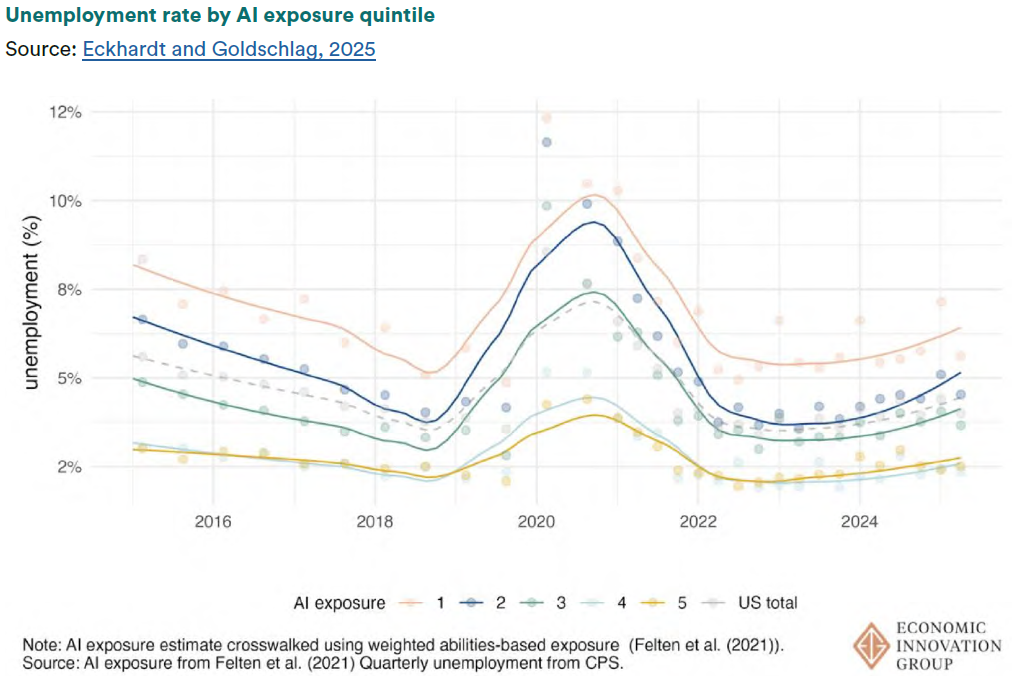
In short, the general forecasts of frictional unemployment by international organizations, think tanks and experts are more pessimistic than the set of data collected on a company-by-company basis. Although accounting for it is a difficult task. Especially with regard to the unemployment generated by the loss of job opportunities.
II. Invisible unemployment
C. Unemployment due to non-job creation
Unemployment due to non-job creation (often referred to in the economic and business literature as non-hiring, hiring freeze or jobless growth driven by technology) represents a structural change in the labor market.
Unlike the massive layoffs of frictional unemployment – which generate a strong media impact – this phenomenon occurs silently and progressively. In most cases, companies maintain or expand their operational capacity without increasing their teams, covering the growth of work through AI, process automation (RPA) and robotics, rather than opening new jobs or replacing spontaneously leaving workers.
D. Characterization of the phenomenon
1. Entry-level squeeze in [young people’s] access to the market
The most critical impact is not so much on experienced workers as on recent graduates and early career professionals. As generative AI and autonomous agents take on repetitive tasks of data analysis, initial code writing, translation, and basic support, entry-level vacancies are shrinking, in some tasks disappearing.
2. Jobless growth
Some companies are able to scale production and sales by taking advantage of productivity gains between 10% and 25% provided by AI, without the need for proportional headcount expansion.
3. Natural attrition replacement
Instead of incurring redundancy costs and social frictions, employers take advantage of natural turnover (retirements, voluntary resignations) and choose not to replace these [former] workers, automating the remaining tasks.
E. Relevance of the phenomenon
1. Robotization and automation from scratch
- Xiaomi’s electric vehicle factory: The flagship example of Xiaomi’s SU7 electric vehicle factory in Beijing fully reflects this paradigm. The facility operates with hundreds of industrial robots and AI-guided computer vision systems, covering steps from stamping and welding to painting, quality inspection and battery assembly. The line is capable of producing a car every 76 seconds with almost residual human intervention.
In this scenario, Xiaomi’s factory didn’t need to lay off 5,000 workers to become efficient; it simply never hired them. “No job creation” is invisible unemployment: operational jobs that were theoretically supposed to emerge with the birth of a new industrial giant, but which were fully absorbed by algorithms and automation from day one of operation.
There are many other telltale cases of the impact of AI, automation and robotics on the labor market through the cancellation/freezing of hiring, although not as radical as in the case of Xiaomi’s SU7 electric vehicle factory.
2. Drop in hiring in Big Techs
A report from SignalFire, a venture capital firm that monitors the job movements of over 650 million employees on LinkedIn, found that big tech companies have reduced hiring new graduates by 25% from 2023 to 2024, while startups decreased these admissions by 11% in the same period.
It is worth looking at some concrete data, numbers that prove this trend:
2.1. The collapse of entry-level vacancies in programming
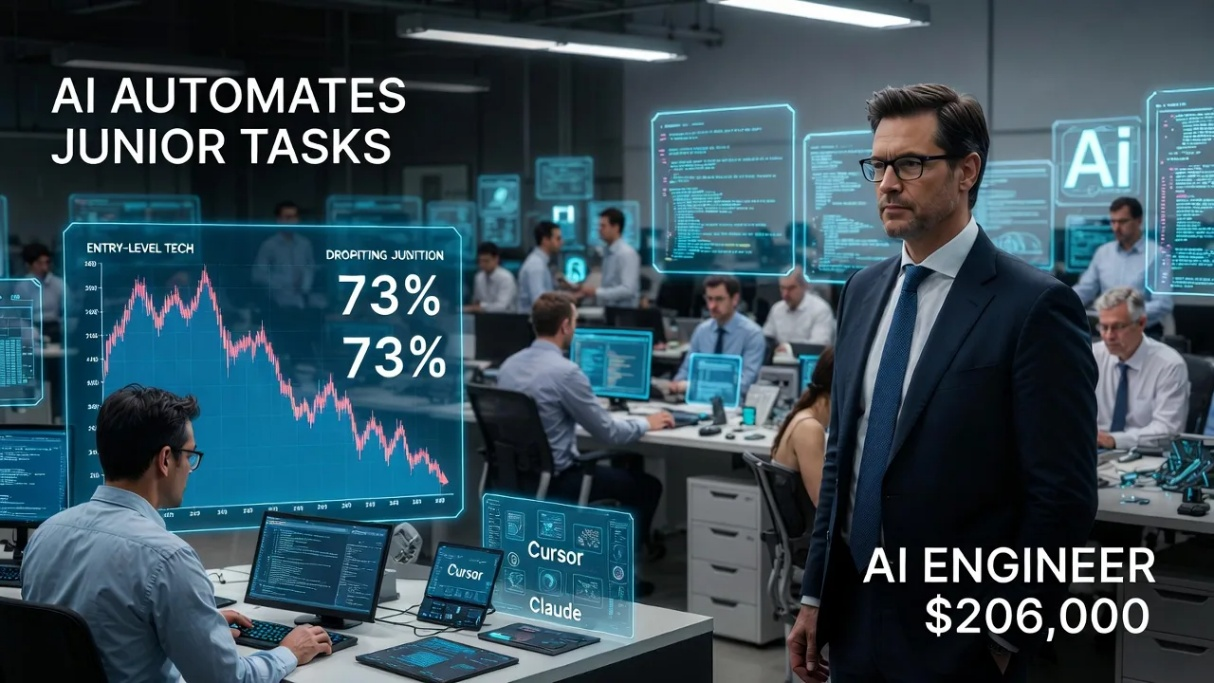
The most direct indicator of unemployment due to non-job creation is the drastic reduction in the number of job postings for early-career software engineers (juniors/P1).
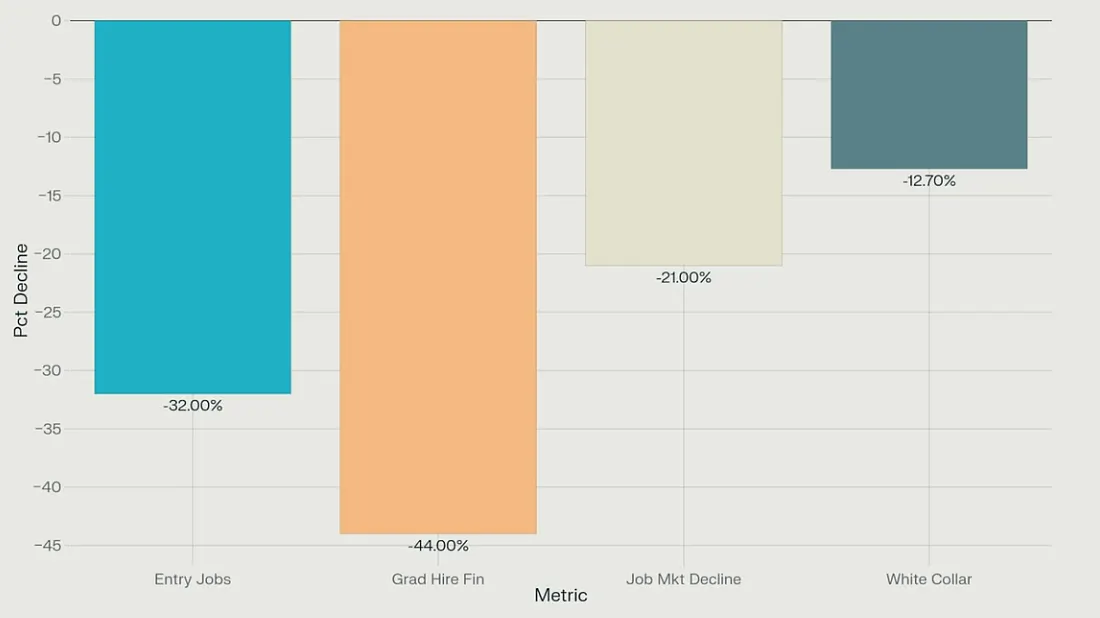
- Plateau down by up to 73%: Tech market analysis based on reports from compensation platform Ravio revealed that hiring for entry-level positions as software engineers in the tech sector collapsed by about 73%, while overall hiring fell by only about 7%.
- Decline in jobs on Indeed: According to data collected from Indeed, the total number of job postings for software development is down >50% from its peak at the end of 2022.
2.2. Data from the Stanford Digital Economy Lab (young workers)
Researchers led by Erik Brynjolfsson at Stanford University’s Digital Economy Lab looked at the effects of AI on employment by age group and degree of exposure to technology:
- Workers aged 22-25: In occupations highly exposed to generative AI (such as junior programming, code development, input data analysis, and customer support), employment among 22~25-year-olds saw a drop of c. 16% ~ 20% compared to the end of 2022. On the other hand, the age groups of seniors (35 to 49 years old) remained stable or even grew slightly in the same period.
- Unemployment rate for recent graduates: The unemployment rate among recent graduates in Computer Science and Computer Engineering rose to levels between 6.1% and 7.5%, double the national average for unemployment for graduates in the US.
2.3. Global drop in internships and university recruitment
Big Techs and software companies have significantly reduced their university recruitment programs (graduate schemes and internships):
- United Kingdom (ISE Report): The Institute of Student Employers in the United Kingdom reported a 46% drop in tech vacancies aimed at recent graduates.
- Internships: Internship offers at tech companies are down about 30% to 50% from the pre-generative AI period.
3. Imbalance between the demand for senior and junior professionals
- Overall drop of 35% in junior vacancies: According to data from Revelio Labs released by the World Economic Forum, the global number of entry-level job offers fell by 35%.
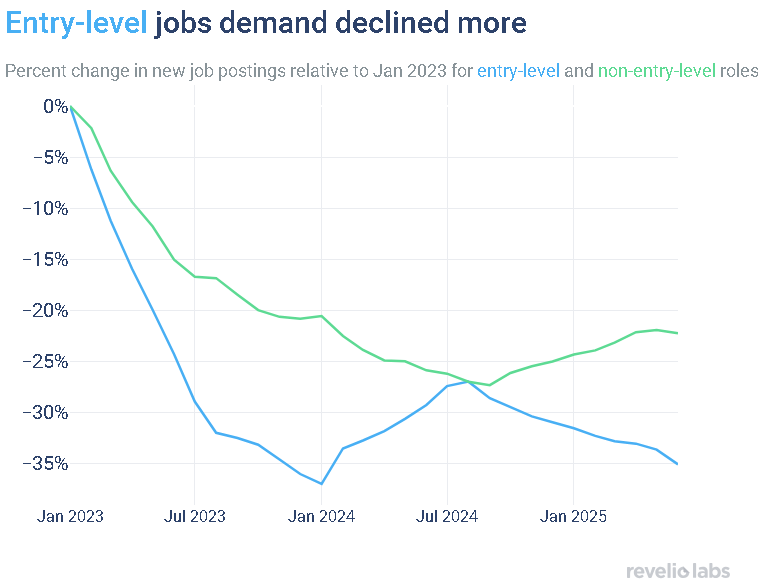
- Disproportionate impact on AI-exposed roles: Entry-level vacancies for roles with high exposure to AI (easily automatable tasks) have seen a drop >40%.
- Hiring divergence: While the market reduces the hiring of new graduates, every 10% increase in a role’s “AI exposure” is associated with an 11% reduction in the demand for junior positions, but a 7% increase in the demand for senior positions capable of managing and overseeing these tools.
- Commoditization of execution: Companies prefer to hire a senior professional equipped with AI assistants (such as GitHub Copilot or Claude), obtaining the equivalent income of three juniors without the need to invest 1 to 2 years in training and supervision.
4. Financial services, advocacy and information services
The lack of job creation is also directly affecting graduates in social sciences, management and law:
- Financial services and management: Entry-level job postings in the financial and consulting sector fell by 44%. Preliminary analysis of contracts, due diligence, and basic financial models is now carried out by large-scale language models (LLMs).
- Leaders recognize the impact: In LinkedIn surveys of more than 3,000 executives, 63% of business leaders said AI will progressively take over most of the routine tasks previously assigned to junior employees.
- Graduate unemployment vs. overall average: For the first time in recent periods of economic expansion, the unemployment and underemployment rate among recent university graduates in several advanced economies has surpassed the global average unemployment rate, reaching about 5.8% to 7.5% in the white-collar sector.
F. Recent developments in the U.S.
Recent data from the U.S. shows that private-sector job growth has fallen by 60% over the past two months (May~July 2026). ADP NER data shows that employers added just 16,500 jobs a week as of July 4, up from 40,750 in early May. The June employment report recorded 57,000 vacancies, about half of expectations. Initial jobless claims fell to the lowest level since 1969. Companies have stopped hiring, but they are not laying off workers either. The American labor market is not collapsing. It seems to be frozen.
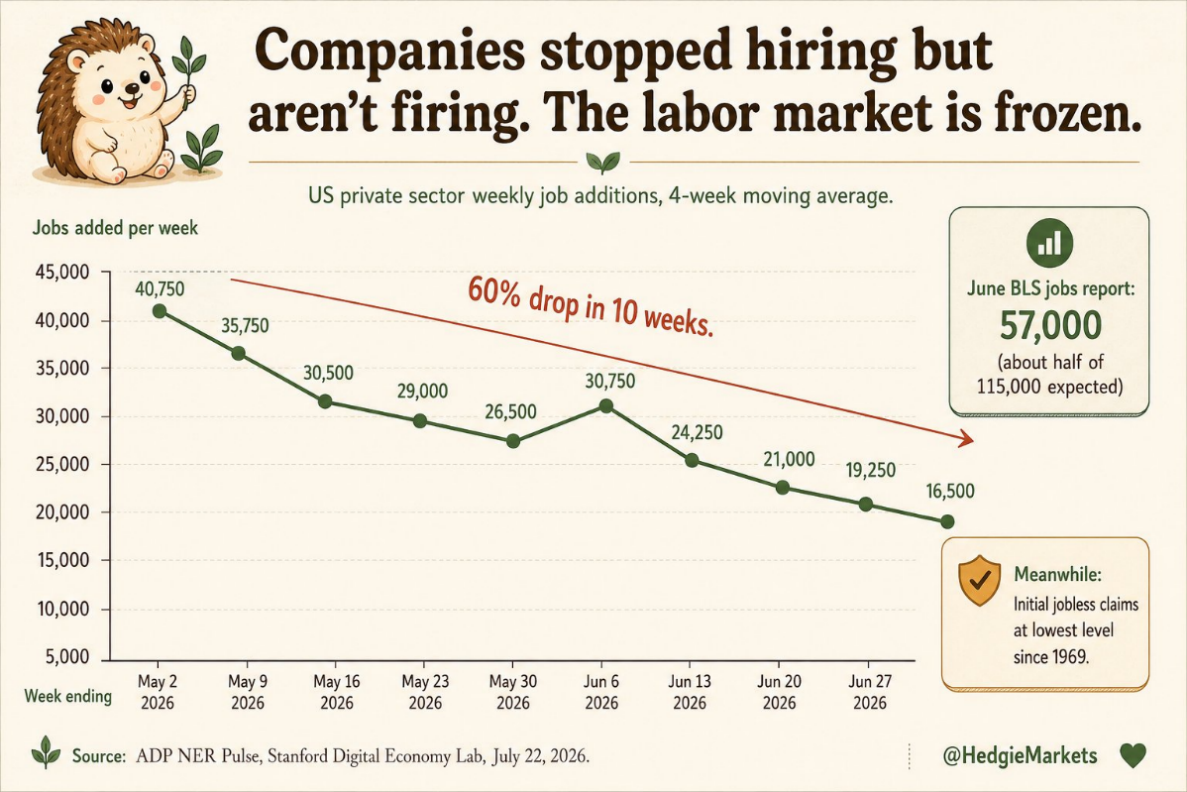
Hiring is declining because companies are learning to operate with fewer people, and workers who lose their jobs are entering a market where almost no one is hiring.
It is possible that it is a temporary situation.
This situation is also likely to stem from the instability created by the Trump administration’s erratic management.
However, there seems to be a kind of hiring freeze on a national (U.S.) scale.
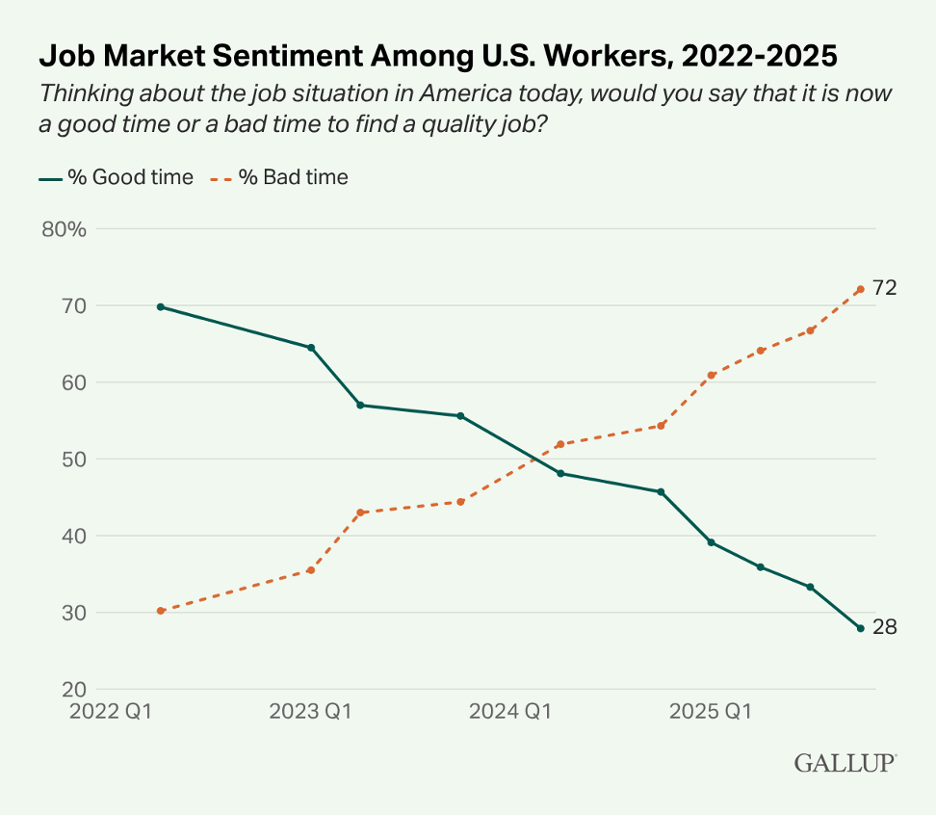
Workers’ discouragement is at the highest level since January. Labor force participation in the U.S. is at its lowest level in five years. The unemployment rate of 4.2% only seems healthy because many people are leaving the labor market.
This situation – the frozen hiring of new workers, the inability of companies to absorb [due to the increasing use of AI and automation] millions of new university graduates launched annually on the market, and more young people being forced to live permanently with their parents (such as the “tang ping” (躺平) / “lying flat” of young Chinese) – will certainly extend to other countries, starting with European and other OECD countries.
It is imperative that governments assume the existence, and relevance, of this “invisible unemployment” and address its effects, including social security mitigation and compensation mechanisms.
.