

What are Large Scale Language Model Operations (LLMOps)?
Large-Scale Language Model Operations (LLMOps) is a methodology for managing, deploying, monitoring, and maintaining LLMs in production environments.
LLMOps focuses on the Machine Learning Operations (MLOps) framework, an extension of DevOps, to address the unique challenges associated with LLMs such as OpenAI's GPT series, Google's Gemini, and Anthropic's Claude. LLMOps has been gaining prominence and popularity since early 2023, as enterprises have increasingly started considering the adoption of generative artificial intelligence (AI).
The main goal of LLMOps is to ensure reliability, efficiency, and scalability when integrated into real-world applications. This approach has many advantages:
- Flexibility. LLMOps focuses on enabling models to handle different workloads and integrate with different applications, making LLM deployments more scalable and adaptable.
- automation. Like MLOps and DevOps, LLMOps emphasizes automated workflows and continuous integration/continuous delivery (CI/CD) pipelines to reduce the need for manual intervention and speed up development cycles.
- collaboration. Adopting an LLMOps approach standardizes tools and practices across the organization and encourages best practices and knowledge sharing among relevant teams, including data scientists, AI engineers, and software developers.
- performance. LLMOps implements continuous retraining and user feedback loops with the aim of maintaining and improving model performance over time.
- Security and ethics. The cyclical nature of LLMOps ensures that security testing and ethics reviews are performed regularly over time, protecting against cybersecurity threats and promoting responsible AI practices.
What are the stages in the LLMOps life cycle?
The LLMOps lifecycle has some overlap with similar methodologies such as MLOps and DevOps, but there are some differences related to the specific characteristics of LLMs, and the content of each stage differs depending on whether the LLM is built from scratch or fine-tuned from a pre-trained model.
Data collection and preparation
This stage of LLMOps involves sourcing, cleaning, and annotating data for model training. Building an LLM from scratch requires collecting a large amount of textual data from various sources: articles, books, internet forums, etc. It is easier to fine-tune an existing foundational model, and the focus is on collecting curated, domain-specific data sets that are relevant to the task at hand, rather than large amounts of general data.
In either case, the next step is preparing the data for model training. This includes standard data cleaning tasks such as removing duplicates and noise and handling missing data, as well as labeling the data to make it more useful for a specific task such as sentiment analysis. Depending on the scope of the task, the dataset might also be augmented with synthetic data at this stage.
Given the scope and nature of LLM training data, teams must be careful when collecting training data to comply with relevant data privacy laws and regulations – for example, personally identifiable information must be removed to comply with laws such as the General Data Protection Regulation, and copyrighted works should be avoided to minimise potential intellectual property concerns.
Train or fine-tune the model
The next step is to choose a model (either an algorithmic architecture or a pre-trained foundational model) and train or fine-tune the model based on the data collected in the first stage.
Training an LLM from scratch is complex and computationally intensive. Teams need to design the right model architecture and train the LLM on a large and diverse corpus of text data to enable it to learn common linguistic patterns. They then optimize the LLM by tuning certain hyperparameters, such as the learning rate and batch size, to achieve the best performance.
Fine-tuning an existing LLM is easy, but still technically challenging and resource-intensive. The first step is to select a pre-trained model that is suitable for the task, considering factors such as model size, speed, and accuracy. Then, the machine learning team trains the selected pre-trained model on a task-specific dataset to adapt it to the task. As with training an LLM from scratch, this process involves tuning hyperparameters. However, when fine-tuning, the team must balance adjusting weights to improve performance on the fine-tuning task without compromising the benefits of the model's pre-trained knowledge.
Testing and validating the model
This stage of the LLMOps lifecycle is similar for both types of models, but because the underlying models have been tested during pre-training, fine-tuned LLMs are more likely to perform better in initial testing compared to models built from scratch.
For both types, this stage involves evaluating the performance of the trained model on a different dataset that it has never seen before, to assess how it handles new data. This is measured by standard machine learning metrics such as accuracy, precision, F1 score, and applying cross-validation and other techniques to improve the model's ability to generalize to new data.
This step should also include bias and security assessment. Although the underlying model has typically already undergone such testing, teams fine-tuning existing models should not overlook this step, as new data used for fine-tuning may introduce new biases or security vulnerabilities not present in the original pre-trained LLM.
Expand
The deployment stage in LLMOps is similar for both pre-trained models and models built from scratch. As with DevOps in general, this includes preparing the necessary hardware and software environment, setting up monitoring and logging systems to track performance and identify post-deployment issues.
Compared to other software, including most other AI models, LLMs require a large amount of high-performance infrastructure, typically graphics processing units (GPUs) and tensor processing units (TPUs). This is especially true for organizations that build and host their own LLMs, but even hosting fine-tuned models and applications that leverage LLMs requires significant computing power. In addition, developers typically need to create application programming interfaces (APIs) to integrate trained or fine-tuned models into end applications.
Optimization and Maintenance
The LLMOps lifecycle doesn't end after a model is deployed: teams must continually monitor the performance of deployed models in production to detect model drift and other issues, such as latency or integration problems, that can reduce accuracy.
Similar to DevOps and MLOps, this process might include the use of monitoring and observability software to track model performance and detect bugs or anomalies, as well as a loop of iteratively improving the model with user feedback, and version control to manage different model versions so they can be rolled back if necessary.
For LLM, continuous improvement also involves various optimization techniques, including compressing the model using techniques such as quantization and pruning, as well as load balancing to distribute the workload more efficiently during periods of high traffic volume.
MLOps vs LLMOps: What's the difference?
While MLOps and LLMOps share a common foundation and goal of managing machine learning models in real-world settings, they differ in scope: LLMOps focuses on a specific type of model, while MLOps is a broader framework designed to encompass ML models of any size or purpose, including predictive analytics systems and recommendation engines.
MLOps applies DevOps principles to machine learning, emphasizing CI/CD, rapid iteration, and continuous monitoring. The overall goal is to combine team practices and tools to simplify and automate the lifecycle of ML models.
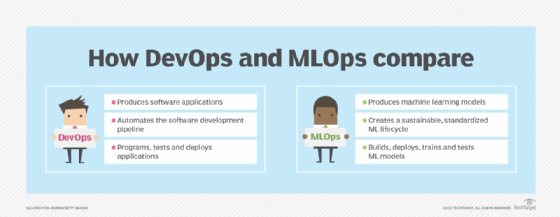
MLOps is applicable to LLM, a subcategory of machine learning models, because it is designed to ensure that machine learning models are consistently tested, versioned, and deployed in a reliable and scalable manner. However, with the growing use of LLM, the term is no longer used. LLMOps The following theory has emerged to explain how LLM differs from other ML models:
- Development process. While less complex ML models are typically developed in-house, LLMs are often provided as pre-trained models by AI startups or large tech companies. This shifts the focus of LLMOps to fine-tuning and customization, requiring different tools and workflows.
- Visibility and interpretability. Developers have little control over the architecture and training process of pre-trained LLMs, especially proprietary LLMs. Even open source LLMs typically only provide access to the model's code, but not the training data. Lack of access to the model's inner workings and training data, as well as reliance on APIs from external AI providers, complicates troubleshooting and performance optimization.
- Ethical, security and compliance considerations. Ethics and security are concerns for any machine learning project, but LLMs pose unique challenges due to their complexity and widespread use. Some biases and vulnerabilities may only emerge in response to specific prompts, making them difficult to detect. Enterprise LLM deployments also raise concerns about data provenance, user privacy, and regulatory compliance, necessitating an advanced data governance strategy.
- Operational and infrastructure requirements. LLM is resource intensive, requiring significant computational power, specialized hardware such as GPUs or TPUs, and distributed computing techniques. Many other types of machine learning models are typically more resource intensive than non-ML software, but are relatively lightweight.
- Scale and complexity. The size and complexity of LLMs require teams to pay close attention to resource allocation, scaling, and cost management. In particular, LLMs can introduce significant latency when served in real-time applications. Advanced optimization techniques such as model quantization, distillation, and pruning may be required to mitigate this issue.


