

Following the announcement of ChatGPT in November, the tech industry is well on its way with a spate of AI chatbot announcements. These versatile tools make life easier by making many of your daily tasks easier.
But unlike humans, who can infer meaning from context and nuances, AI chatbots need to be given precise and clear language to properly understand user intent.
So today, we’re going to take a look at what an AI prompt is and the various complexities involved in engineering the perfect prompt.
What exactly are prompts?
Prompts are the input users give to AI chatbots and generation services such as ChatGPT, Bard, and Bing. Prompts tell your chatbot what to do or say and help generate relevant and accurate responses.
Prompt engineering, on the other hand, is the skill of designing and creating effective prompts for different purposes and goals.
Basic Principles of Prompt Engineering
Please be as specific as possible
When building a prompt, the less detail you provide, the more assumptions the AI model has to make. Including constraints in your prompts helps your model produce output that is closer to what you intended.
Suppose you want to use an AI chatbot to identify sentiment in image captions. In that case, the prompt “Categorize this caption: I love my dog so much, I don’t get the desired output. If you replace it with “”,Categorize emotions for this caption as positive, neutral or negative: I love my dog so much‘ works better because it is more specific.
provide sample output
Think of an AI chatbot like a super-smart kid who needs to lead by example every now and then when the task is complicated. Try to feed examples that are similar to the data you are working with to produce better output.
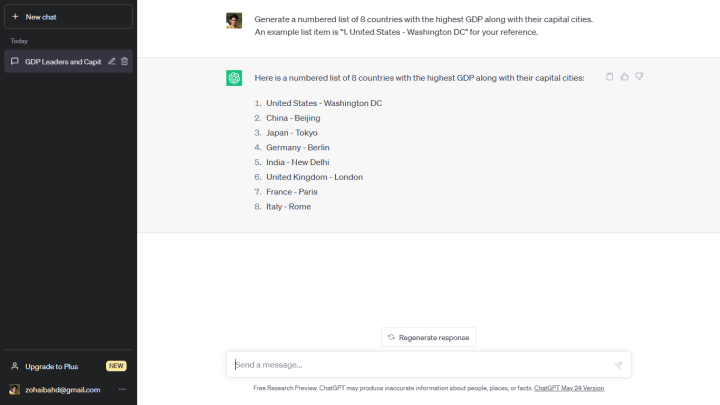
For example, if you want to generate a list in a particular format, for example a list of countries and their capital names, try using a prompt like the following example.
Generate a numbered list of the 8 countries with the highest GDP and their capitals. See 1. United States – Washington, DC for an example list item.

Provide additional relevant context
Because AI models are trained on millions of documents and web pages on the internet, they are prone to hallucinations and confusing facts. Therefore, it can be important to limit the scope of resources used by AI chatbots to generate responses. A good way to ensure that your chatbot’s responses are accurate and factually correct is to include relevant links or pages of documentation as additional context in your prompts. You can ask your chatbot to refer to these prompts when generating output.
Refine and iterate as needed
Coming up with the perfect prompt can be a trial-and-error process, so if the first prompt doesn’t give you the answer you want, don’t hesitate to try again. Additionally, using the same prompt twice can produce very different output, so recycling prompts is sometimes wise.
Now that you’ve learned the basics of prompt engineering, you should be able to use AI chatbots more efficiently to get the results you want. Be sure to be specific, provide sample output, include relevant context, and iterate as necessary. As AI chatbot technology continues to evolve, mastering prompt engineering will enable you to effectively leverage these powerful tools, making interactions more productive and seamless.


