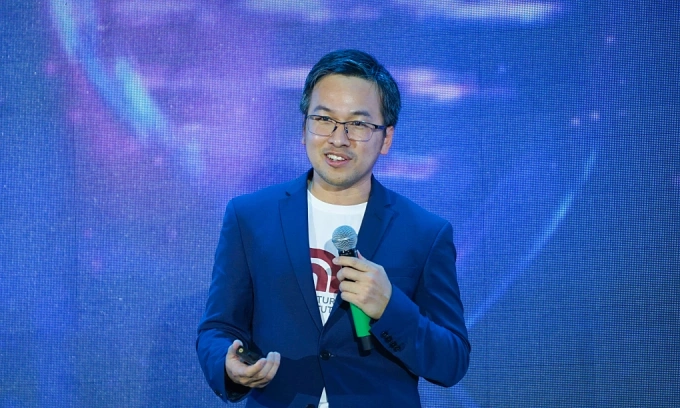
“What Vietnam should not do is not build another big model,” Curtis S. Chin, chairman of senior fellow and senior global market advisor at the US-based Milken Institute, said at the GStar Summit in Ho Chi Minh City on May 29. “Leverage what Google has, what Meta has, what OpenAI has, and build an application tailored for Vietnam on top of that.”
Jay Kim, chairman and CEO of South Korean healthcare company Boryeon and director of healthcare and space company Axiom Space, said the same principles apply beyond AI. Citing the space industry as an example, he said many Asian countries, including South Korea, have long pursued a strategy to catch up with the technology leaders of the United States, Europe and Japan.
“But today, with these new technologies allowing us to do so much, we need to choose a path that makes sense for humanity, rather than simply aiming to catch up. So instead of pursuing a fast-following strategy, just do what you think is important for humanity.”
A fast follower strategy refers to a company that waits for market leaders to test the product before quickly introducing, improving, and expanding the product.
 |
|
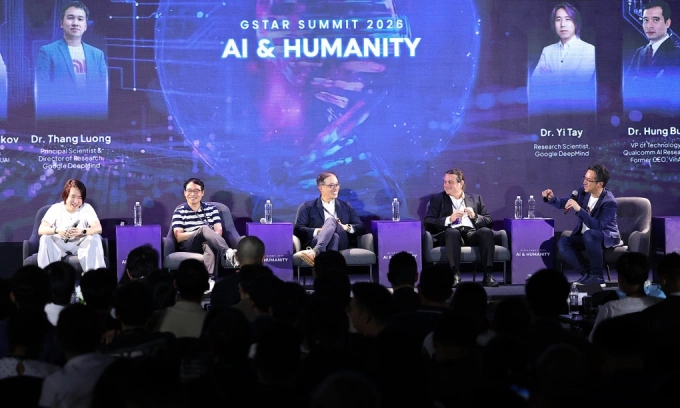
Guest speaker at the GStar Summit held in Ho Chi Minh City on May 29, 2026. Photo credit: VnExpress/Bao Lam |
Dr. Bui Hai Hung, vice president of technology at Qualcomm AI Research, former CEO of VinAI, and former Google DeepMind researcher, said his team came to a similar conclusion while developing AI technology in Vietnam.
Prior to its acquisition by Qualcomm, VinAI had invested heavily in advanced AI models such as GAN-VAE. GAN-VAE combines two AI techniques to generate realistic images, audio, and other data with greater control over the results, and regularly presented its research at major AI conferences.
But the company quickly realized it couldn’t compete directly with organizations with massive GPU resources, and moved to optimizing smaller AI models that retained most of the functionality of larger systems, he said.
Running AI directly on devices such as smartphones is suitable for processing personal data and can reduce resource consumption, protect privacy and minimize delays, he said. He added that Qualcomm AI Research continues to pursue that approach, which has potential applications in wearable devices, robots, smart glasses, and other systems that require near-instantaneous responses.
Yi Tay, a scientist at Google DeepMind, said that while AI has long focused on building increasingly large-scale models, it is entering a new phase. Researchers once believed that simply increasing model size, data volume, and computational power would continue to improve intelligence, but the rise of AI agents has shown that scaling alone is not enough, he said.
Rather than building models from scratch, companies can use open source systems to fine-tune them for specific tasks or develop layers that connect multiple AI components, he said, adding that the greatest impact will come from applying AI to real-world problems.
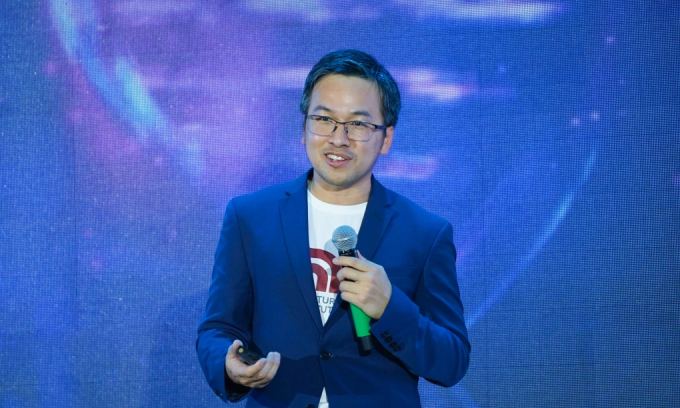
Dr. Luong Minh Tan, research director at Google DeepMind and co-founder of the nonprofit AI organization New Turing Institute (NTI), said the world is moving from the “age of data” to the “age of experiences.” As a result, Vietnamese companies need to place greater emphasis on user experience, he said.
“What AI needs next is to build experiences and build simulations. For example, how do you simulate the world so that AI can move through the real world? How do you simulate virtual cells so that it can validate drugs?”
Wendy Nguyen, co-founder of Pacific Gateway Partners, said Vietnam’s biggest advantage lies not in technology but in talent. “If you look at the Vietnamese people, we are hungry and we are thirsty. We need to keep that going.”
She recalled a conversation with a senior executive who observed that in many countries, as people’s lives improved, motivation waned. However, even though living standards have improved in Vietnam, people maintain a strong desire to progress, she said. “That resilience, that hunger over the years, is what keeps us going.”
He also expressed concern that the global AI startup ecosystem may be overheating. While founders often struggled to raise funding in the past, some startups now raise billions of dollars based largely on their idea and name. He warned that Vietnamese investors should be more cautious and consider whether the AI sector is expanding too quickly.
 |
|
Dr. Luong Minh Tan is research director at Google DeepMind and co-founder of the nonprofit AI organization New Turing Institute. Photo credit: VnExpress/Bao Lam |
Ed H. Chi, Ph.D., vice president of research at Google DeepMind, said developing talent requires developing new skills from an early age, especially the ability to work effectively with AI systems. The most important skill of the future, he said, may not be to answer questions, but to learn the skill of “asking really good questions.”
Current chatbot models are very effective at answering questions, but are “terrible at asking questions,” he said. “I think the next iteration of the technology will ask whether these models are really good at asking questions.”
He said the same principle applies to business, where success often depends on identifying the right problem to solve. He noted that the industry is close to developing AI “engines” with advanced capabilities and should now focus on how the technology can benefit society.
“I think we need to start asking the question, how do we properly use this engine for the benefit of humanity?”
GStar 2026 is part of the annual series of AI events organized by NTI (previously known as VietAI) since 2018 to connect Vietnam’s AI community with global experts. Previous editions featured key figures in AI, including OpenAI CEO Sam Altman and Stanford AI Institute Director Christopher Manning for the 2023 event, and Google Chief Scientist Jeff Dean for the 2024 event.