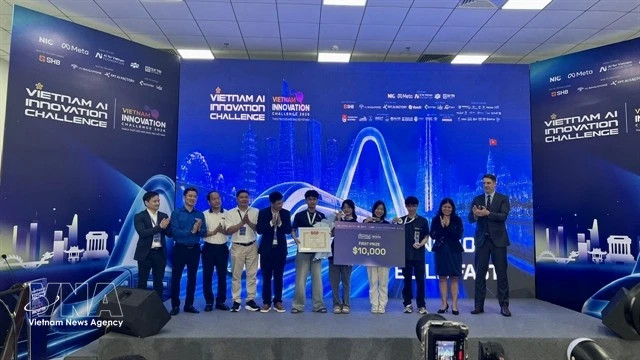
The winning team, L-GPT 6.7, impressed the judges with Lawgic, a legal analytics platform that combines large-scale language models and knowledge graph technology to power legal reasoning and information retrieval. The project won the contest’s top prize of $10,000.
Second place went to Generation for Tangent, an AI platform that transforms user questions into visual learning materials, and third place went to SenAI, which has a real-time translation system between English and Vietnamese.
The annual competition concluded after a 48-hour hackathon that attracted nearly 1,500 participants from 340 teams across the country.
Participants developed AI-powered prototypes under the guidance of industry experts before presenting their products to a panel of judges at a final demo day.
Unlike many previous AI competitions that primarily focused on research and algorithm development, this year’s entries demonstrated a focus on practical deployment, organizers said.
Many of the projects addressed challenges faced by businesses, public services and local governments, and the jury evaluated not only technological innovation, but also commercial potential and real-world applicability.
Dr. Tran The Hung, co-founder and CEO of AI for Vietnam, one of the contest organizers, said the contest aims to build bridges between businesses and young innovators, rather than simply identifying winning AI solutions.
He said the goal is to evolve promising ideas into working products. Hung added that VAIC’s greatest accomplishment was not the prizes, but the perseverance shown by the participants, many of whom continued to work throughout the 48-hour hackathon to complete their projects.
At the closing ceremony, National Innovation Center (NIC) Director Vu Quoc Hui said the quality of this year’s projects reflects the growing maturity of Vietnam’s AI ecosystem and the growing ability of young Vietnamese engineers to develop solutions with commercial potential.
The center said it will continue to support promising teams through its incubation and accelerator programs, providing access to innovation facilities and connecting them with companies, investors and national and international partners to help bring their products to market.
The judging committee included leading AI experts from Vietnam and abroad, including William Tjhi from AI Singapore, Ho Tu Bao from Vietnam Institute for Advanced Study of Mathematics (VIASM), and Nguyen Cam Tu from Nanjing University.
Projects were evaluated for innovation, technical ability, practical application and commercial potential.
Organizers said the challenge is part of efforts to implement Politburo Resolution No. 57-NQ/TW on breakthroughs in science, technology, innovation and national digital transformation by developing AI talent and strengthening cooperation between policymakers, universities, research institutes and businesses.
The competition aims not only to identify promising AI developers, but also to accelerate the commercialization of AI applications and strengthen Vietnam’s innovation ecosystem through closer collaboration between research and industry.
Organizers say the hackathon model allows participants to quickly test ideas, develop prototypes and improve products with direct input from experienced mentors and technical experts.
Truong Quac Anh, director of digital banking at Saigon and Hanoi Joint Stock Bank (SHB), said the bank presented real business problems for contestants to solve, reflecting the growing demand from enterprises for deployable AI applications.
He said SHB hopes competitions like VAIC will help identify solutions that can be adapted for use in banking.
This year’s competition was jointly organized by National Innovation Center, Meta, AI for Vietnam, FPT, and Duy Tan University. VNA