
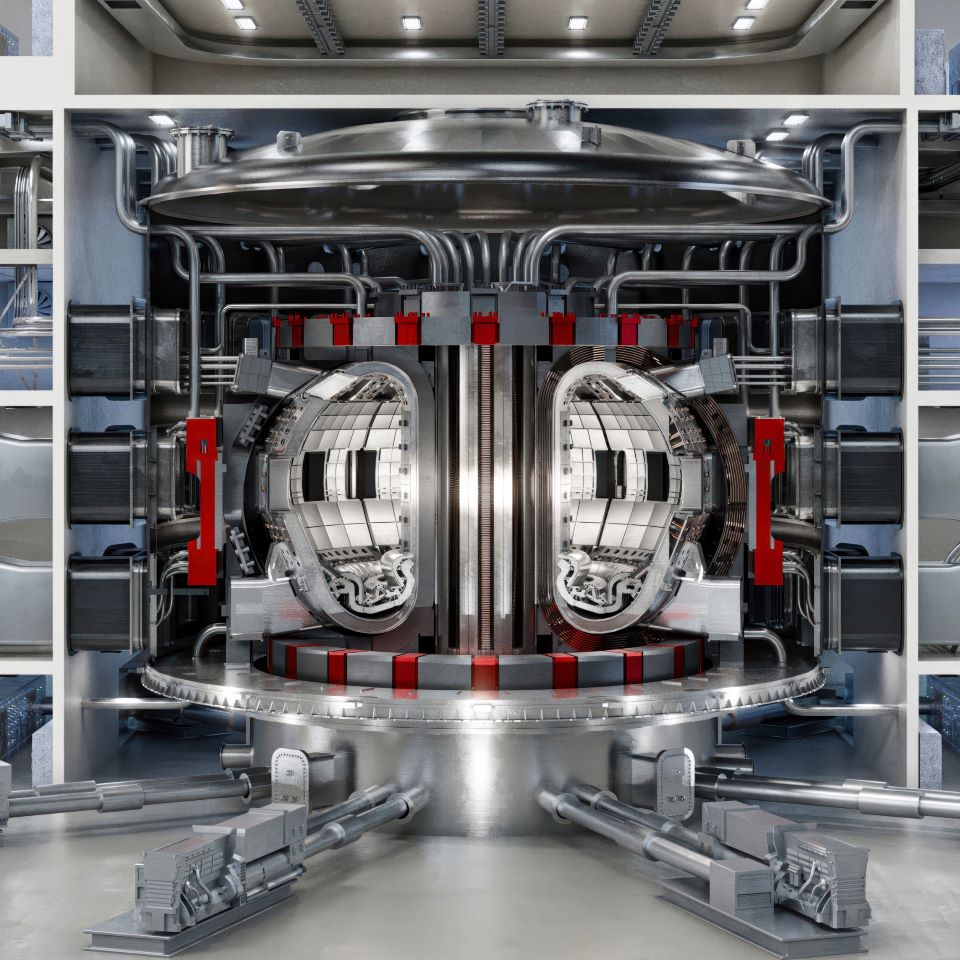
Fusion research aims to replicate on Earth the process that powers the sun. The fusion of atoms requires temperatures exceeding 100 million degrees Celsius, and this holds promise as a rich energy source that does not contain carbon.
But first, researchers need to tame this beast: an ionized gas plasma held in a magnetic field inside a nuclear reactor known as a tokamak. Armed with a recent federal grant, University of Florida researchers are working to do just that.
For Dr. Christopher McDevitt, a plasma physicist and professor in the university’s nuclear engineering program, understanding, predicting, and ultimately preventing the “abnormal” behavior of plasma within tokamaks is a central challenge faced by researchers around the world seeking to harness the energy released by the fusion of atoms.
Two recent projects, one funded by the National Science Foundation and the other by the U.S. Department of Energy/National Nuclear Security Administration, are advancing toward improving the predictability of plasma in tokamaks using cutting-edge AI from UF’s supercomputer HiPerGator.
Inside a tokamak reactor, the extreme heat of the plasma and magnetic confinement cause the fuel nuclei to collide and fuse, releasing large amounts of energy that is absorbed as heat by the walls of the vessel. Like conventional power plants, fusion power plants use this heat to produce steam, which is then used by turbines and generators to generate electricity.
But when the plasma inside a nuclear reactor becomes unstable, bad things can happen.
“At those temperatures, if you suddenly lose control of the plasma, and all of that hot plasma suddenly hits a local area of the reactor wall, you can cause significant damage to the material and structure,” McDevitt explained. “Or worse, high-energy electrons could be created inadvertently, potentially turning a fusion device into a particle accelerator inadvertently. This is interesting physics, but it’s a nightmare scenario for tokamaks.”
Rather than using trial and error to determine the design parameters that produce the most stable plasma, researchers now use machine learning to simulate conditions inside a nuclear reactor and predict plasma anomalies without risking damage to the reactor itself.
McDevitt’s group is harnessing the power of HiPerGator to develop machine learning proxies for these complex plasma events. Recently upgraded supercomputers now allow simulations that previously took days to complete in minutes.
If, with the help of HiPerGator, unstable plasmas can be accurately predicted and ultimately prevented, clean energy from nuclear fusion could be one step closer to reality.


