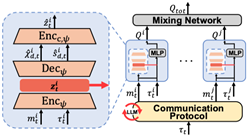
![[CAPTIONS]Overall architecture of the LMAC framework. Research image = UNIST - Seoul Economic News Korea News](https://wimg.sedaily.com/news/cms/2026/07/13/news-p.v1.20260713.d6e10b30e390425e8cfc120c92b7ee3d_P1.png "UNIST develops LLM-based communication design for multiple AI systems")
Overall architecture of the LMAC framework. Research image = UNIST
Researchers have developed a technology that allows large-scale language models (LLMs) such as ChatGPT to design the “communication rules” necessary for multiple artificial intelligence (AI) systems, such as drone swarms and self-driving cars, to avoid collisions and cooperate with each other. This technology is expected to become a foundational tool that will dramatically enhance AI collaboration in complex industrial environments and disaster situations where multiple devices are intertwined.
On the 13th, a research team led by Professor Han Seung-yeol of the Ulsan Institute of Science and Technology (UNIST) Graduate School of Artificial Intelligence announced that they have developed LMAC (LLM-driven multi-agent communication), a technology that uses the advanced inference capabilities of LLM to design and improve communication methods for multi-agent reinforcement learning (MARL).
In systems such as autonomous drones, collaborative robots, and self-driving cars, each device (agent) can only understand part of the overall situation. As a result, the success or failure of the entire mission depends on being able to exchange the information collected. However, existing technology had limitations. Either all the information was shared at once, increasing computational inefficiency, or the AI was unable to semantically determine which information was needed by whom, resulting in information imbalance.
The research team solved this problem by using LLM as a “communication designer” for a multi-agent system. When inputting the purpose of the mission, the role of each AI, and the meaning of observable information in natural language, LLM analyzes them and writes a communication function that selects and transmits only the necessary information as code.
In particular, it is a technology that automatically supplements communication rules based on past reinforcement learning data. The researchers introduced a state awareness index (SAI) that measures how well an agent understands its real-world environment based on the messages it receives. As the evaluation program identifies gaps and errors in information and provides feedback, LLM reflects this by adding reference coordinates and identifying information to accurately refine the communication code.
Efficiency has also improved significantly. Rather than constantly calling the LLM during actual training or mission execution, code pre-completed by the LLM receives each AI observation and generates a message, saving significant cost and computing burden. In addition, each AI has a metacognitive learning structure that does not use the transmitted information as is, but compresses only the core content necessary for collaboration, and judges the reliability of that information on its own.
The performance of LMAC was demonstrated through the popular game StarCraft II. In a task where one reconnaissance unit (Overseer) who can see the enemy and 10 attack units (Baneling) who cannot see in front of them work together to confront the enemy, the AI that applied LMAC recorded a 96.2% win rate. Under the same conditions, the success rate when applying the existing communication methods SMS and TarMAC was only 59.0% and 25.2%, respectively.
Lead author and researcher Bae Sang-jun explained, “Existing research has focused on how to learn messages, and has been limited in determining what information is essentially needed. LMAC maximizes execution efficiency by giving LLM understanding and inference through the task of designing a protocol, and supplementing this with database feedback.”
Professor Han Seung-yeol said, “In the future, it will become an extremely important fundamental technology in real-world environments such as autonomous drones, robot swarms, smart factories, and autonomous driving coordination systems, where multiple AI systems must make decisions and move in coordination with limited information.”
The results of this research were selected and presented at ICML (International Conference on Machine Learning) 2026, the most prestigious international academic conference in the field of machine learning, which was held in Seoul from July 6th to 12th. This research was supported by the Ministry of Science, Information and Communication, the Institute of Information and Communication Technology Planning and Evaluation (IITP), and the National Research Foundation of Korea (NRF).