
In Phase II, the team plans to expand the framework beyond UC’s groundwater observatory by incorporating additional datasets, field sites, and scientific applications. The broader goal is to create a scalable, AI-enabled framework that supports research into critical minerals, geothermal energy, carbon and hydrogen storage, and other underground energy and environmental challenges.
“This project aims to transform the way scientists characterize and predict complex subsurface systems,” Soltanyan said. “Rather than analyzing geological information, geophysical measurements, field observations, and numerical simulations separately, we are developing an AI-enabled integrated science workflow that brings together these various sources of information into a unified framework.
“One of the most exciting aspects of this project is that we are developing a general scientific framework that can be adapted to a variety of subsurface challenges, rather than addressing only a single application,” he said.
Tan will lead the development of the project’s augmented reality interface, allowing researchers to interactively explore spatial datasets and model predictions generated by AI-enabled workflows.
“My primary role is to develop an AI-enabled digital twin that allows scientists to interactively explore the spatial data generated from surrogate predictions,” Tan said.
“We believe that augmented reality and interactive environments are essential to keeping humans informed in the age of AI,” said Tan.
National news outlets such as Politico highlighted the new initiative.
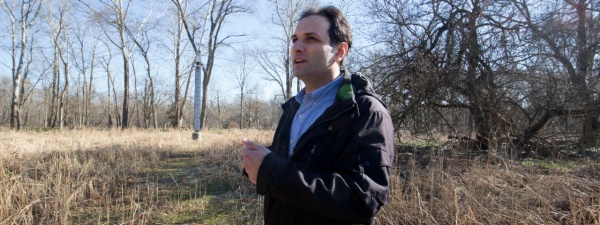
Featured image at top: University of California professor Reza Soltanyan’s project has been selected for a new Department of Energy initiative to use artificial intelligence to accelerate scientific progress. Photo/Andrew Higley/UC


