

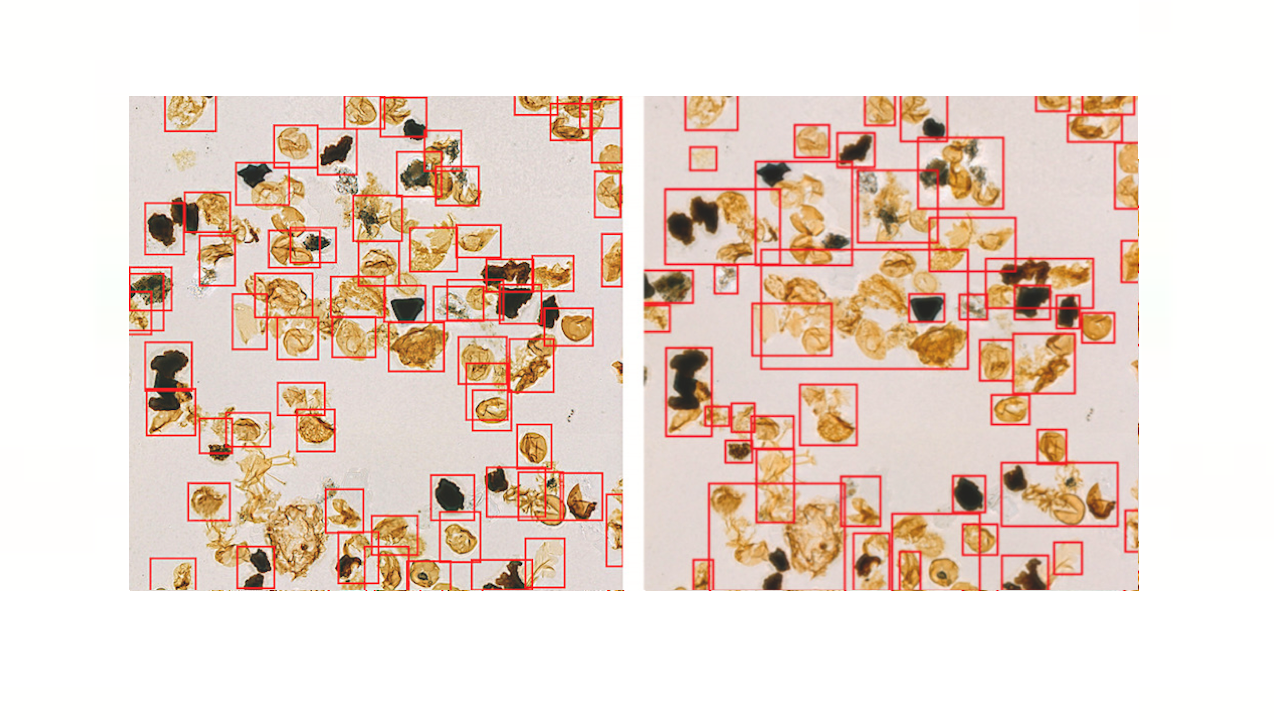
Comparing methods. Comparing methods. Left: Machine learning approach. Right: Standard image processing method pipeline. The machine learning approach isolates more fossils. — Science Direct
Editor's note: The two large rovers that NASA operates on Mars are using AI, i.e. machine learning, both on Earth and possibly on the Mars rovers themselves. Images play a key role as we search for biological signatures and evidence of past life (fossils) and present life. Even on Earth, a trained human eye cannot always pick up obvious signs in a field survey. When it comes to microscopy, you only have a microscope. Even then, it takes time to sort out what you see and what it means. This research shows how machine learning can automate that process and do it more efficiently than humans on Earth. This is exactly what we need for future robotic exploration. Not only can it help the rovers find what they are looking for, it can find it more efficiently and send data back to Earth that has already been parsed and analyzed. And when we send humans to assist the robots, the robots will also greatly benefit from such analytical tools, allowing them to explore further. This research is being done over vast distances with limited communication. Having the intelligence (even if it is human or machine) in the field that is needed to advance and change the research will only accelerate and enhance the search for life.
Microfossil analysis allows us to map the subsurface and understand past geological times. In laboratories around the world, geologists spend countless hours peering through microscopes to identify and count microfossils from sedimentary rocks beneath the ocean floor. This analysis is time-consuming, but important, as the distribution of species can tell us a lot about the geological age of the subsurface sediments, as well as the climatic conditions on the surface when the microfossils formed.

From left to right: An object detection algorithm is trained to detect individual crops (shown by red bounding boxes) from a microscope slide. The detected crops are used to train a self-supervised feature extractor (SSL stands for Self-Supervised Learning). Finally, the feature extractor is used on a small dataset of labeled examples to train a lightweight supervised classifier. This final classifier is trained using the features obtained from the feature extractor, rather than using the images directly. — Science Direct
In a recent study published in the KeAI journal Artificial Intelligence in Geosciences, researchers from the Machine Learning Group at the Arctic University of Tromsø (UiT) in Norway developed an advanced method to automatically detect and analyze microfossils in microscopic images using AI. The team presented their method for automated microfossil detection and analysis in collaboration with industry partner Equinor.
“This study shows that there is great potential for using AI in this field,” said researcher Iver Martinsen, lead and co-corresponding author of the study. “Using AI to automatically detect and recognize fossils may give geologists a tool to better utilize the vast amount of information that well samples provide.”
Microfossils are found everywhere and in abundance, but only a small fraction of the available fossils have been analysed because analysing the data requires time and expertise. The method the researchers used is based on cutting-edge AI techniques, utilising large amounts of raw data provided by the Norwegian Offshore Authority to train an AI model without annotation.
“We used AI to detect fossils in one selected well on the Norwegian continental shelf, and then used 100,000 detected fossils to train an image recognition model,” Martinsen says.
To evaluate the model's performance, the researchers tested it by classifying hundreds of labelled fossils from the same well.
“We are very pleased with the results. Our model exceeds the benchmarks available so far. We hope that this work will be useful for geologists in both industry and academia,” Martinsen added.

Labelled crops. Examples of labelled crops. Descriptions refer to the original annotation. The genus used for the class name is shown in brackets. A: Inaperturopollenites hiatus (Inaperturapollenites). B: Areosphaeridium diktyoplokum (Areosphaeridium). C: Glaphyrocysta sp. (Glaphyrocysta). D: Spiniferites manumii (Spiniferites). – Science Direct

Comparison of methods. Comparison of methods. Left: Machine learning approach. Right: Standard image processing method pipeline. Machine learning approach isolates more fossils. – Science Direct
Researchers Develop New AI Algorithm to Analyze Microfossils, Artificial Intelligence in Geosciences, Science Direct (Open Access)
Astrobiology


