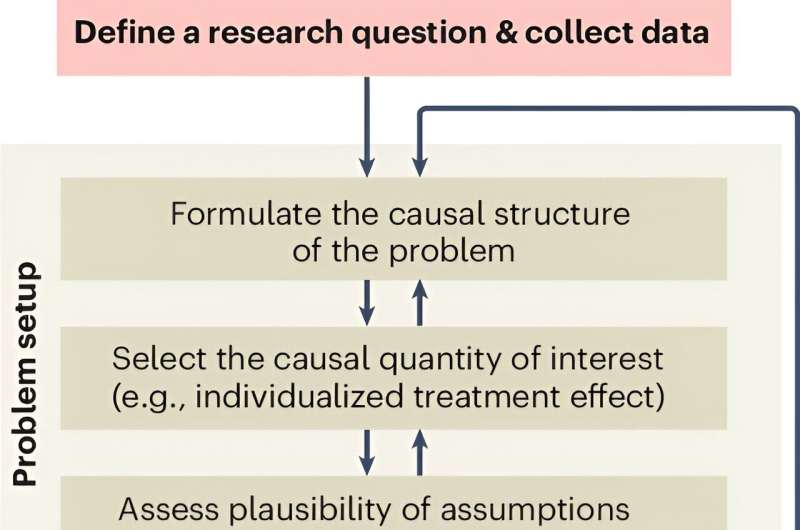
Causal machine learning workflow in medicine. Credits: Nature Medicine (2024). Publication date: 10.1038/s41591-024-02902-1
Machines can not only make predictions but also learn to process causal relationships, which an international research team shows could make medical procedures safer, more efficient and more personalised.
Artificial intelligence techniques are useful in a variety of medical applications, such as radiology and oncology, where the ability to recognize patterns in large amounts of data is essential. In these types of applications, AI compares information with learned examples to draw conclusions and make inferences.
Now, an international team led by researchers from the Ludwig Maximilian University of Munich (LMU), including researchers from the University of Cambridge, is exploring the potential of the relatively new field of AI in diagnosis and treatment.
Researchers have found that causal machine learning (ML) can predict treatment outcomes and does so better than previously commonly used machine learning methods. Causal ML can help clinicians personalize treatment strategies to improve individualized patient health outcomes.
The results reported in the journal Nature Medicinesuggests how causal machine learning could improve the efficacy and safety of various medical treatments.
Traditional machine learning recognizes patterns and finds correlations. But machines cannot understand the principles of cause and effect, and they cannot answer the question, “why.” When making treatment decisions for patients, knowing “why” is essential to ensure the best possible outcome.
“Developing machine learning tools that answer 'why?' and 'what if?' questions empowers clinicians by enhancing their decision-making process,” said senior author Professor Mihaela van der Schaal, director of the University of Cambridge's Centre for Medical AI. “But this kind of machine learning is much more complex than assessing an individual's risk.”
For example, when trying to make treatment decisions for people at risk of developing diabetes, traditional machine learning aims to predict the probability that a given patient with various risk factors will develop diabetes.
Causal ML can be used to measure how risk changes when a patient takes an antidiabetic drug, i.e., the causal effect, and to estimate whether metformin, a commonly prescribed drug, is the best treatment or whether an alternative treatment plan would be better.
To predict the effects of hypothetical treatments, AI models need to be able to answer the question “What if?” “We give the machine the rules to recognise the causal structure and to correctly formulate the problem,” says LMU professor Stephan Feueriegel, who led the study. “The machine then needs to recognise the effect of the intervention and, so to speak, learn to understand how the data fed into the computer are reflected in real-world results.”
Even in situations where a reliable standard of care does not yet exist, or where randomized studies are not possible for ethical reasons because they always include a placebo group, the researchers hope that the machine will be able to assess potential treatment outcomes from available patient data and generate hypotheses for possible treatment plans.
With such real-world data, it will generally be possible to estimate and describe patient cohorts more accurately than ever before, bringing personalized treatment decisions closer. Of course, challenges will remain in ensuring the reliability and robustness of the methods.
“The software required for causal ML methods in medicine does not exist off-the-shelf,” says Professor Feuerriegel, “rather, it requires complex modelling of the respective problem, which requires close collaboration between AI experts and physicians.”
Feuerriegel explains that in other fields, such as marketing, research into causal machine learning has already been in the testing phase for several years. “Our goal is to bring the technique one step closer to practice,” he said. The paper describes the direction in which things could go in the coming years:
“I have been working in this field for almost a decade, working tirelessly with generations of students in our lab to understand this problem,” said van der Schaal, who is part of the School of Engineering, School of Applied Mathematics and Theoretical Physics, and School of Medicine.
“This is an incredibly challenging area of machine learning, and it's very satisfying to see it move closer to clinical use and empower both clinicians and patients.”
Professor van der Schaa continues to work closely with clinicians to validate these tools in different clinical settings, including transplantation, cancer and cardiovascular disease.
For more information:
Stefan Feueriegel et al. “Causal Machine Learning for Predicting Treatment Outcomes” Nature Medicine (2024). Publication date: 10.1038/s41591-024-02902-1
Provided by University of Cambridge
Quote: Training AI models to answer “what if” questions could improve medical treatments (June 14, 2024) Retrieved June 14, 2024, from https://techxplore.com/news/2024-06-ai-medical-treatments.html
This document is subject to copyright. It may not be reproduced without written permission, except for fair dealing for the purposes of personal study or research. The content is provided for informational purposes only.