

Currently, there are only seven companies in the world with a market capitalization of more than $1 trillion. If you rank those companies from largest to smallest, microsoft, apple, Nvidia, alphabet, Amazon, saudi oiland meta platform.
The obvious theme here is that most of these companies operate in the technology sector. Additionally, in the technology space, Microsoft, Alphabet, and Amazon all have in common that they are dominant forces in cloud computing and artificial intelligence (AI).
Beyond the mega-cap tech companies, I see another player quietly emerging at the intersection of cloud AI infrastructure.Let's take a closer look at how oracle (NYSE:ORCL) has made significant advances in AI and analyzes the company's path to a $1 trillion valuation.
Oracle Greenfield Opportunities
According to Statista, Amazon is the top cloud infrastructure provider with a 31% market share at the end of the first quarter of this year. Microsoft and Alphabet round out the top three with 25% and 11% market share, respectively. With only 2% market share, Oracle is well behind the big technology companies.
However, Oracle's performance over the past few quarters has been quite impressive. For example, through the first nine months of Oracle's fiscal year 2024 (ending February 29), the company's cloud services revenue increased 26% year over year to $14.5 billion. Notably, in the most recent quarter, cloud services grew 25% year over year to $5 billion. By contrast, Amazon's cloud business grew 17% year over year in its most recent quarter.
Amazon is a much larger cloud operation, but Oracle is currently growing at a faster pace. I think this shows that cloud infrastructure in general is experiencing accelerated growth and that businesses are using platforms outside of the top three providers. These secular tailwinds should bode well for Oracle over the long term.

Demand is at record levels
One of the most important metrics that Oracle reports, other than revenue, is remaining performance obligation (RPO). RPO is important because it provides investors with a preview of revenue that has been accounted for but not yet recognized.
As of the end of the most recent quarter, Oracle's RPO increased 29% year-over-year to a record $80 billion. Additionally, management told investors on the earnings call that approximately 43% of these RPOs will be recognized as revenue over a 12-month period.
Given that Oracle's backlog is growing faster than its reported revenue, I think it's safe to say that demand for the company's cloud services is strong.
Can Oracle become a trillion dollar business?
The graph below shows analyst consensus forecasts for Oracle's revenue and earnings per share (EPS) for the next few years. Although these metrics are expected to accelerate, the growth rate may appear to have slowed somewhat when compared to other SaaS (Software-as-a-Service) providers.
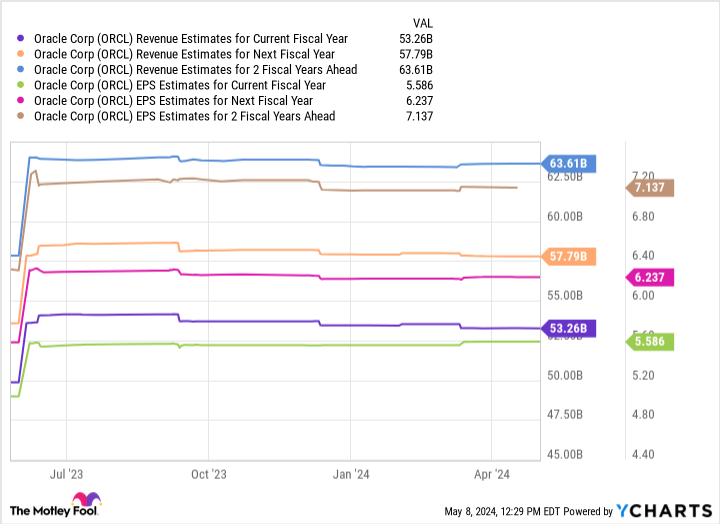
One reason for this is the slowing growth of Oracle's on-premises business. In the first nine months of fiscal year 2024, Oracle's on-premises cloud operations generated $3.2 billion in revenue. This is an 11% annual decline.
While this may seem like a drawback or a risk, it actually makes some sense. As on-premises services move to the cloud, Oracle actually has an opportunity to shift this slowing element of its business into a new axis of growth.
Given Oracle's position in the cloud market relative to giants like Microsoft, Amazon, and Alphabet, the general consensus is that it will take more time for the company to scale, and I agree. Masu.
Currently, Oracle's market capitalization is approximately $320 billion, and the company's price-to-sales (P/S) multiple is just 6.3x. It's easy to see that Oracle in particular is trading at a deep discount to Microsoft and slightly lower than Alphabet.
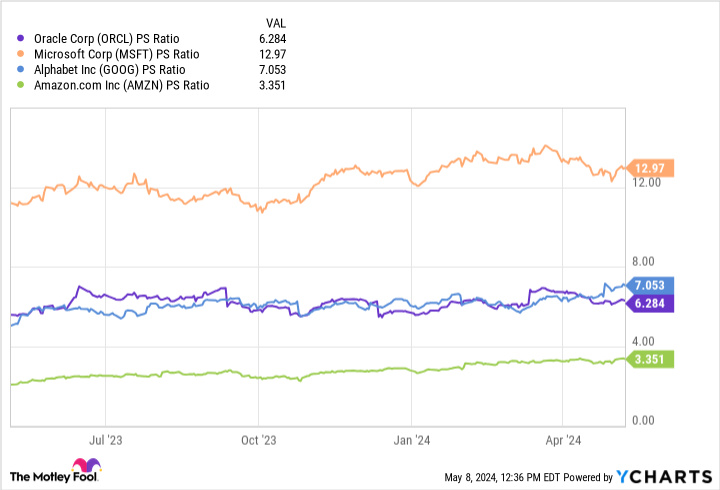
Given Oracle's growth rate and the opportunity to turn its on-premises business into a major growth engine, I think there's a good argument that the company's valuation could rise significantly over the long term. – Perhaps the above estimates are a bit conservative.
In other words, as cloud database management continues to be a key pillar of the overall AI narrative and digital transformation efforts at the enterprise level, Oracle's valuation multiple will eventually see significant expansion, and the company will someday reach a trillion dollar valuation. This means that there is a possibility of reaching this position.
But what investors must realize is that this transition will take time. I think Oracle has made some legitimate progress in the heated cloud market. I view Oracle as a very strong buying opportunity in the cloud infrastructure business, and holding the stock for the long term should reward you handsomely.
Should you invest $1,000 in Oracle right now?
Before purchasing Oracle stock, consider the following:
of Motley Fool Stock Advisor Our analyst team has identified what they believe Best 10 stocks For investors to buy now…and Oracle wasn't among them. These 10 stocks have the potential to generate impressive returns over the next few years.
when to think about it Nvidia This list was created on April 15, 2005…if you invested $1,000 at the time of recommendation. you have $550,688!*
stock advisor provides investors with an easy-to-understand blueprint for success, including guidance on portfolio construction, regular updates from analysts, and two new stocks each month.of stock advisor For the service more than 4 times The resurgence of the S&P 500 since 2002*.
See 10 stocks »
*Stock Advisor returns as of May 6, 2024
Alphabet executive Suzanne Frye is a member of The Motley Fool's board of directors. John Mackey, former CEO of Amazon subsidiary Whole Foods Market, is a member of the Motley Fool's board of directors. Randi Zuckerberg is a former head of market development and spokesperson at Facebook, sister of Meta Platforms CEO Mark Zuckerberg, and a member of the Motley Fool's board of directors. Adam Spatacco has held positions at Alphabet, Amazon, Apple, Meta Platforms, Microsoft, and he has Nvidia. The Motley Fool has positions in and recommends Alphabet, Amazon, Apple, Meta Platforms, Microsoft, Nvidia, and Oracle. The Motley Fool recommends the following options: A long January 2026 $395 call on Microsoft and a short January 2026 $405 call on Microsoft. The Motley Fool has a disclosure policy.
“Prediction: This artificial intelligence (AI) cloud stock will join Microsoft, Alphabet and Amazon in the $1 trillion club” was originally published by The Motley Fool.


