Integrating artificial intelligence (AI) in healthcare will transform medical practice by increasing the accuracy and efficiency of diagnosis and treatment planning. By leveraging advanced algorithms, AI supports a wide range of applications, from detecting anomalies in medical images to predicting disease progression, increasing the overall effectiveness of medical interventions.
One of the main hurdles in implementing AI in healthcare is ensuring the accuracy and reliability of AI predictions, especially when data is lacking. Due to privacy concerns and the specialized nature of medical data, small datasets are common in the healthcare industry and often limit the information available for training AI systems. This shortfall challenges AI's ability to learn effectively and provide reliable results. This is critical when these results directly impact patient care.
Existing research on medical AI includes innovative models like TranSQ that enhance medical report generation through semantic query capabilities. Advanced NLP techniques improve the management of electronic medical records and make it easier to extract valuable information. Clinical applications of AI, such as GPT-3, will revolutionize diagnosis and clinical decision-making. BioBERT and BlueBERT are pre-trained on biomedical text and significantly improve disease classification accuracy. Additionally, initiatives like deep Gaussian processes address the black-box nature of AI, increasing interpretability and promoting user trust in medical applications.
Researchers from renowned institutions such as the University of Southampton, the University of New South Wales, the UAE's Institute for Technology Innovation, and the UK's Thomson Reuters Institute have collaborated to introduce a Bayesian Monte Carlo dropout model to improve confidence in AI predictions in healthcare. Increased sex. Unlike traditional methods, this approach utilizes Bayesian inference and Monte Carlo techniques to effectively manage uncertainty and data scarcity. Integrating a kernel function adjusts the model's sensitivity to the unique dynamics of medical datasets, significantly increasing predictive accuracy and model transparency.
This methodology integrates Bayesian inference and Monte Carlo dropout techniques and leverages kernel functions to effectively handle sparse data. The model was rigorously tested using SOAP, medical transcription, and ROND clinical text classification datasets selected for diverse medical contexts and data challenges. The Bayesian Monte Carlo dropout approach systematically assesses prediction uncertainty by incorporating prior knowledge through a Bayesian prior distribution and assessing variability through a dropout configuration. This process increases the reliability and applicability of the model in medical diagnosis and provides a quantifiable measure of the reliability of the output. This is essential for high-stakes medical decision-making.

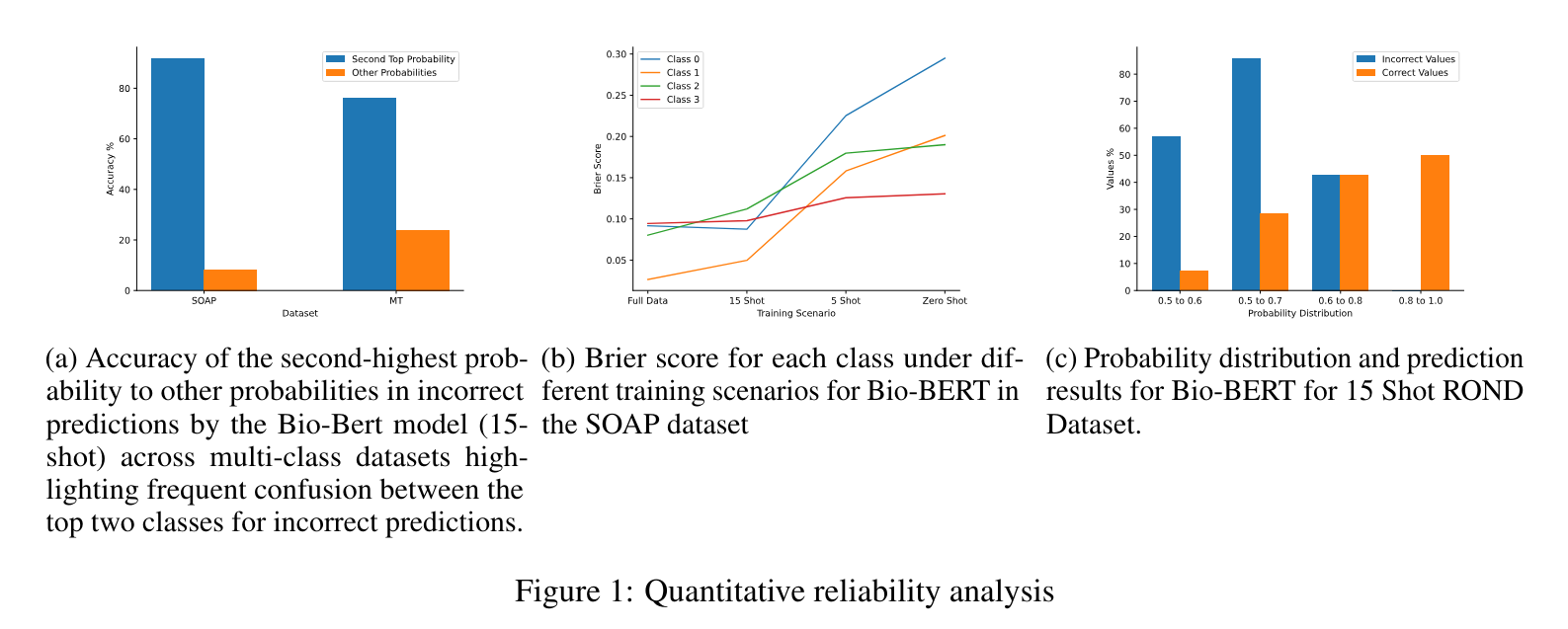
Bayesian Monte Carlo dropout models demonstrated significantly improved prediction reliability. On the SOAP dataset, we achieved a Brier score of 0.056, indicating high prediction accuracy. Similarly, on the ROND dataset, the model outperforms traditional methods with an F1 score of 0.916 and maintains a low Brier score of 0.056, confirming its effectiveness across a variety of settings. Results for the medical transcription dataset show significant improvement in model reliability and consistent improvement in prediction accuracy, as evidenced by a significant reduction in prediction error rate compared to the baseline model. I showed that.
In conclusion, this study introduces a new Bayesian Monte Carlo dropout model that significantly improves the reliability and transparency of AI predictions in medical applications. The model demonstrates robust performance across a variety of medical datasets by effectively integrating Bayesian inference with Monte Carlo techniques and kernel functions. The proven ability to quantify prediction uncertainty not only brings measurable improvements to AI-powered medical diagnostics, but also has the potential to directly impact patient care, making AI more effective in healthcare. It paves the way for technology to become more widely accepted and trusted.
Please check paper. All credit for this study goes to the researchers of this project.Don't forget to follow us twitter.Please join us telegram channel, Discord channeland LinkedIn groupsHmm.
If you like what we do, you'll love Newsletter..
Don't forget to join us 40,000+ ML subreddits


Nikhil is an intern consultant at Marktechpost. He is pursuing an integrated double degree in materials from the Indian Institute of Technology, Kharagpur. Nikhil is an AI/ML enthusiast and is constantly researching applications in areas such as biomaterials and biomedicine. With a strong background in materials science, he explores new advances and creates opportunities to contribute.