

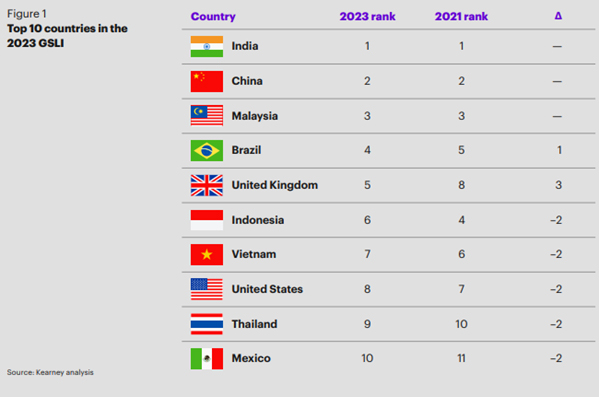
- The UK climbs to fifth place in the Global Service Location Index, marking the first time a Western economy is in the top five.
- A strong investment and focus on digital skills training has lifted the UK rankings in 2023.
- India, China and Malaysia continue to lead as the world’s most attractive destinations for offshore services.
Global management consultancy Kearney today released the 12th edition of its Global Service Location Index (GSLI). It explores the key factors that make each country attractive as a potential location for offshore business services. India, China and Malaysia continue to hold the top spot this year, while Brazil and the UK make the top five.
In an era of rapidly evolving technology and ever-changing trends, business services such as IT, business process outsourcing, and engineering are increasingly being delivered across borders as companies look to reduce costs, expand talent, and leverage more of their global talent base to increase efficiency. The global market for business services has also grown from USD 624 billion (£476 billion) in 2022 to USD 681 billion (£519 billion) in 2023 and is expected to grow at a CAGR of 8% to 2027, increasing the demand for such services.
To evaluate and compare offshoring candidate locations, this year’s GSLI ranked 78 countries based on 52 indicators across four dimensions: financial attractiveness, talent skills and availability, business environment, and digital resonance.
A key trend at GSLI this year is the importance of talent regeneration**. As more tasks and processes are automated with the advent and adoption of digital technologies, cost-centric service locations are at risk of losing their competitive edge against more developed and technologically advanced countries. The regeneration of talent will therefore be at the heart of this change.
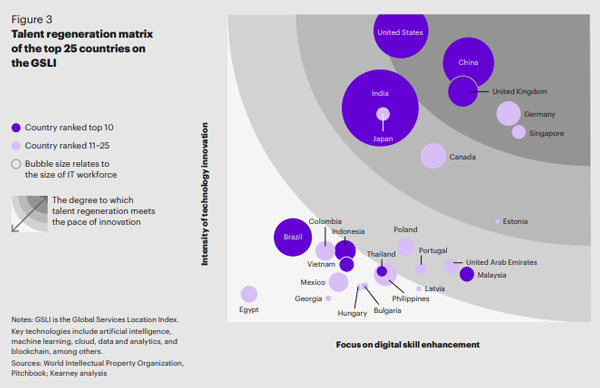
The UK tech sector is a $1 trillion (£800 billion) economy, trailing the US and China, making it one of the strongest ecosystems in Europe. Earlier this year, the government announced it would invest £100m in funding for the Foundation Model Task Force, which is responsible for accelerating Britain’s capabilities in a rapidly emerging type of artificial intelligence. The investment is part of the UK’s ambition to become a science and technology powerhouse by 2030 and will boost the sector, which already employs 3 million UK workers and includes world-class companies.
The country has the highest number of technology patents filed in emerging technologies such as AI/ML, automation, blockchain, robotics and other digital technologies, making it a front-runner in the technology sector in the region.
Ramyani Basu, Digital Transformation Partner, commented:
“The skills of the workforce and the digital outcomes of business operations are becoming important factors in determining the performance of the country. The UK’s rise in the rankings is partly due to its heavy investment in digital training, newly announced government programs and funding companies that increase the potential for talent regeneration.
“Taking advantage of the potential of technological advances such as AI presents enormous opportunities to grow economies, create more jobs and continue to lead the region. It is critical that countries build strong talent pipelines and robust business environments that will not only meet the needs of today, but also those of future generations.
About the 2023 GSLI and Country Ranking Methodology
The 78 countries for the 2023 Global Service Location Index were selected based on business opinion, current remote service activity, and government efforts to promote the sector. These were evaluated against 52 metrics across four main categories: Financial Attractiveness, Talent Skills and Availability, Business Environment, and Digital Resonance. This year, Kearney made the Index more forward-looking, refocusing on capturing digital resonance and the regenerative capacity and availability of talent. In the process, several metrics were removed from his traditional IT-focused Talent Skills Availability and Digital Resonance pillars, and new digital-focused parameters were added. In addition to this, global trends and key regional disruptors have resulted in notable differences in some country rankings.
Click here to access the report.


