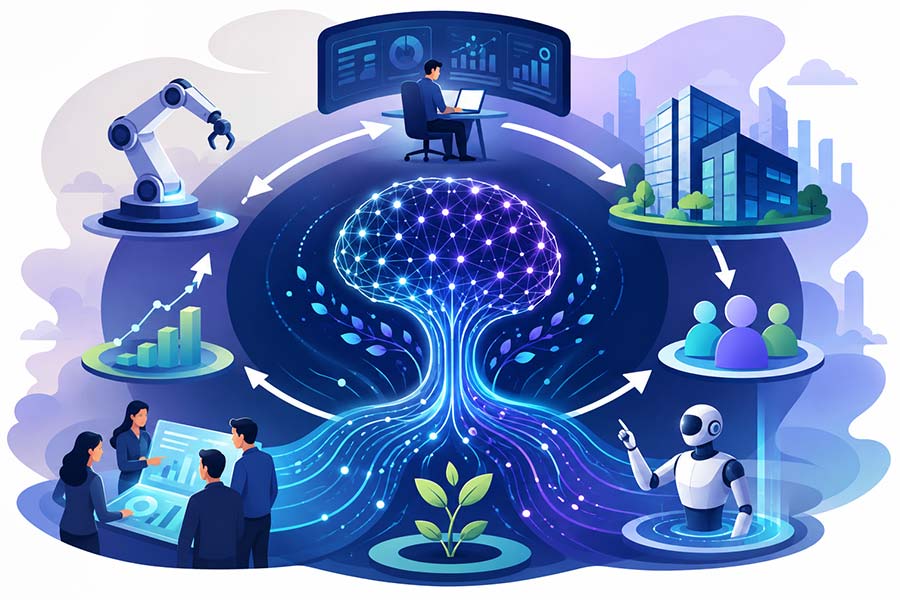
Never before has the pace of technological innovation been faster and businesses are operating in an environment of continuous disruption. AI, cloud computing, automation, edge technologies and digital ecosystems are revolutionizing industries at a pace never seen before, while changing customer expectations, changing regulations, geopolitical uncertainties and competitive pressures are redefining the global business landscape. Companies are not competing on the quality of their products or services anymore, they are competing on how fast they can learn, adapt and respond to change. In this environment, enterprises need intelligent systems that evolve continuously, not static technologies that become outdated quickly.
Traditional AI has undoubtedly revolutionized modern business by automating repetitive tasks, enhancing decision-making, and providing valuable predictive insights. But most traditional AI systems are trained on historical data sets and deployed with pre-defined models that are not significantly changed until they are manually retrained or updated. But as market conditions change, customer behaviours change, operational requirements get more complex, these static AI models become less and less relevant and accurate over time. Their inability to adapt continuously limits their effectiveness in organizations that need to make decisions in real time in fast-changing environments. The consequence is that organizations are finding that AI can’t just automate yesterday’s processes, but must learn from today’s experiences to solve tomorrow’s problems.
Static automation has similar limitations. Rule-based workflows work well when business processes are predictable, but they fail when the unexpected occurs and when flexibility, context or autonomous decision making are needed. Organizations need systems that can change their behaviour without waiting for manual intervention whether they are dealing with supply chain disruptions, cybersecurity threats, workforce changes or changing customer demand. This growing demand has led to an increased search for smart platforms that are able to evolve on their own, improving their knowledge with each interaction, transaction and operational result.
This shift has led to a new breed of intelligent enterprises powered by Living AI. Unlike legacy AI systems built on rigid models, Living AI keeps learning from enterprise data, employee interactions, operational feedback, customer behavior, and business decisions. Each completed workflow, each customer interaction, each operational occurrence represents an opportunity for the system to learn and enhance its future performance. Instead of being set in stone after deployment, Living AI evolves with the organization it serves, creating enterprise intelligence as a dynamic, self-improving capability.
Living AI is the next evolution of enterprise intelligence, integrating continuous learning, adaptive decision-making, autonomous optimization and contextual reasoning into a single AI ecosystem. Living AI is powered by technologies such as online machine learning, reinforcement learning, knowledge graphs, multi-agent intelligence and real-time analytics, which enable enterprises to proactively respond to emerging opportunities and challenges. Instead of relying on occasional software upgrades or manual model retraining, organizations get intelligent systems that learn from new information as it becomes available, so recommendations and decisions remain relevant as business conditions change.
The impact of Living AI is much more than just operational efficiency. It allows organizations to create enterprise-wide learning capabilities that integrate people, processes and technology into continuously improving ecosystems. AI systems that can capture organizational knowledge, identify emerging patterns, optimize workflows and recommend more effective actions over time have the potential to improve many business functions, including human resources, finance, operations, customer service, IT, procurement and supply chain management. This results in enterprises that are more intelligent with every decision they take, not just following pre-defined instructions.
Let us examine the rise of Living AI and how it is helping to build self-evolving enterprises that never stop learning. It explores the idea of Living AI and its transition from traditional automation, the underlying technologies that power continuous enterprise learning, its architecture and business applications, the strategic benefits it provides, the challenges organizations need to overcome, and the future of AI-powered adaptive enterprises. In the end, Living AI is emerging as the cornerstone of robust, intelligent organizations capable of learning, innovating, and evolving continuously with shifting business landscapes and customer demands.
Also Read: AiThority Interview with Gou Rao, co-founder and CEO at NeuBird AI
Understanding Living AI
Over the past decade, artificial intelligence has made enormous strides, moving from simple task automation to a core element of enterprise decision-making and operational management. Traditional AI systems have achieved impressive gains in efficiency and productivity, but typically utilize static models that must be manually re-trained and updated periodically.
As organizations operate in increasingly dynamic environments, these static AI systems are ill-equipped to keep pace with shifting customer expectations, evolving business strategies, market disruptions, and regulatory requirements.
Living AI is the next step of this evolution. Living AI learns from what enterprises are doing, adapting to changing conditions and refining its knowledge over time, unlike a static software solution. It makes artificial intelligence a living, evolving enterprise capability that gets better with each interaction and enables organizations to be more intelligent, resilient and responsive.
What is Living AI?
Living AI is what we call intelligent systems that continue to learn and evolve post deployment with new data, business processes, interactions with employees, customer behaviour and operational results. Unlike traditional AI models that are static in nature and require manual retraining, Living AI is dynamic and updates its understanding in near real time, enabling organizations to take proactive action on new opportunities and challenges.
Living AI is a combination of continuous machine learning, enterprise knowledge management, autonomous reasoning and adaptive decision-making that builds self-improving business ecosystems. Each enterprise action is an opportunity to learn . Over time the system can improve its recommendations , automate more and more complex workflows , and improve the quality of decisions .
For living AI, deployment is not the end of the AI implementation process, but the start of an ongoing learning cycle. The more the enterprise uses the system, the more capable the AI becomes, the more context aware.
Living AI Core Components:
- Continuously evolving AI systems after deployment
- Real-time learning from enterprise interactions
- Autonomous knowledge accumulation
- Continuous adaptation to changing business conditions
- Dynamic decision-making capabilities
- Enterprise-wide contextual intelligence
- Self-improving operational performance
Living AI enables enterprises to move from reactive operations to proactive and predictive business management by constantly increasing its organizational knowledge.
a) Living AI-Characteristics
Living AI is unlike previous generations of enterprise AI in that it is not confined to operate within fixed boundaries, but it instead continuously evolves. It’s the combination of learning, reasoning, automation and optimization that creates an intelligent ecosystem which can learn and improve itself through its operational lifecycle.
One of the features that set it apart is the ability to learn continuously. Living AI doesn’t just use historical data sets, but constantly ingests new information from enterprises to inform its decision-making. This means the system can keep its accuracy as customer preferences, market conditions and organizational priorities change.
Another key ability is adaptive decision-making. Living AI considers the real business context before making recommendations, enabling it to adapt decisions based on the real-time environment, rather than a set of pre-defined rules. This flexibility makes organizations more nimble and responsive.
Context awareness improves decision quality by including relationships among employees, customers, departments, operational activities and external market events. Living AI doesn’t just analyze individual data points; it understands how enterprise activities relate to one another.
The technology also supports self-optimization, identifying opportunities to improve workflows, reduce inefficiencies, allocate resources more effectively and optimize enterprise performance without being constantly overseen by humans.
Living AI has advanced reasoning abilities that enable it to consider multiple scenarios and propose actions accordingly. It does not simply perform programmed instructions but assesses potential outcomes and determines the best course of action.
Living AI: Key Characteristics:
- Continuous learning from enterprise data & experience
- Adaptive decision making under changing business conditions
- Context-aware intelligence for departments and workflows
- Self-optimization of enterprise processes and operations
- Autonomous reasoning for complex business decisions
- Enterprise-wide intelligence connecting people, data, and systems
- Continuous feedback integration for ongoing improvement
These qualities transform AI from a static software program to an intelligent enterprise asset that grows with the business.
b) Evolution of Enterprise AI
The journey to Living AI is a story of decades of advances in enterprise intelligence technology. With each generation of AI, companies have become more capable of automating work, analyzing data and informing business decisions. Living AI builds on these advances and overcomes many of the limitations of earlier technologies.
The early enterprise systems were very rule-based, where all actions were driven by pre-defined business rules. Such systems were efficient for repetitive and structured tasks but had little flexibility and could not intelligently react to unexpected situations.
The introduction of machine learning was a huge leap forward, allowing systems to recognize patterns in historical data and increase the accuracy of their predictions. Machine learning diminished the need for manually coded rules, but still necessitated periodic retraining and curated datasets.
With the evolution of AI, predictive AI allowed organizations to predict future events, customer behavior, operational risks and market trends using statistical modelling and advanced analytics. Businesses had valuable insights but static learning cycles limited them.
With the arrival of generative AI came systems that can create new content, write software code, summarise information, support employees and accelerate knowledge work. Generative AI was a big productivity booster for the enterprise, expanding AI’s role from prediction to creativity and communication.
More recently, Agentic AI released autonomous software agents that can autonomously plan tasks, coordinate workflows, communicate with other systems, and complete multi-step goals with minimal human supervision. These smart agents are an important step in moving the enterprise toward autonomy.”
Living AI takes it even further and integrates continuous learning, adaptive reasoning, enterprise memory and autonomous optimization into a single unified intelligence ecosystem. Living AI does not work as isolated AI models, but as organizations that are constantly evolving, learning and improving all areas of business performance.
Evolution of Enterprise AI:
- Rule-based automation for repetitive business processes
- Machine learning for pattern recognition and predictive analysis
- Predictive AI for forecasting business outcomes and risks
- Generative AI for intelligent content creation and knowledge assistance
- Agentic AI for autonomous workflow execution and decision support
- Living AI for continuously learning, self-evolving enterprise ecosystems
- AI-native enterprises that continuously adapt, innovate, and optimize operations
At the same time, as enterprise intelligence evolves, Living AI will become the foundation of tomorrow’s organizations. Living AI will enable organizations to learn and adapt continuously and at speed and to be resilient in the face of an ever more dynamic digital economy.
Core Technologies Enabling Living AI
Living AI is a big leap for enterprise intelligence, because it is a combination of multiple AI technologies, not isolated algorithms, and it is an evolving ecosystem. Unlike traditional AI systems that need to be retrained and manually updated, Living AI continuously learns, adapts to the changing business environment and improves decision-making via continuous learning. This is possible through a combination of machine learning, reinforcement learning, enterprise knowledge management, intelligent agents, real-time analytics, and responsible AI frameworks.
Together these technologies allow organizations to create intelligent systems that automate business processes and adapt to the enterprise, getting more accurate, efficient and context-aware over time.
a) Continuous Machine Learning
Machine learning models are typically trained on historical datasets prior to deployment. Although these models are effective initially, they tend to lose accuracy over time as customer behaviours, operational processes and market conditions change. Living AI solves this limitation with continuous machine learning that enables models to update themselves with new enterprise data without requiring complete retraining.
Continuous machine learning allows organizations to react to changing business environments quickly. Instead of waiting for scheduled model updates, AI systems integrate new experiences, refine predictions, and improve recommendations in real time, all the time. This ensures that enterprise intelligence remains relevant as business priorities change.
Living AI learns continuously from operational data, customer interactions, financial transactions and workforce activities, keeping decision accuracy high and reducing manual intervention from data science teams.
Advantages of Continuous Machine Learning:
- Online learning algorithms that make use of new information in a continual
- Incremental upgrades to models, without rebuilding the entire AI model
- Real-time retraining on live enterprise data
- Feedback-driven optimization for continuous improvement
- Faster adaptation to changing business environments
- Improved prediction accuracy over time
- Reduced model degradation and AI drift
Continual machine learning allows organizations to make AI a living system that evolves as the business does.
b) Reinforcement Learning
Reinforcement learning enables AI systems to improve at what they do by learning from experience. The system learns not only from historical data sets, but also from interaction with its environment. It considers the results of its actions and modifies its future behavior based on the rewards or penalties it receives.
Enterprise systems can continuously optimize their decisions with Living AI’s reinforcement learning. AI agents trial and error various approaches, analyze business outcomes, and eventually hone in on those strategies that maximize organizational performance. The system gets better and better over time with not too much manual programming.
This is especially true in dynamic environments where optimal decisions depend on changing variables, such as supply chain management, workforce scheduling, pricing strategies, and customer engagement.
Reinforcement Learning: Key Features:
- Reward-driven adaptation to enterprise objectives
- Continuous decision optimization
- Autonomous experimentation with alternative strategies
- Long-term learning from operational outcomes
- Dynamic policy improvement
- Intelligent resource optimization
- Continuous performance enhancement
Reinforcement learning allows Living AI to get smarter through practical experience rather than static programming.
c) Enterprise Knowledge Graphs
Knowledge is one of the most valuable assets an organization possesses, yet it is often scattered throughout departments, documents, databases, e-mail and enterprise applications. Enterprise knowledge graphs take this information and organize it into relationships that are linked together so that Living AI can understand not only individual data points, but also how they relate to each other.
Unlike traditional databases, knowledge graphs create rich networks of employees, customers, products, projects, suppliers, financial information and operational activities, rather than simply storing isolated records. This interconnected structure gives Living AI an understanding of context that greatly improves reasoning and decision making.
Knowledge graphs also aid in the preservation of organizational memory by capturing institutional knowledge that could otherwise be lost as employees leave or business processes change.
The Benefits of Enterprise Knowledge Graphs:
- Centralized organizational memory
- Relationship mapping across enterprise data
- Context preservation for better decision-making
- Semantic intelligence for improved understanding
- Enterprise-wide knowledge discovery
- Faster information retrieval
- Improved collaboration across departments
Enterprise knowledge graphs enable Living AI to reason more intelligently, by understanding relationships instead of just analyzing isolated datasets.
d) Multiagent Intelligence
Living AI goes beyond isolated AI models to a collection of specialized AI agents working collaboratively toward enterprise goals. Each AI agent specializes in a specific business function and communicates with other agents to coordinate complex workflows.
For example: HR agents may work with finance agents during workforce planning . Procurement agents may work with supply chain agents to optimize purchasing decisions . These distributed AI systems collaborate to allow organizations to automate advanced cross-functional processes.
The multi-agent intelligence is more scalable because specialized agents can work independently to solve problems, but also contribute to decision-making across the enterprise.
Multiple Agent Intelligence Abilities:
- AI agents working together across business functions
- Distributed reasoning on multiple intelligent systems
- Orchestration of business processes independently
- Collective Intelligence For Smarter Decision Making
- Cross Functional Problem Solving
- Collective enterprise knowledge
- Smart Workflow Orchestration
Instead of siloed automation tools, the future will see the use of AI to enable collaboration between specialized AI agents, creating an intelligent enterprise ecosystem.
e) Real-Time Data Intelligence
Enterprises today generate huge amounts of operational data every second from customer interaction, Internet of Things (IoT) devices, enterprise applications, financial systems, manufacturing equipment and digital channels. Living AI needs to learn constantly from these fast-changing streams of information with the help of real-time data intelligence.
Living AI is not just about analyzing historical data, it is about processing streaming data as it happens. It allows organizations to recognize emerging trends, identify operational risks and optimize resource allocation to adapt to changing business conditions immediately.
Real-time intelligence also enables enterprise agility by ensuring that AI recommendations are based on the latest information available, not stale historical snapshots.
Real-Time Data Intelligence: Core Components
- Continuous monitoring using streaming analytics
- Event-driven enterprise activity learning
- Integration of IoT in connected devices
- Enterprise sensing dynamic
- Anomaly detection in real time
- Continuous monitoring of operations
- Real time intelligence generation
Living AI becomes an enterprise system that is constantly aware and able to adapt to events as they occur through real-time data intelligence.
f) Explainable and Accountable AI
As artificial intelligence grows ever more autonomous, organizations must ensure that intelligent systems are transparent, ethical and accountable. Therefore, Living AI incorporates explainable and responsible AI principles in its decision-making.
Explainable AI provides the ability to understand how recommendations are made, which builds trust and satisfies regulatory requirements. Living AI is not a black box but gives you the clear reasoning behind its predictions, risk assessments and automated decisions.
And human oversight is just as important. Living AI automates many routine tasks, but human oversight is still needed for critical business decisions, especially in legal compliance, employee management, financial approvals or ethical concerns.
Responsible AI governance also helps keep enterprise intelligence fair, unbiased, secure and aligned with organizational values. Continuous monitoring enables to detect algorithmic bias, compliance and accountability across the AI lifecycle.
Explainable and Responsible AI Principles:
- Transparent learning and decision-making
- Human oversight for high-impact decisions
- Ethical AI governance frameworks
- AI accountability and auditability
- Explainable recommendations
- Bias detection and mitigation
- Regulatory compliance and responsible automation
Living AI builds transparency, ethics and accountability into enterprise intelligence, allowing organizations to innovate confidently and keep the trust of employees, customers, regulators and stakeholders.
Living AI is based on a convergence of continuous machine learning, reinforcement learning, enterprise knowledge graphs, multi-agent intelligence, real-time data intelligence and explainable AI. Together, these capabilities transform enterprise AI from static automation to a dynamic, self-evolving ecosystem that constantly learns, adjusts and improves. As these technologies mature, Living AI will be able to power autonomous operations, accelerate innovation, improve decision-making and enable organizations to remain resilient in a constantly changing business environment.
Living Artificial Intelligence Architecture
Living AI is based on a multi-tiered architecture that enables enterprises to continuously acquire knowledge, improve performance over time, make intelligent decisions, take autonomous actions, and learn from new information.
Living AI is not like traditional AI systems that are stand-alone applications. It combines data, machine learning, enterprise intelligence, automation and continuous feedback into a single ecosystem. Enterprise intelligence isn’t static; it’s adaptive, as each layer builds upon the organization’s ability to adapt to changing business conditions.
a) Enterprise Data Layer
The foundation of Living AI is the Enterprise Data Layer, which aggregates data across the organization. Enterprise Intelligence is dependent on the quality and variety of data. This layer integrates structured databases, enterprise documents, communication records, customer interactions, operational systems, and external market intelligence into a single knowledge environment.
Living AI updates its knowledge continuously as new information arrives and combines multiple data sources to form a complete picture of the operations of an enterprise.
Key Components of Enterprise Data Layer
- Structured enterprise data from ERP, CRM, HR and Finance systems
- Unstructured enterprise knowledge from collaboration platforms, reports, documents, emails
- External intelligence is market trends, customer behavior, and industry insights.
- Ingest data from digital platforms, IoT devices, and operational systems.
- Data integration throughout the organization
- Availability of real-time information
- Single source of knowledge
b) Continuous Learning Engine
The Continuous Learning Engine transforms raw enterprise data into organizational intelligence. Rather than repeatedly retraining models, this engine is continuously learning enterprise knowledge, updating AI models, spotting emerging business patterns, and continuously learning new information.
Every customer interaction, every employee action, every operational workflow, and every business outcome contributes to the betterment of potential future recommendations. This constant learning process also improves the context-awareness and accuracy of living AI.
Key Capabilities of the Continuous Learning Engine
- Continuous learning from enterprise operations
- Model retraining using new data in an automated way
- Spotting trends in business operations
- Experience can be accumulated by continuous learning.
- Adaptive Knowledge Refinement
- Real-time improvement of the model
- Development of intelligent enterprise memory
c) Cognitive Decision Level
The Cognitive Decision Layer is the intelligence hub of Living AI. This layer analyses the enterprise information, assesses alternative scenarios, predicts future outcomes, analyses business situations, and recommends the most effective course of action.
Unlike traditional analytics that provide historic reports, Living AI applies predictive reasoning and contextual understanding to enable forward-looking recommendations.
Functions of Cognitive Decision Layer
- Predictive reasoning for proactive decision-making
- Business scenario evaluation
- Adaptive recommendations that react to changing conditions
- Intelligent prioritization of business activities
- Opportunities identification and risk estimation
- Contextually aware business intelligence
- AI-assisted executive decision support
d) Autonomous Execution Layer
The Autonomous Execution Layer produces decisions, which are then implemented as recommendations within the enterprise. AI agents work together across departments to coordinate business processes, automate workflows and continuously optimize operational performance.
This layer boosts enterprise productivity, consistency and speed by reducing manual intervention.
Features of Autonomous Execution Layer
- Intelligent Workflow Orchestration
- Specialist AI agents work together.
- Workflow automation for enterprise
- Continuous operations optimization
- Cross-functional task coordination
- Automated business rule execution
- Dynamic allocation of resources
e) Feedback loop of the company
Ongoing enhancements to Living AI are performed through an Enterprise Feedback Loop that assesses results of operations, gathers human feedback, assesses business metrics, and updates AI models.
This constant feedback loop means that enterprise intelligence responds to operational needs, customer expectations and organizational priorities.
Critical Elements of an Enterprise Feedback Loop
- Evaluating performance in progress
- The addition of human feedback
- AI self-correction and learning
- Enrichment of organizational knowledge
- Refinement of the model based on the results
- Continuous Quality Improvement (CQI)
- Enterprise intelligence that’s flexible
AI in Business: Living AI
Living AI is more than automation. It evolves on the fly by learning from your business to improve enterprise performance across a spectrum of functions. Rather than an individual department, living AI creates an intelligent ecosystem enabling collaboration across HR, finance, operations, IT, customer service, procurement and executive leadership with adaptive enterprise intelligence.
Its uses are varied, covering almost all business functions, and allow organizations to become more resilient, predictive and agile.
a) Smart Workforce Management
Living AI transforms workforce management from reactive administration to proactive talent optimization. By continually reviewing employee skills, productivity, performance and learning patterns, organizations can improve employee experiences and make better decisions about their workforce.
Managers also receive support from AI that detects future workforce requirements and suggests customized development opportunities.
Applications in Workforce Management
- Continuous employee skill analysis
- Adaptive workforce planning
- Learning-based productivity optimization
- Employee experience improvement
- Intelligent career development recommendations
- Predictive talent gap identification
- Workforce performance forecasting
b) The Customer Experience Evolves
Customer expectations are always changing, so organizations need to be able to personalize interactions in real time. Living AI continuously learns from customer behaviors, purchase history, engagement patterns, and service interactions to improve customer experiences.
Living AI adjusts recommendations and engagement strategies dynamically to changing customer preferences, unlike static customer segments.
Applications in the Customer Experience Domain
- Customized customer interaction
- Dynamic customer journey optimization
- Customer interaction based behavioral learning
- Real-time services optimization
- Engines of smart recommendation
- Prescriptive Customer Support
- Customer retention optimization
c) Financial Intelligence
The continuous learning capabilities of Living AI are a great benefit to financial management. Smart systems are always looking for changes in the market, how well your operations are going, where your money is going, and the risks to your business so you can plan your finances strategically rather than just looking at past financial reports.
AI allows finance teams to make better, faster decisions and build financial resilience.
Applications of Financial Intelligence
- Financial projections that are flexible
- The continuous surveillance of risks
- Intelligent Fraud Detection.
- Dynamic planning & budget
- Cash flow optimization
- Detecting financial irregularities
- Investment performance review
d) Supply Chain Optimization
Modern supply chains are impacted by fluctuating demand, supplier disruptions, transportation delays and global economic conditions. Living AI allows companies to keep a constant watch on these variables, making supply chain performance optimal in real-time.
AI learns from operational data to improve inventory planning, logistics coordination and supplier management.
Applications in Supply Chain Management
- Demand sensing and forecasting
- Intelligent inventory adaptation
- Logistics route optimization
- Supplier intelligence and evaluation
- Warehouse optimization
- Procurement decision support
- Supply chain risk prediction
e) IT and Cybersecurity
Living AI improves enterprise technology operations by automating systems maintenance, identifying emerging threats, and continuously monitoring IT infrastructure. AI is trained on previous cybersecurity events, to enhance cybersecurity responses and reduce system downtime.
Autonomous IT operations improve infrastructure resilience and enterprise security.
Applications in information technology and cybersecurity
- Infrastructure management that operates in isolation
- Ongoing threat learning
- Self-healing enterprise systems
- Prognostic maintenance
- Intelligent Cybersecurity Monitoring
- Automated incident response
- Infrastructure performance tuning
f) Enterprise Decision Intelligence
Executive leadership increasingly uses data-driven insights in strategic planning. Living AI consumes operational data, financial performance, workforce intelligence, customer behavior and external market conditions in real time to help executive leadership make decisions.
Living AI does not replace leadership but it enhances strategic thinking with smart recommendations and predictive analysis.
Applications in Enterprise Decision Intelligence:
- Executive decision support
- Business scenario simulation
- Strategic planning assistance
- Organizational optimization
- Enterprise performance forecasting
- Risk and opportunity analysis
- AI-powered business intelligence
The highest value of Living AI is realized when these applications operate as an integrated enterprise ecosystem. Workforce insights drive financial planning, customer intelligence drives supply chain decisions, cybersecurity drives operational resilience and executive intelligence drives strategic transformation. Living AI enables organizations to build adaptive enterprises that learn and grow from every interaction and business outcome to innovate, optimize performance and adapt to a more dynamic business environment.
Business Benefits of Living AI
Following business benefits of living AI
a) Continuous Enterprise Learning: The Self-Improving Enterprise
Living AI allows organizations to move beyond static automation by creating systems that learn from business operations, customer interactions, and employee activities in real-time. These AI systems don’t rely on scheduled updates but instead build their knowledge in real-time, allowing organizations to build a knowledge base that is always on the move. With each transaction, decision, and workflow, the organization becomes smarter, adding to its intelligence over time.
As knowledge accumulates, companies can preserve institutional knowledge, reduce the number of times they need to solve the same problem and improve interdepartmental collaboration. Living AI takes valuable insights that would otherwise be locked in teams and enables organizations to respond better to future challenges. Continuous learning also shortens adaptation cycles, allowing enterprises to respond more rapidly to evolving customer expectations, competitive pressures, and emerging technologies.
b) Operational Agility The need for speed in business change
Business environments are constantly changing, and so organizations need to react quickly and flexibly. Living AI improves operational agility by constantly analysing internal and external conditions and recommending adjustments as circumstances change. Intelligent systems don’t follow pre-defined workflows; they dynamically change processes to improve efficiency and ensure business continuity.
The technology continuously measures operational performance, identifies bottlenecks and recommends improvements before problems become problematic. Smart resource allocation means that employees, budgets and tech investments are focused on the highest-priority activities. This dynamic approach allows organizations to respond quickly to changes in the market, supply chain disruptions, customer needs and regulatory changes without requiring long manual processes.
Living AI supports adaptive operations across multiple business functions to help enterprises stay productive and flexible in highly competitive markets.
c) Better Decision-Making Through Continuous Intelligence
Good decision-making is based on timely, accurate, and relevant information. Live AI is analyzing enterprise data in real time, giving business intelligence to decision-makers, not historical reports. Leaders get a holistic view of how the organization is performing from fresh insights that are constantly refreshed to reflect the current state of the business.
The system detects emerging opportunities, operational risks, and changes in customer behaviour and also makes predictive recommendations based on historical patterns and live data. These recommendations help to reduce uncertainty by exploring different business scenarios and predicting possible outcomes prior to making strategic decisions.
The more organizational knowledge Living AI gathers, the more accurate and context-aware its recommendations become. This enables executives to make faster and more confident decisions across finance, operations, sales, marketing and human resources, as well as inform long-term strategic planning.
d) Innovation Acceleration Through Continuous Improvement
Once AI is learning continuously from customer feedback, operational performance and market developments, innovation becomes an ongoing business capability. Living AI spots opportunities to improve products, services and business processes, without waiting for scheduled reviews or manual analysis.
Organizations can continuously experiment, test new ideas, measure their performance, and make real-time adjustments. Automation-driven optimization also helps to drive innovation as the business environment changes, through better workflow, pricing strategy, customer engagement models and operational efficiency.
Living AI also boosts product development by constantly analysing customer behaviour, product usage and market trends to find opportunities for improvement. This helps development teams to prioritize new features, enhance user experiences, reduce product development risks, and speed up innovation cycles.
e) Improved Customer and Employee Experiences
Living AI delivers better customer and employee experiences through personalized, adaptive interactions that get better over time. Recommendations, services and communications are relevant to customers’ changing preferences and behaviours, building more meaningful relationships and increasing satisfaction.
Smart support that grows with their roles. AI systems can automate repetitive tasks, recommend relevant knowledge to the user, support decision making and provide easier access to organisational information. This allows employees to concentrate on strategic and creative endeavors, thus boosting productivity and collaboration.
Living AI learns from every interaction, creating experiences that are more relevant for customers and employees, driving engagement, loyalty and operational effectiveness.
f) Continuous Evolution for Long-Term Competitive Advantage
The greatest benefit of Living AI is the potential to establish sustainable competitive advantage through ongoing evolution. Unlike traditional software that becomes less relevant over time, Living AI gets better as it learns from new experiences, making business operations more efficient.
Living AI constantly detects risks, adapts to market disruptions, and proposes proactive responses to changing business environments, thus benefiting organizations with stronger resilience. Continuous improvement improves operational performance, customer satisfaction, innovation, and strategic decision-making. There is no need to replace the system constantly.
As organizational intelligence accumulates in organizations, Living AI grows into an ever more important strategic asset, enabling sustainable growth and long-term competitiveness in an AI-driven economy.
Risks and Challenges
Let’s understand the risks and challenges below:
a) Data Quality and Governance: Building the Foundations for Trustworthy AI
The better the data it continuously learns from, the more effective Living AI will be. Bad recommendations, inefficient automation, and unreliable business decisions can be the result of wrong, incomplete or inconsistent information. Living AI is constantly updating its knowledge, so even minor errors in data can slowly influence future learning.
Robust governance frameworks are critical to ensuring data quality, ownership and consistency across enterprise systems. Organizations need to set clear standards for data collection, validation, storage and lifecycle management, while remaining transparent about how data is used across the AI ecosystem.
Living AI will keep learning from trusted information and delivering accurate, reliable business intelligence through good governance.
b) AI Drift and Model Reliability: Ensuring Long-Term Performance
Living AI is never static, but continuous learning carries the risk of model drift. AI models may gradually become less accurate as business conditions evolve if they learn from out-of-date, biased or unrepresentative information. Weak learning can result in reduced decision quality and a negative impact on business performance.
Organizations need to continuously validate, benchmark and test AI performance on an ongoing basis. But our experience shows that human supervision is still necessary to detect abnormal behavior, correct learning errors and keep AI recommendations aligned with business goals.
For long-term reliability, a balance between self-learning and structured oversight is required to prevent gradual degradation of model performance.
c) Ethical and Responsible Learning: Trustworthy AI
Hence, Living AI is an ethical concern as it constantly affects business decisions, customer interactions and operational processes. Training data may include historical bias, which could lead to AI systems perpetuating unfair outcomes or discriminatory practices.
Organizations should build algorithmic fairness, explainability, and accountability into the AI life cycle. Decision-making processes should be transparent and open so that employees, customers and regulators understand how recommendations are developed. Accountability for automated decisions and meeting evolving legal and ethical standards are also key aspects of responsible AI governance.
Incorporating ethical principles into continuous learning enhances organizations’ ability to build trust and mitigate legal and reputational risks.
d) Privacy & Cybersecurity: Safeguarding Ever-Learning Systems
Living AI requires constant access to information from the enterprise. As a result, privacy and cybersecurity are essential components of successful implementation. We need to protect sensitive customer, employee, and operational data during its collection, storage, processing, and model training.
To mitigate exposure to cyber threats, organisations should implement robust identity management, encryption, access controls and secure AI training environments. As AI systems become increasingly interconnected, attackers may seek to manipulate training data or exploit the vulnerabilities of intelligent systems.
Living AI is protected from new threats by robust cybersecurity policies and ongoing monitoring, and compliance with privacy regulations is maintained.
e) Organizational Readiness: Preparing People for Continuous AI Adoption
Organizational readiness is required to unlock the full value of Living AI for technology to deliver. Successful implementation requires leadership commitment, employee trust, AI literacy and effective change management. Employees need to understand how Living AI supports their work, not replaces their expertise.
Companies must invest in training programs that improve AI awareness and promote collaboration between human employees and intelligent systems. Leaders should define clear goals, listen to employee concerns, and create governance structures that support responsible AI adoption.
To benefit from Living AI in the long term, enterprises need a strong culture of continuous learning, innovation and collaboration, enabling them to successfully manage technological and organizational transformation.
Future Outlook
a) The Rise of Self-Improving Organizations: The Dawn of Autonomous Self-Evolving Enterprises
The enterprise AI future is going to be won by organizations that are continually evolving, rather than waiting for system upgrades or process redesigns. With Living AI, enterprises will become self-evolving ecosystems, where every business interaction will drive improvements in operational performance, customer engagement, and strategic decision-making. Rather than responding to change, organizations will predict and adapt with AI-powered intelligence, learning from real-time experience.
b) AI-Powered Organizational Evolution: Continuous Learning and Adaptation
Future enterprises will leverage living AI to continuously optimize workflows, policies, and business strategies. As AI systems learn from internal processes and external market conditions, organizations will become more agile and able to respond quickly to shifting customer expectations, economic conditions, and emerging technologies. Continuous learning will be a core capability, not an occasional initiative.
c) Self-Optimizing Business Processes for Greater Operational Excellence
Business processes will increasingly be optimized by continuous monitoring and learning. Living AI will identify inefficiencies, recommend improvements to workflow, and automate routine adjustments without much human intervention. This self-improving approach will improve operational efficiency, while reducing costs, improving productivity, and accelerating business outcomes across departments.
d) Enterprise-wide autonomous optimization of operations
Living AI will take autonomous optimization from individual business units to entire enterprise ecosystems. Finance, human resources, supply chain management, customer service, marketing, and product development will function as interconnected intelligent systems that can coordinate decisions and dynamically allocate resources. This optimization across the enterprise will bring operational consistency and improve agility.
e) Persistent Organizational Memory: Keeping Enterprise Intelligence Alive for the Future
The most valuable contribution Living AI will make is in building persistent organizational memory. Instead, organizations will retain institutional knowledge in the ever-learning AI system rather than lose it through employee attrition or reorganization. This living knowledge base will contain operational experiences, best practices, and decision histories available to support future business growth.
f) Living AI For Enterprise-Wide Knowledge Retention
Living AI allows organizations to preserve valuable knowledge across all departments and business functions. Enterprise intelligence will continue to be reinforced by lessons from projects, customer interactions, operational improvements, and strategic initiatives. This shared knowledge environment will enhance collaboration, reduce duplication of effort and speed up organizational learning.
g) Continuous Institutional Learning Beyond Individual Expertise
Future organizations will depend less on the expertise of isolated individuals and more on the collective intelligence of the organization. Living AI will continuously integrate insights from employees, customers, partners and enterprise systems, creating an adaptive knowledge network that evolves with the business. Institutional learning will be a continuous process that fosters innovation and resilience.
h) AI-Driven Knowledge Retention for Sustainable Business Value
Knowledge preservation supported by artificial intelligence will enable organizations to remain consistent and support long term strategic planning. Historical experiences, operational improvements and customer insights will still be available for future decision-making, enabling enterprises to build on past successes instead of repeatedly solving the same problems.
i) Collaborative Human-AI Intelligence: Creating Smarter Decision Partnerships
The future of Living AI will be about collaboration, not replacement. Human expertise and AI intelligence will be each other’s complement, bringing together creativity, ethical judgement and business experience with constant data analysis and predictive capabilities. This partnership will deliver faster, more accurate and better-informed business decisions.
j) Human-AI Co-Learning for Ongoing Organizational Growth
Employees and AI systems will learn together through continuous collaboration. As employees give feedback and make decisions, Living AI will update its recommendations, and employees will learn more from AI-generated intelligence. This model of co-learning will raise productivity of the workforce, foster innovation, and enable continuous professional development.
k) AI Copilots as Intelligent Enterprise Partners
AI copilots will be trusted assistants across enterprise functions, assisting employees with contextual recommendations, knowledge retrieval, workflow automation and decision support. These smart collaborators will not replace human workers but will improve productivity and free employees to focus on higher-value strategic activities.
l) Shared Innovation & Operational Excellence through Cross-Company Learning
Organizations will more and more benefit from collaborative learning across industry ecosystems. “Collective intelligence, shared best practices and anonymized operational insights will allow businesses to improve performance while accelerating innovation and reducing common operational challenges.
m) Collaborative AI Intelligence for Ecosystem-Wide Optimization
With Living AI we will be able to optimize the whole ecosystem, orchestrating processes across different companies at the same time. Intelligent collaboration will boost supply chains, customer experiences, logistics, sustainability initiatives and industry resilience, while enabling more efficient use of shared resources.
n) AI-Native Adaptive Enterprise The Next Generation Of Business
The next generation of enterprises will be AI-native organizations, built around continuous intelligence, not discrete automation projects. Adaptive AI will be infused in every element of day-to-day business, enabling organizations to naturally evolve as markets, technologies and customer expectations change.
Ultimately, Living AI will make constant change an everyday business skill, not a strategic project we do once in a while. Organizations will transform through continuous learning, intelligent automation, and adaptive decision-making, building resilient enterprises that can thrive in ever-changing and AI-augmented business environments.
Conclusion
Living AI is the next evolution of enterprise intelligence, moving beyond traditional automation and conventional machine learning to systems that learn, adapt and continuously improve. Living AI is different from static AI models that require periodic retraining and instead evolves through continuous interactions with data, employees, customers, and business processes. This continuous learning capability allows organizations to be responsive to the rapidly changing business environments and to improve operational performance over time.
Living AI is the combination of artificial intelligence, enterprise knowledge, real-time analytics and autonomous decision-making to build intelligent systems that improve with every interaction. They automate routine tasks but also provide valuable insights, highlight areas for improvement and help strategic decision-making in all business functions. With each learning cycle organizations build a knowledge base that becomes the foundations of smarter operations, faster innovation and more resilient business models.
Living AI is also key to improving customer experience, employee productivity and organizational agility. Adaptive workflows, predictive intelligence and intelligent collaboration allow enterprises to respond proactively to market shifts, changing customer expectations and emerging business risks. With Living AI, organizations can anticipate challenges, optimize resources, and continuously refine operations to stay competitive, instead of responding to change after it has occurred.
As AI technologies mature, self-evolving enterprises will become a hallmark of successful organizations in all industries. Institutions will increasingly depend on smart systems that capture institutional knowledge, enable collaborative human-AI decision-making, and continuously optimize enterprise performance. Organizations that embrace Living AI today will be better positioned to create sustainable competitive advantages, accelerate innovation and enhance long-term resilience.
But Living AI is not just the next step in artificial intelligence, it’s a new operating model for the modern enterprise. Living AI uses continuous learning, adaptive intelligence and autonomous optimization to help organizations evolve with changing technologies, dynamic markets and ever-shifting customer expectations. Organisations that adopt this approach will be well-placed to build resilient, knowledge-led, future-ready businesses that can sustainably grow in the AI-powered digital economy.
Also Read: AI and The Future of Work: Artificial Intelligence Is Expanding Organizational Intelligence Beyond Human Limits
[To share your insights with us, please write to psen@itechseries.com]