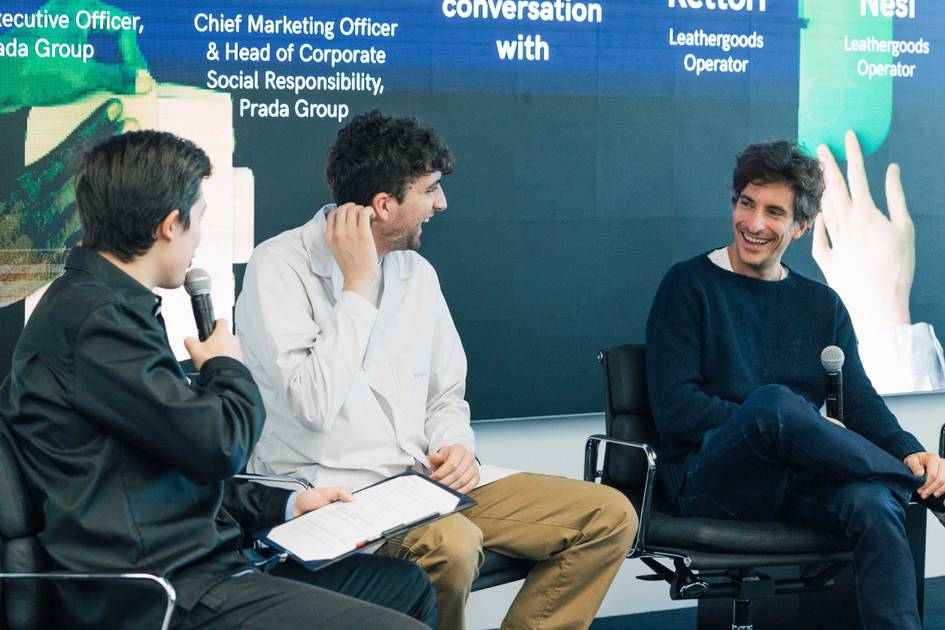
Scandicci (Florence, Italy). “Technology and artificial intelligence bring us efficiencies and free up time for high-value work,” said Lorenzo Bertelli, Chief Marketing Officer and Head of Corporate Social Responsibility and future CEO of the Prada Group. Bertelli visited Scandicci in November with current CEO Andrea Guerra to celebrate the Prada Academy Group's 25th anniversary. Mr. Bertelli also had a long conversation with two of the Scandicci factory's artisans, Francesca Rettori and Leonardo Nesi, both specialists in leather goods.
Lorenzo Bertelli: “Artificial intelligence will cause disruption in the short term, but I'm positive for the long term”
Bertelli addressed a question everyone inside and outside of the fashion industry has: whether AI will eliminate roles within fashion companies. “Transition periods are always fraught with challenges. Artificial intelligence will cause disruption in the short term, but I'm positive for the long term,” Bertelli said. Craftsmanship and manufacturing are not limited to the increasingly specific and detailed prompts of AIs like Gemini. Employee Francesca Rettori echoed this sentiment, saying, “The Academy teaches us to learn by observing.” This means that the care, curiosity, passion and experience that goes into creating a handbag brings added value. According to Bertelli, this value guarantees the longevity and continued recognition of the craftsman's profession.
Moreover, the paradigm between white-collar and blue-collar jobs will completely change in the coming years. Young people are increasingly demanding a better work-life balance and better employee benefits.
Many white-collar activities have been or will be absorbed into processes related to AI development. If you work in an office, you'll increasingly be dealing with presentations and spending your day on your smartphone. This change could make manual labor more attractive and, in turn, more valuable.
Underscoring this vision, Andrea Guerra said that for a group like Prada, manufacturing is an industrial craftsmanship: “Eighty percent of what we do is with our hands, our minds and our thoughts.” FashionUnited visited the Scandicci factory, including the production department and the Prada Academy Group's laboratory. We observed Prada and Miu Miu artisans at work and experienced firsthand the meaning of Guerra's words: “No two leathers are the same and requires the utmost care'' in the production of luxury bags and clothing.
Andrea Guerra: Luxury must embrace technology while maximizing the value of human ingenuity
There's no need to rush into luxury. “We are in a world where we have to slow down. It is a world where we have to embrace technology, but we have to succeed in ingenuity and in giving maximum value to everything human,” stressed the CEO of the Prada Group.
The history of the Prada Group is one of production facilities, of which there are 23 in Italy alone. “From the very beginning, my father believed in owning their own factory. In fact, the story of my parents is the story of one person, my mother, Miuccia Prada, who was dedicated to design, and my father, Patrizio Bertelli, who was dedicated to the factory,” Bertelli explained. He stressed that in-house production is “a cultural issue that runs in our blood. In our offices in Milan, we can't talk about business without discussing factories.”
The Prada Group has 15,433 employees (as of June 30) and operates 25 industrial locations, 23 of which are located in Italy. The Global Industries sector employs 4,167 people. The leather goods sector is 2,087. 1,081 for footwear. The clothing division has 999 employees.
Regarding production, Prada Group management said that the Scandicci factory and the Prada Academy Group are “already preparing to accommodate Versace and its production. The Academy serves the entire group, because when we make bags for a brand, the philosophy is always the same,” Bertelli said.
An important aspect of the Prada Group's production model is its direct control of the supply chain, which guarantees genuine “Made in Italy” products. The company also decided a while ago to publish the names of its suppliers.
“We have decided to publish the names of our suppliers that we are particularly proud of. As you know, eventually we will publish all our suppliers as part of our long-term plan.” Bertelli explained, “We are not legally required to disclose every level of our production chain. If at some point the reporting rules change, we will be happy to disclose 100 percent, but the rules must apply to everyone.” He questioned, “Why should we give an advantage to competitors who can gather information about their supply chain?”
This article was translated into English using AI tools.
FashionUnited uses AI language tools to speed up the translation of (news) articles and proofread the translations to improve the final result. This saves human journalists time spent researching and writing original articles. Articles translated with the help of AI are checked and edited by human desk editors before going online. If you have any questions or comments about this process, please email us at info@fashionunited.com.