Researchers hope to use synthetic biological intelligence to create ‘better AI machines’ despite concerns over ‘existential risks’
-
Tory Shepherd/The Guardian
Research to fuse human brain cells with artificial intelligence (AI) has received a $600,000 grant from the Australian Department of Defense and the Office of National Intelligence (ONI).
A research team led by Monash University and the Cortical Institute is the team that created dish brains, brain cells that can play the vintage video game Pong.
Adeel Raj, an associate professor at the University’s Turner Institute for Brain and Mental Health, said their work “brings together the fields of artificial intelligence and synthetic biology to create a programmable biological computing platform.”
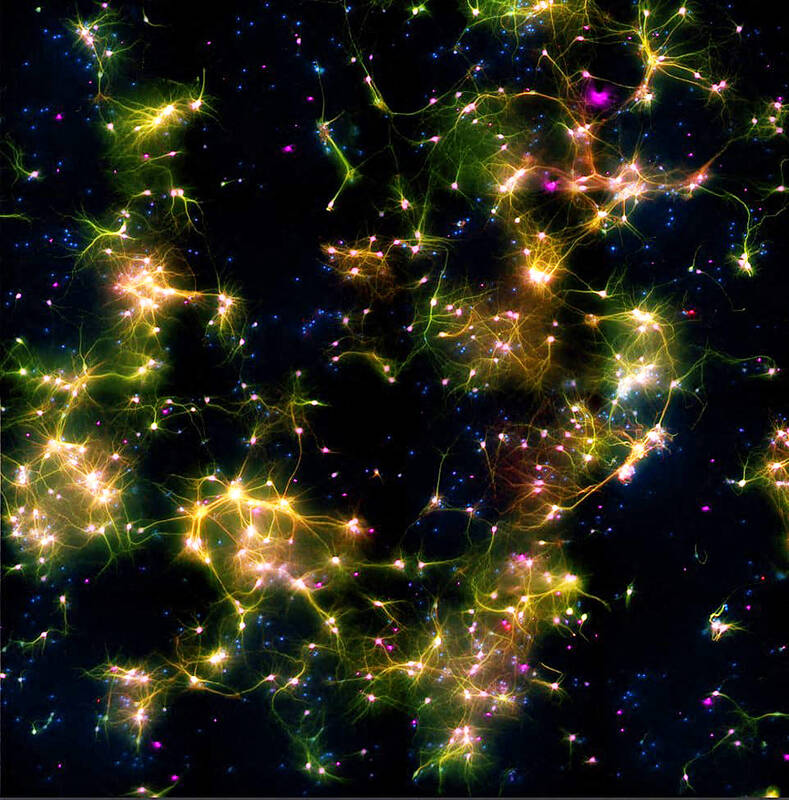
Photo: AFP
Hundreds of thousands of living brain cells grown in a lab learn how to perform a variety of tasks, such as playing a pong. A multi-electrode array uses electrical activity to give feedback to cells when a ‘paddle’ hits a ‘ball’.
In an article published in the scientific journal Neuron, the researchers wrote that synthetic biological intelligence “previously confined to the realm of science fiction” may be within reach.
Raj said the team won grants from ONI and the Defense Science and Technology Center for National Security because they needed a new type of machine intelligence that they could “learn for a lifetime.”
Such intelligence will improve machine learning for technologies such as self-driving cars, autonomous drones and delivery robots, he said.
“This new technology capability in the future may eventually surpass the performance of existing pure silicon-based hardware,” said Raj. “The outcome of such research could have significant implications for multiple areas such as planning, robotics, advanced automation, brain-machine interfaces and drug discovery, giving Australia a significant strategic advantage.”
While the brain excels at the lifelong learning necessary to acquire new skills, adapt to change, and apply existing knowledge to new tasks, artificial intelligence suffers from what researchers call “catastrophic forgetting.” Normally, when an AI starts a new task, it forgets information about previous tasks.
DishBrain research aims to understand the biological mechanisms behind continuous learning.
“We will use this grant to develop better AI machines that replicate the learning capabilities of biological neural networks,” Raj said. “This will help scale up the power of our hardware and methods to become a viable alternative to in silico computing. [using simulations]”
The news comes as AI leaders urge governments to recognize “potentially catastrophic or persistent risks from AI.”
The Australians For AI Safety group has written a letter to the Australian Minister for Industry and Science, Ed Husik, signed by academics and industry leaders.
Husic announced a government review of AI, stating that “what we want is modern law for modern technology.”
The letter calls on him to “recognize the potential for catastrophic and existential consequences,” to work with the international community to manage risks, support research on AI safety, and “urgently train AI safety auditors that the industry will soon need.”
Spokesman Greg Sadler said Australia was “lagging behind” in attention to the dangers of AI.
“The alarming thing is that even planned and organized institutions like the United Nations recognize the potential for catastrophic and existential risks from AI, but the Australian government does not,” he said.
Husic said in opening the review that using AI safely and responsibly is “a balancing act that the whole world is working on.”
“Whether it’s fighting superbugs with new AI-developed antibiotics or preventing online fraud, the benefits are huge,” he said. “But as I have said for many years, appropriate safeguards are needed to ensure the safe and responsible use of AI.”
Comments are moderated. Please keep your comments relevant to the article. Speech containing profanity, obscenity, personal attacks of any kind, or promotion will be removed and users will be banned. The final decision is at the discretion of The Taipei Times.