Physically informed neural networks (PINNs) have shown remarkable potential in solving forward and inverse problems involving partial differential equations (PDEs). However, it often stumbles when the collocation points are unevenly distributed. This is a common feature of real simulations where complex regions require denser sampling than simpler regions. In standard training, the PDE residuals of all constellation points contribute equally to the loss. When using non-uniform sampling, the traditional PDE loss tends to cause the network to reduce errors primarily where points are crowded, and sparse areas receive less attention. Due to these challenges, detailed studies on more reliable residual evaluation strategies for non-uniformly sampled PINNs need to be performed.
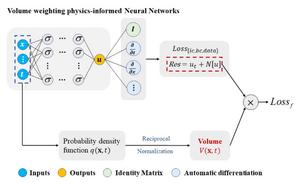
In this study, we introduce Volume Weighted Physical Information Neural Networks (VW-PINN), a new framework that changes the way residual errors are evaluated during training. This method avoids overfitting in regions where collocation points are densely sampled by weighting the PDE residuals according to the volume occupied by the collocation points in the computational domain. It ensures that the PDE residuals are sufficiently reduced over the entire computational domain. The payoff is that it can successfully resolve flows over cylinders or wings where PINNs fail.
Researchers from the School of Aeronautics, the International Collaborative Research Institute for Fluid Dynamics and Artificial Intelligence, and the State Key Laboratory of Aircraft Component Design, Northwest Polytechnic University in Xi’an, China, Acta Mechanica Sinica. This paper was published online on July 30, 2024. In this study, a volume-weighted physical information-based neural network (VW-PINN) was proposed to address the loss imbalance affecting traditional PINNs under nonuniform colocation points. The framework also includes a kernel density estimation (KDE)-based algorithm to estimate the volume occupied by collocation points in a mesh-free setting.
The central idea is simple. In other words, a point is important not because it is in a crowded area, but because of how much physical space it represents. In VW-PINN, its modification helps rebalance optimization across domains. The team tested the method on four forward problems and one inverse problem, including flow over a cylinder, flow over a NACA0012 airfoil, and Burgers’ equation. When traditional PINN failed, VW-PINN recovered a physically meaningful solution. For inviscid compressible flow over a cylinder, the relative pressure coefficient is L2 The error was 1.33%. For viscous incompressible flow over a cylinder, the relative L2 The error was 0.53% and 3.21% for the NACA0012 airfoil. For Burgers’ equation with adaptive sampling, the new method achieved an overall speedup of 2.19x. For the inverse Berger equation problem, the relative error of the viscosity coefficient was reduced from 19.82% to 1.48%.
The impact goes far beyond a single technical adjustment. Many practical science and engineering problems naturally involve non-uniform sampling, especially around airfoils, wakes, boundaries, and steep slopes. With methods that can maintain accuracy under these conditions, physics-based artificial intelligence (AI) could become even more useful in aerodynamics analysis, fluid dynamics, and inverse parameter identification. VW-PINN retains the mesh-free flexibility of PINN while improving its robustness under adaptive and non-uniform sampling, and thus may help narrow the gap between neural network solvers and the reliability levels expected in scientific computing.
###
References
Toi
10.1007/s10409-024-24140-x
Original source URL
https://doi.org/10.1007/s10409-024-24140-x
Funding information
This research was supported by the National Natural Science Foundation of China (Grant No. 92152301), the National Key Research and Development Program of China (Grant No. 2022YFB4300200), and the Key Research and Development Program of Shaanxi Province (Grant No. 2023-ZDLGY-27).
About Acta Mechanica Sinica
Acta Mechanica Sinica is an international journal sponsored by the Chinese Society of Theoretical and Applied Mechanics. It publishes high-quality original research from contributors around the world and serves as an important platform for scientific exchange between domestic and international Chinese scholars. The journal focuses on recent advances across the full spectrum of theoretical and applied mechanics, covering classic fields such as solid mechanics and fluid mechanics, as well as emerging fields such as interdisciplinary mechanics and data-driven mechanics. Focuses on analytical, computational, and experimental advances in mechanics and related fields. By encouraging interdisciplinary research, the journal also helps connect mechanics with the broader fields of engineering and science through articles, reviews, rapid communication, comments, experimental techniques, and special topic features..
Disclaimer: AAAS and EurekAlert! We are not responsible for the accuracy of news releases posted on EurekAlert! Use of Information by Contributing Institutions or via the EurekAlert System.