
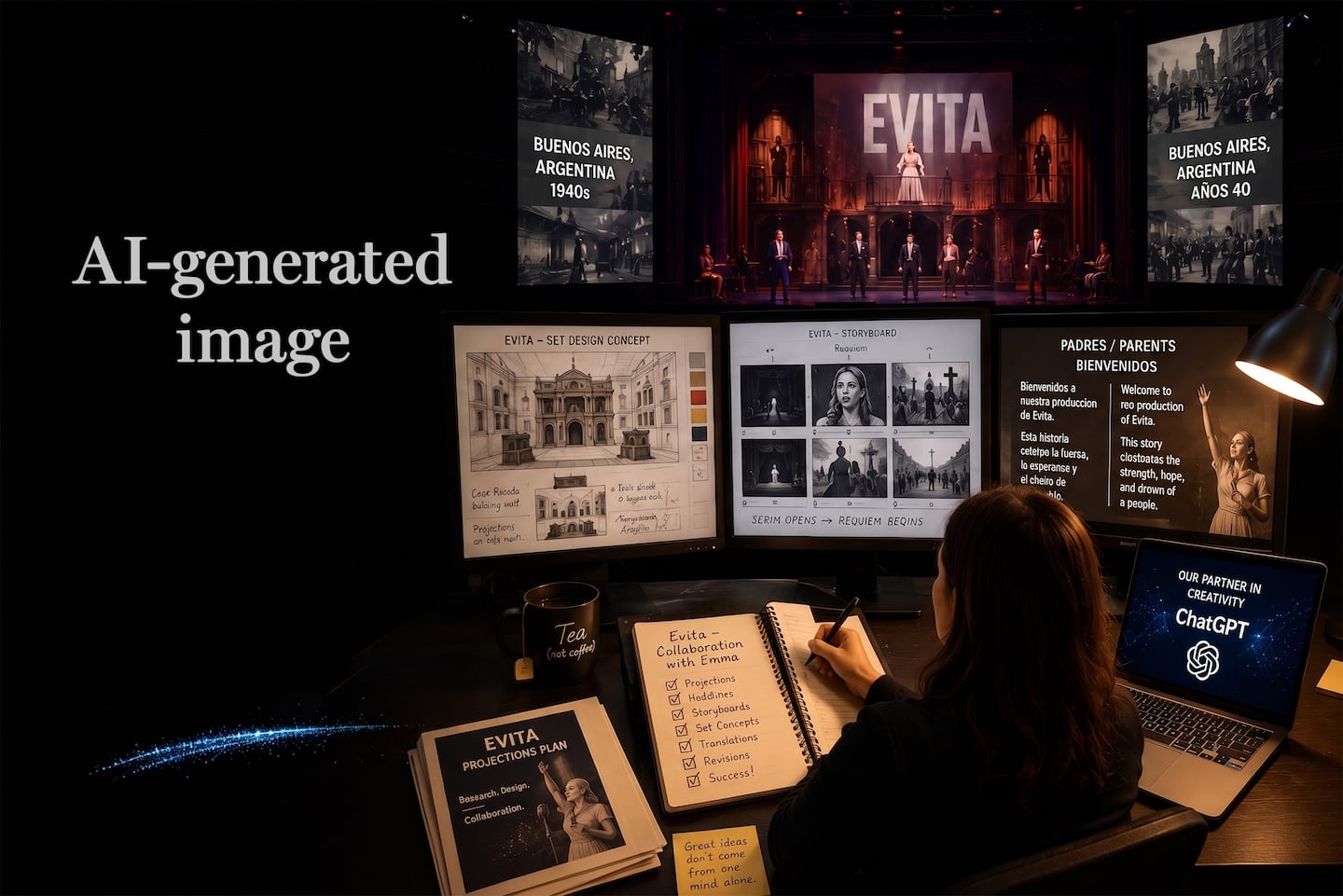
“[ChatGPT] “She was my graphic and set designer and production assistant,” Lawrence’s theater teacher, Laurie Donlan, told me. Suddenly, her personal ChatGPT subscription has a partner. “I was actually having production meetings in the middle of the night while ideas were coming up.” This has allowed Donlan, the program director, to teach more efficiently, spend more time with kids and nurture talent, she said. “They won the state championship,” she said.
As school officials across the country debate how they should and shouldn’t allow students and teachers to use artificial intelligence, Donlan is already putting it into practice at his own expense. she is not alone. A recent national poll of K-12 public teachers conducted by the Walton Family Foundation and Gallup found that while most teachers use AI, only 18% receive formal guidance on its use. (This does not include Mr. Donlan, who told me, “The truth is, I don’t know what our policy is.”) A spokesperson said Lawrence Public Schools is developing a district-wide AI policy).
Donlan’s experience encapsulates both the promise of AI in K-12 education and the lack of clear policies defining what responsible use should look like in the classroom.
The issue brought about 100 students, two from each state, to Boston and Cambridge over the weekend for the Youth AI Festival. During the three-day summit, hosted by the independent nonprofit Day of AI, the School Superintendents Association, and MIT RAISE, students discussed, created, and approved models for AI use policies in the classroom, culminating with a mock debate and vote in the Senate plenary chamber at the Edward M. Kennedy Institute.
Among the provisions students considered were a ban on the use of AI in grades 8 and below and in artistic tasks, and a ban on teachers entering student-identifying information when using AI tools to create personalized education plans.
Their efforts are ahead of most districts and most state legislatures. Although most states, including Massachusetts, have issued non-binding guidance on the use of AI in schools, fewer than 10 states have passed laws that actually require school districts to implement AI policies. Tennessee and Oklahoma recently passed some of the most stringent laws, including bans on the primary use of AI tools for grading, discipline, and other high-stakes decisions, and provisions that allow parents to opt out of their children’s use of AI tools without academic penalty.
One thing became clear while listening to the students at the festival. That is, while students are all familiar with AI tools, they are not convinced that they belong in the classroom. Lucy Cox, a rising senior at Marshwood High School in South Berwick, Maine, joined because she wanted to “redefine what ethical use looks like” by drawing a clearer line between plagiarism and inspiration, which is an issue at her high school. She said her school doesn’t have a standardized policy regarding the use of AI, so the rules usually vary from teacher to teacher. Because of environmental concerns (AI services are power-hungry), Cox said, “I don’t use AI for myself.”
Chase Johnson, a rising high school senior in Alaska’s Denali Borough School District, takes the opposite view. AI “is a very useful tool and should definitely be introduced into school systems,” he says. Johnson emphasized that he did not use AI tools while in school and only used them for learning purposes outside of the classroom. His roster is long: ChatGPT, Claude, Grok, GammaAI, Granola, Notebook, Manus, Wispr Flow, Gemini, and Base44. “I mainly use Grok for research, and Gemini’s tools are better for searching.” He also explained that he combines different tools to create podcasts on specific subjects, which he listens to while trying to fall asleep.

I asked Johnson if he ever worried about getting the wrong information or the AI making obvious mistakes. Don’t worry, he said. “A lot of people don’t know about it, but most AIs have a feature called a master prompt where you can input a set of rules,” Johnson said. “You can make sure you’re not making anything up, double check your sources, and provide sources.”
Well then! What Johnson is describing are custom instructions, or system prompts, a feature of most generative AI models that allow users to direct the chatbot’s behavior. But unfortunately, that alone does not make the model reliable.
Johnson’s comments illustrate two related but very different concepts that are often confused: learning or teaching AI literacy and learning or teaching using AI.
Consider this: A new research paper reviewing state policies on the use of AI in elementary and middle schools finds that states are more prepared to procure AI than teach with it, and that most state guidance does not specify how teachers should integrate AI pedagogically or how teaching with AI differs from teaching students how technology and AI actually work.
This is a clear gap that policymakers should pay attention to. Day of AI’s executive director, former Massachusetts Secretary of Elementary and Secondary Education Jeff Riley, told me that’s part of the nonprofit’s mission. “We’re going to figure out what AI is,” Riley said. “Curriculum is being built to show teachers how to incorporate AI into their lessons” and “Standalone AI Literacy Lessons.”
Meanwhile, Lawrence drama teacher Donlan’s experience provides perhaps the most compelling argument for AI in schools. That means AI could work to interfere with teachers’ lessons. She told me that AI technology has expanded her creativity. “AI is already here on Broadway,” she said. “That’s why the stage is a mirror of life.”
Marcela Garcia is a Globe Theater columnist. She can be reached at marcela.garcia@globe.com. Follow her on X @Marcella_Elisa and Instagram @marcela_elisa.


