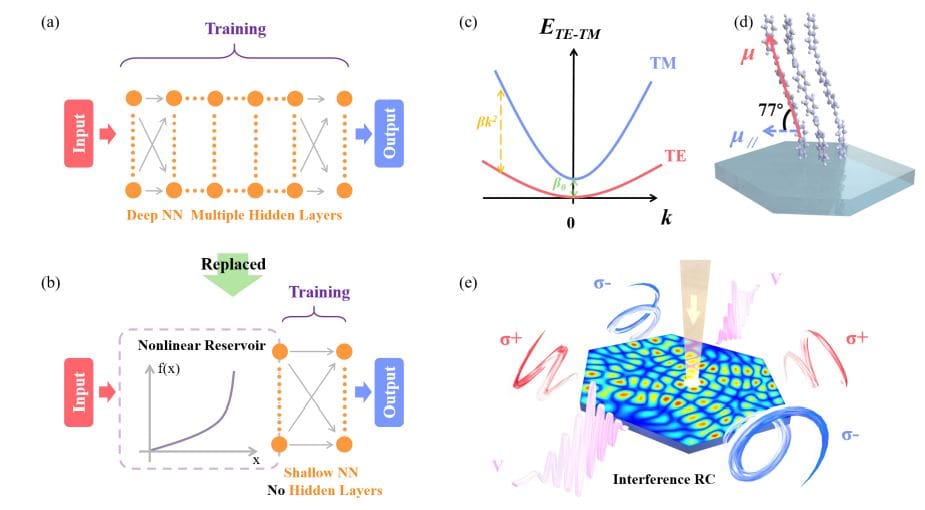
Artificial intelligence continues to advance, but it requires increasingly large amounts of computational resources and energy. Researchers are currently exploring alternative computing paradigms, and a team led by Teng Long, Yibo Deng, and Xuekai Ma from the Beijing Key Research Institute is demonstrating a significant advance in reservoir computing. This approach exploits the inherent nonlinear properties of physical systems to perform computations, potentially reducing power consumption and accelerating the learning process. The researchers show that interference in organic crystal resonators efficiently separates light patterns, enabling smaller and faster neural networks, and by extending the system’s capabilities through spin-orbit coupling, they achieve a tenfold reduction in network size and a threefold increase in processing speed, suggesting a promising route to enhance photonic reservoir systems.
Organic resonators for polariton calculations
Scientists are pioneering a new computing paradigm that uses organic materials to create efficient and compact photonic reservoirs. This research focuses on exploiting exciton polaritons, or hybrid photomatter quasiparticles, to perform calculations within specially designed organic crystal resonators. To manipulate these exciton polarizers and perform complex calculations, the research team designed hexagonal resonators from BPDBNA, a molecule that exhibits excellent optoelectronic properties. This approach offers potential advantages in terms of cost, tunability, and manufacturing compared to traditional computing architectures.
This study demonstrated a new method for pattern recognition, successfully identifying handwritten digits and simple symbols. Scientists carefully control the polarization of light to encode information and process it inside organic cavities. Detailed experimental and theoretical studies confirm the feasibility of this approach and provide a basis for future development. The researchers used angle-resolved spectroscopy to characterize the material and confirmed the formation of the desired exciton-polariton mode. They used a focused laser beam and a spatial light modulator to generate input data for the resonator, allowing dynamic control of the pattern presented to the system.
By analyzing the emitted light, scientists were able to decipher the results of their calculations. The research team also developed numerical simulations to model the behavior of the exciton-polariton resonator and verified the experimental results. This work opens up exciting possibilities for future research, including improving the accuracy of pattern recognition, scaling up the system to handle more complex calculations, and exploring different organic materials to improve performance. The development of new algorithms specifically for exciton-polariton platforms could further unlock the potential of this innovative computing approach. This research represents an important step toward realizing a new generation of energy-efficient and compact computing devices.
Organic crystal waveguides for photonic reservoir computing
Scientists have designed a new photonic reservoir computing system using organic crystals to overcome limitations in artificial intelligence resource demand. This work pioneered the use of (2Z,2’Z)-3,3-(.[1,1’-biphenyl]-4,4’diyl)bis(2-(naphthalen-2-yl)acrylonitrile) (BPDBNA) hexagonal microcrystals as the core component of the reservoir. Manufactured by physical vapor deposition. The molecule has a rod-like structure and excellent optoelectronic properties, exhibiting transition dipole moments aligned to maximize birefringence and promote coupling of light into organic crystal waveguides. The researchers excited the cavity with a focused laser, creating a strong optical field that propagated the cavity’s optical modes.
These modes have relatively long lifetimes, resulting in localized emission at the crystal edges. The scientists used Stokes parameters to characterize the polarization distribution and demonstrated strong spin-orbit coupling within the cavity, a key factor for system performance. This spin-orbit coupling has previously been exploited to generate circularly polarized electroluminescence and is central to the system’s functionality. The researchers created 10 different symbols using a focused laser beam, generating waves that propagate photonic modes in a narrow emission spectrum. To reduce the reservoir dimension and accelerate learning, the scientists integrated the total emission intensity from three sectors of the hexagon while preserving the separation properties. This integration allows us to efficiently train very simple neural networks, significantly reducing network size and 3x faster training.
Photonic reservoir computing achieves speed and size improvements
Researchers have demonstrated a new approach to artificial intelligence using photonic reservoirs, achieving a significant reduction in network size and increased training speed. This research focuses on hexagonal resonators grown from organic polymer crystals, which effectively replace some traditional neural networks. Experiments show that the system can efficiently separate optical patterns, reduce network size by a factor of 10 when using complex symbols, and speed up the learning process by three times. The team measured the performance of the reservoir computing system across a variety of output dimensions and demonstrated that increasing the number of channels directly correlated with increased accuracy.
Analyzing the data reveals certain scaling laws that govern the relationship between error rate, training step, and number of channels. These findings demonstrate the potential efficiency gains associated with reservoir computing. By applying this approach to the MNIST numeric dataset, the researchers achieved a reduction in network size while maintaining and even improving accuracy compared to shallow networks without reservoirs. This size reduction directly translates into a 3x speedup of the training process performed on high-performance workstations. This photonic reservoir operates with low optical power consumption and can perform symbol recognition on sub-microsecond timescales, thus confirming its potential for efficient artificial intelligence applications.
Organic reservoir computing delivers speed and accuracy
This study demonstrates a new approach to reservoir computing that utilizes organic crystal waveguide resonators as physical reservoirs that replace traditional neural network components. By exploiting the interference of light within this cavity, the team achieved a significant reduction in network size (up to a factor of 10) while maintaining, and in some cases improving, accuracy for pattern recognition tasks. This size reduction directly leads to a significant speed-up of the training process, and the developed system demonstrated a 3x improvement in training speed compared to shallow networks. This study highlights the flexibility of this physical reservoir system, showing that the number of output signals can be adjusted to the complexity of the input data, providing a tunable balance between speed and accuracy.
Importantly, the researchers note that the resonator is easy to manufacture, requiring only a single organic crystal without the need for mirrors, paving the way for possible integration into chips for further efficiency gains. Although the current experiments collect light from the edge of the sample, future developments could connect the output waveguide directly to the edge of the resonator to minimize scattering losses and improve performance. The authors acknowledge that the performance of the photonic reservoir is limited by the lifetime of the organic crystal, but this does not represent a bottleneck during training. This research represents an important step towards realizing energy-efficient and compact artificial intelligence systems based on organic photonics.
👉 More information
🗞 Reservoir neuromorphic computing based on spin-orbit coupling in organic crystal resonators
🧠ArXiv: https://arxiv.org/abs/2511.23155