

January 6, 2026
soul – South Korean industry heavyweights are arriving at CES 2026 with a common message: artificial intelligence is moving beyond software and screens and into the physical world.
Hyundai Motor Group, LG Electronics, and Doosan plan to show off their latest AI robotics technology at this year's CES in Las Vegas, focusing on what they call the next stage of AI: systems that can recognize real-world situations and perform physical tasks.
At the heart of their showcase is physical AI, a buzzword that refers to artificial intelligence embedded in machines such as robots and self-driving cars. Unlike AI, which processes data or generates content, physical AI combines sensors, computer vision, and actuators to enable machines to interact with and adapt to their environments. This transition reflects a broader shift from AI that simply “thinks” to AI that “bodies.”
Hyundai Motor will unveil its AI robotics strategy at Monday's CES Media Day under the theme “Aligning with Human Progress: AI Robotics, Beyond the Laboratory Scale and into Everyday Life.” A key highlight will be the world's first public live demonstration of Atlas, a next-generation humanoid robot developed by Boston Dynamics, Hyundai's US-based robotics subsidiary. The fully electric Atlas replaces hydraulic actuation with an advanced electrical system, allowing for more precise movement, including 360-degree rotatable joints.
Beyond a hardware upgrade, Atlas reflects a shift toward learning-based control. The robot has built-in reinforcement learning that allows it to refine its movements through trial and error. This is a distinctive feature of physical AI, as opposed to fixed, pre-programmed behavioral systems.
Hyundai will also reveal plans to expand its AI robotics ecosystem through the Software Defined Factory, a data and software-driven manufacturing model designed to maximize flexibility. By integrating AI robotics, vehicles, logistics and software, the group aims to position itself as an end-to-end provider of robot development, training and deployment.

LG Electronics' home robot CLOiD will debut at the CES Technology Show in Las Vegas this week. Photo: LG Electronics/Korea Herald
Meanwhile, LG Electronics debuts its humanoid home robot CLOiD, signaling a strategic shift in its robotics roadmap. Designed for the home, CLOiD has two arms and a five-fingered hand that can perform household tasks, while also acting as a personal AI assistant that adjusts smart home appliances based on the user's schedule and lifestyle.
“At CES 2026, we will introduce LG's efforts towards realizing 'zero labor housing', including the LG CLOiD home robot,” said Baek Seung-tae, executive vice president and head of home appliance business at LG.
Doosan Robotics introduces Scan & Go, a physical AI-powered system that combines a robotic arm and an autonomous mobile robot. Using advanced 3D vision, the system can scan large structures such as turbine blades, aircraft fuselages, and building facades. Generate optimal work routes. Perform tasks such as inspection, polishing, and grinding. The technology won both the CES 2026 Best of Innovation Award in the AI category and the Robotics Innovation Award.
Meanwhile, Samsung Electronics is expected to emphasize its extensive AI ecosystem centered on home appliances, TVs, and mobile device applications under the theme of “AI companion for daily life.” The focus will be Bespoke AI Refrigerator, the first appliance to integrate Google's Gemini AI, offering real-time food tracking, personalized recipe recommendations, and automated grocery management.
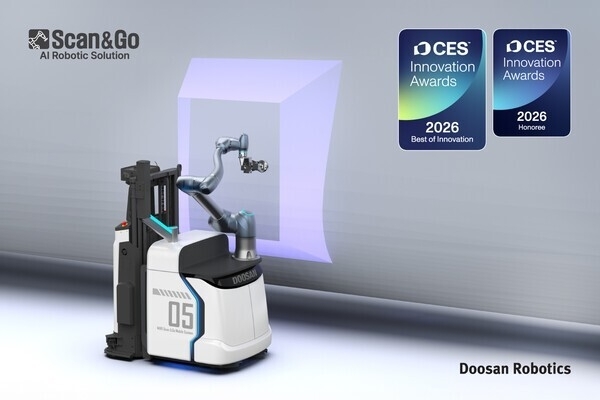
Doosan Robotics' industrial robot “Scan & Go”. Photo: Doosan Group/Korea Herald


