


Quick links: Swipe fees on sales tax | The new AI bill | Thieves steal CenturyLink’s copper wire | Another moon rover | NSF awards $45M for weather tech | SBA drought loans
A more efficient state government? Who wouldn’t want that?
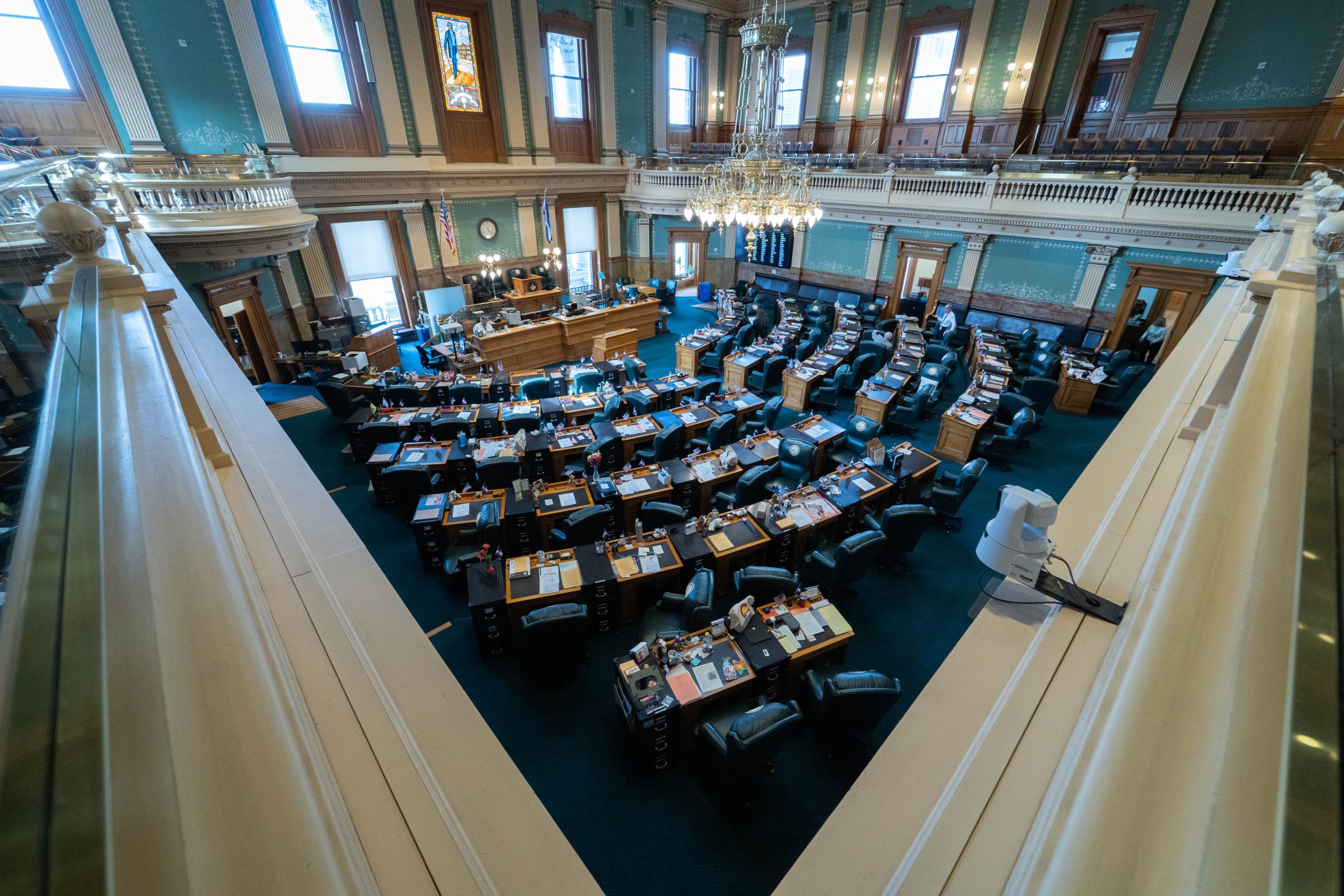
That’s the gist of a bill supported by the Colorado Chamber of Commerce that passed in this legislative session and now awaits Gov. Jared Polis’ signature.
Senate Bill 137 faced little opposition, but its passage was meaningful to local organizations representing small businesses after years of feeling defeated during the annual lawmaking session. The bill is among the chamber’s priority legislation this year, and is part of an ongoing multiyear effort to reign in the state’s regulatory environment and cut down on the volume of laws.
“This represents a significant win for the Chamber and the broader business community,” Loren Furman, the Chamber’s president and CEO, said in an email. Furman didn’t have a list of rules ready to go but shared a report of how the Chamber would determine them.

Even the AFL-CIO was on board. “We understand the Chamber’s intent and agree with accountability in government. We just didn’t want to overburden state workers or sunset hard-fought programs in the name of efficiency,” said Kjersten Forseth, legislative director for the Colorado AFL-CIO.
The bill, also supported by the state’s Department of Regulatory Agencies or DORA, modernizes rule maintenance. Agencies must review rules at least every five years, add criteria to determine their effectiveness and let departments handle their own rules instead of consulting with DORA.
And it appears that Polis will be signing the bill based on this comment from his office: “Governor Polis is an entrepreneur and called on the legislature to take a look at our laws to ensure that Colorado encourages innovation, and that’s what this bill does. This bipartisan effort cuts through red tape, strengthening our businesses and economy, and Governor Polis is excited to sign the final version of the bill,” said Polis spokesperson Eric Maruyama.
Michael Smith, state director of the local National Federation of Independent Business, said his members are grateful that lawmakers agreed state agencies need to review their rules more regularly. But it’s still been a challenge for small businesses who are trying to survive.
“Despite some progress on pro-small business bills we’ve seen this session, there continue to be several concerning anti-business bills,” Smith said in an email.

He’s not a fan of a labor bill that passed, House Bill 1005, which would make it easier for workers to unionize in Colorado. The state’s Labor Peace Act, which goes beyond federal requirements of a simple majority and requires workers to get 75% approval of all employees, would be repealed. But a similar bill passed last year only to be vetoed by Polis, who is likely to veto this one.
And Smith is concerned about Senate Bill 116, which would remove indexing a business property tax exemption to inflation, putting “more financial strain on Main Street businesses,” he said.
The legislative session ends Wednesday. Other business organizations are waiting to see if their other proposals pan out before commenting. But here are some other bills giving local businesses some relief even if compromises were made.
No credit card fees on sales tax passes with one more hurdle
The effort to eliminate credit card fees on sales tax passed the state legislature Wednesday. It was significantly watered down from last year’s failed bill, which proposed ending credit card fees on taxes and tips.
But this year’s version focused just on sales tax, a fraction of the interchange fee that credit card companies collect from merchants that accept credit cards. Customers don’t usually see the charge on a bill but whatever they pay — including added tips — merchants pay up to 3% of the total to the credit card processor as an interchange fee, or swipe fee.

In 2024, Colorado merchants paid $218 million in swipe fees just on sales tax, according to CMSPI, a consulting firm that tracks global payments. Overall, businesses in the state paid $2.1 billion on swipe fees that year.
That was enough for small businesses and especially local restaurants to cheer the passage of Senate Bill 134, even if there’s uncertainty that Polis will sign off on it. The governor is reviewing the bill “and considering the impact of national regulations,” his office said.
“It’s an important step in helping restaurants succeed right now, amid the loss of the state sales tax vendor fee and mounting costs of all kinds,” Sonia Riggs, president and CEO of the Colorado Restaurant Association, said in a statement.
Opposition came from the banking and credit industry, which uses swipe fee revenue to invest in cybersecurity and reward cards. Banks, credit unions and financial institutions that are authorized to do business in Colorado are exempt if they manage assets of $60 billion or less.
For businesses that now need to separate the swipe fee on sales tax from the rest of the bill, the Colorado Restaurant Association said nearly all point-of-sale systems can do this because payment processors already track “level 2” data, which includes tax information. But if they don’t use a digital system, merchants can submit documentation after the transaction and get a refund on the swipe fees charged on sales tax.
This year’s artificial intelligence bill
The third attempt to change the state’s artificial intelligence law is moving quickly through the legislature after its May 1 introduction.
The proposed Senate Bill 189 repeals and replaces the 2-year-old Senate Bill 205, which goes into effect June 30 if 189 fails.
In five days, the new bill zipped through the Senate and a House committee. Public testimony this week revealed SB-189 is the result of significant compromises between consumer-protection groups that pushed for responsible AI systems and business and tech companies that felt the original law would push innovation out of Colorado.

“While I viewed Senate Bill 205 as a comprehensive AI disclosure bill, I’ve whittled this bill down to more of a discrimination decision bill,” cosponsor and Senate Majority Leader Robert Rodriguez, a Denver Democrat, said at a committee hearing this week. “It’s not as comprehensive and I am not happy with that but as you heard from everybody, sometimes when everybody’s not happy then you’re in a good place.”
“We do need to regulate AI and not have AI regulate us,” Rodriguez added.
The new bill requires companies to notify consumers upfront if “automatic decision making technology” is being used to make a decision that could impact a person’s employment, housing, healthcare, education or finances. If a person doesn’t like the decision made by AI, the company must provide a way to request additional information. The new bill also allows the Colorado attorney general’s office to give violators three years to fix violations.
The Colorado Technology Association supported the bill but told lawmakers Friday that they’d like the right to cure to be permanent to allow inadvertent violators to fix the issues.
“For CTA, the most important objective is advancing a workable replacement for SB-205 that protects consumers and allows companies to build, adopt and use AI responsibly,” Brittany Morris Saunders, CTA president, testified at a House committee hearing Friday. “To be clear, this bill is a compromise, shaped by hundreds of hours of stakeholder work. It is not perfect, and it is not identical to the working group framework. But it represents significant progress for Colorado.”
Sun economy stories you may have missed

➔ US skier visits fall off a cliff after the West’s winter that wasn’t. The National Ski Areas Association shows 52.6 million visits to about 500 U.S. ski areas in 2025-26, marking one of the steepest annual declines in ski traffic ever. >> Read story
➔ Effort to attract data centers to Colorado with tax incentives fails. A compromise bill backed by environmental groups is still being negotiated. >> Read story
➔ Denver diners can sample new dishes this week, created to reduce food waste. The Food Matters Restaurant Challenge is back after a six-year hiatus, with 11 restaurants reinventing their recipes to save money and ingredients. >> Read story

➔ As Colorado gas prices near $4.50 per gallon, driving to work is like taking a pay cut. It’s even more painful for truckers and ride-sharing drivers. Many are contractors who are paying out of pocket to fuel up. >> Read story
➔ Colorado voters’ views on TABOR and the state budget may not be what they appear. At Colorado SunFest 2026, the nonpartisan Colorado Polling Institute shared key insights from their latest survey of likely voters. >> Read story
➔ Colorado’s labor force shrinks again in March to fourth-lowest participation rate since 1976. The state’s unemployment rate remains at 3.9%. Fewer are unemployed and employed, which is impacting the size of Colorado’s labor force. >> Read story
Other working bits
➔ Copper wire theft grows, as CenturyLink beefs up security. As of Thursday, CenturyLink has logged 99 cases of stolen copper wires and damaged telecom pedestal boxes in Colorado so far this year. Last year? They had 78 cases. Just over half of the cases this year are in the Denver metro area, said Mike Griffith, senior security professional at CenturyLink in Denver.
And those are just CenturyLink’s stats.

“What the criminals are looking for is the copper wires because they want to sell it and get quick money for it because the price of copper has skyrocketed,” Griffith said. “And they know that by getting into a pedestal, cutting out some copper, they can take it to a scrapper or recycler and get quick and easy cash.”
It’s a costly issue for the company, which has seen an uptick in the Denver area in the past six to eight months. The amount of copper could also be pretty small, “maybe only $15 worth of copper,” he said. And inside the boxes, it’s not always copper wiring but newer fiber-optic cables, which have little value for thieves. But fiber gets cut, too, which disrupts the internet for customers in the neighborhood. The pedestals also cost the company about $6,000 to replace.
To combat the theft, CenturyLink supported a bill that penalizes junk shops, salvage yards and buyers of critical infrastructure material like copper wires. House Bill 1101 passed the legislature and Polis approved it on Thursday. Buyers of such goods must pay sellers by check and are prohibited from paying cash unless there’s documentation, including a picture of the seller or the transaction is less than $300.

Denver is a hot spot for some reason, and Griffith isn’t sure why. But the new state law would be similar to how the city of Denver adopted theft prevention measures a few years ago when theft of catalytic converters skyrocketed in the Denver area. The city passed a law to penalize scrap recyclers so thieves would have fewer options for a quick cash turnaround. Catalytic converter theft declined dramatically, from more than 3,000 a year to about 100, Denverite reported.
Griffith said CenturyLink isn’t solely relying on the new law or law enforcement as its solution. The company is also adding GPS tracking devices in and around the copper lines. They’ve also added hidden cameras around the pedestals.
“That allows us to monitor their locations and share that information with law enforcement so they can see it when copper is stolen,” he said. “So when copper is stolen, if it’s got that tracking device in or on it, it will allow us and law enforcement to see where it’s going. Is it going to somebody’s house? Is it being taken to recyclers? This will allow for a better, stronger law enforcement response.”
➔ Moon rover maker attracts $30 million in funding. Investors put another $30 million into Golden-based Lunar Outpost to help the company accelerate production of its “advanced robotics and mobility platforms,” or moon rovers that will help astronauts drive on the moon. The company also plans to hire another 50 people worldwide over the next year. The Series B round was led by Industrious Ventures in Denver.

Lunar Outpost already has eight contracts with NASA for lunar missions and was the first commercial company to get a rover on the moon. It was a small guy, the MAPP lunar rover, short for Mobile Autonomous Prospecting Platform. This week, the company also unveiled Pegasus, its new lunar terrain vehicle. >> Details
➔ National Science Foundation awards $45 million to local tech group tackling wildfires, drought. The multistate effort by the Colorado-Wyoming Advanced Sensing and Computation for Environmental Decision-making (ASCEND) Engine will use the $45 million to develop technologies that respond to extreme weather hazards, like wildfires and drought.
Fort Collins accelerator Innosphere is leading the ASCEND Engine, which connects more than 40 businesses and organizations, including research universities, federal labs, businesses, startups, investors and more. Innosphere has been working on technology solutions to protect power and water systems and develop high-resolution weather forecasting, so the award is a “vote of confidence in our region’s ability to lead the nation in environmental intelligence and resilience,” Innosphere CEO Mike Freeman said in a statement. >> See the plans
➔ SBA loans for Colorado small businesses impacted by drought. The U.S. Small Business Administration is now offering loans of up to $2 million to Colorado companies impacted by drought conditions. Loans, with interest rates as low as 4% for small businesses, don’t require a payment until 12 months after the first disbursement, and no interest accrues during that year, according to the SBA.
Businesses must be in eligible counties, which include Adams, Arapahoe, Bent, Cheyenne, Crowley, Douglas, El Paso, Elbert, Kiowa, Kit Carson, Las Animas, Lincoln, Logan, Morgan, Otero, Pueblo, Yuma, and Washington. >> Apply online
Got some economic news or business bits Coloradans should know? Tell us: cosun.co/heyww
Thanks for sticking with me for this week’s report. If you really want to know more about what happened during the legislature this session, The Colorado Sun’s 2026 Legislative Session Recap is May 19. Gov. Polis and other lawmakers will be there. Register here. ~ tamara
Miss a column? Catch up:
What’s Working is a Colorado Sun column about surviving in today’s economy. Email tamara@coloradosun.com with stories, tips or questions. Read the archive, ask a question at cosun.co/heyww and don’t miss the next one by signing up at coloradosun.com/getww.
Support this free newsletter and become a Colorado Sun member: coloradosun.com/join
Corrections & Clarifications
Notice something wrong? The Colorado Sun has an ethical responsibility to fix all factual errors. Request a correction by emailing corrections@coloradosun.com.


