
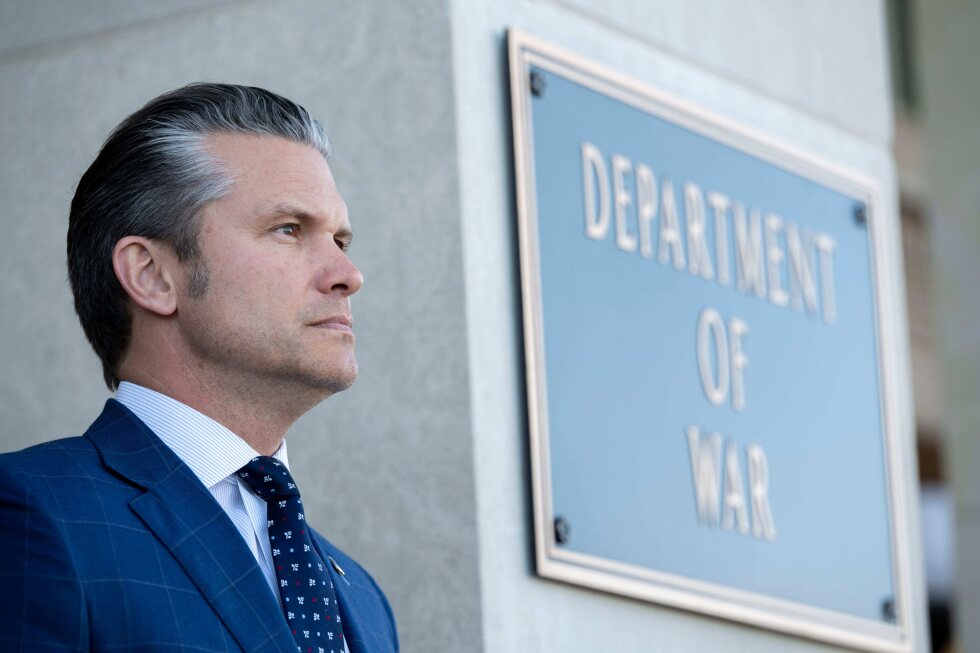
WASHINGTON (AP) – The high-stakes debate over military uses of artificial intelligence was thrust into the public eye this week when Secretary of Defense Pete Hegseth used a law created to combat foreign supply chain threats to slap a scarlet letter on the American company and bluntly end Anthropic’s cooperation with the Pentagon and other government agencies.
President Donald Trump and Mr. Hegseth accused up-and-coming AI star Antropic of endangering national security after CEO Dario Amodei refused to back down, citing concerns that the company’s products could be used for mass surveillance or autonomous armed drones.
The San Francisco-based company has vowed to sue over Mr. Hegseth’s call to designate Anthropic as a supply chain risk, an unprecedented move to apply a law meant to counter foreign threats to a U.S. company.
Anthropic said it will challenge what it calls a legally unsound practice that has “never before been publicly applied against a U.S. company.”
The impending legal battle could have major implications not only for the balance of power in Big Tech, which is at a critical juncture, but also for the rules governing the military use of AI and other guardrails put in place to prevent the technology from posing a threat to human life.
of dust up ChatGPT maker OpenAI has already staged a coup, and after Anthropic challenged some of the Trump administration’s terms, OpenAI seized the opportunity to step into the void and offer its technology to the Department of Defense. This is a turn of events that could further deepen the animosity between him and OpenAI CEO Sam Altman. temporarily banished Amodei left OpenAI in 2021 to start Anthropic, partly due to concerns about the safety of AI.
Impact of being designated as a supply chain risk
The Pentagon’s move to classify Anthropic as a risk to the nation’s defense supply chain Contracts up to $200 million With AI companies. Other defense contractors will also be prohibited from doing business with Anthropic, the Pentagon said.
President Trump wrote in Truth Social that most government agencies should immediately stop using Anthropic’s AI, but gave the Pentagon six months to phase out the technology already integrated into military platforms.
Anthropic argues that Hegseth does not have the legal authority to terminate business relationships with other defense contractors. Companies with commercial agreements with Anthropic can continue to use its products for non-defense projects. wrote in a statement.
The supply chain risk designation was created to give U.S. military leaders a way to limit the Department of Defense’s exposure to companies that pose potential national security risks. The list typically includes companies with ties to adversaries, such as telecommunications giant Huawei. Chinaor Russia-linked cybersecurity expert Kaspersky.
For Anthropic, this designation serves as a warning to other AI and defense companies. If you do not comply with the request, you will be blacklisted.
“We don’t need it, we don’t want it, and we’ll never do business with them again!” President Trump said on social media.
President Trump’s six-month grace period for the Pentagon essentially opens the door for other companies to obtain the security clearances they need to work with the Pentagon.
How the conflict affects Anthropic’s business
Anthropic said it has not yet been formally notified of Hegseth’s designation.
“If we receive any formal litigation, we will review it, understand it and challenge it in court,” Amodei vowed in an interview with CBS News that aired Sunday morning.
For now, Anthropic is trying to convince companies and government agencies that the Trump administration’s supply chain risk designation only affects the use of Claude, its AI chatbot and computer coding agent, when military contractors use the tool for Department of Defense work.
“Uses for other purposes are not affected,” Anthropic said in a statement.
For Anthropic, it’s important to make this distinction because most of its expected $14 billion in revenue this year will come from businesses and government agencies that use Claude for computer coding and other tasks. More than 500 customers pay Anthropic at least $1 million a year for Claude, according to an announcement revealing the investment that values the company at $380 billion.
Anthropic’s Claude technology has gained a lot of attention and has emerged as a viable alternative to the wide range of business software tools currently sold by major technology companies such as Salesforce and Workday. That possibility has caused stock prices of companies that sell business software as a service to plummet this year.
But now that Anthropic has been deemed a supply chain risk, there is some uncertainty as to whether customers will continue to feel comfortable using Claude for non-military work and risk the wrath of President Trump. Despite Claude’s advances over the past year, widespread reluctance to use it could slow U.S. progress in AI at a time when the U.S. is racing to stay ahead of China in a technology that promises to reshape its economy and society.
At the same time, Anthropic and Amodei may now have a bully pulpit to push their agenda of building stronger guardrails around how AI works.
“No threat or penalty from the Department of the Army will change our position on domestic mass surveillance or fully autonomous weapons,” the company said in a statement. “We will challenge the supply chain risk designation in court.”
In an interview with CBS, Amodei portrayed Anthropic’s dispute with the Trump administration as a democratic position.
“Disagreeing with the government is the most American thing in the world,” Amodei said. “And we are patriots. In everything we’ve done here, we’ve defended the values of this country.”
OpenAI steps into the ring
Hours after his competitors were punished, OpenAI’s Altman announced Friday night that he had signed a deal with the Pentagon to provide his company’s AI to classified military networks. But Altman said the same AI restrictions that were the sticking point in Anthropic’s dispute with the Department of Defense are now included in OpenAI’s new partnership.
“We have long believed that AI should never be used for mass surveillance or autonomous lethal weapons, and that humans should always be involved in high-stakes automated decision-making. These are our key red lines,” Altman told OpenAI employees in a memo obtained by The Associated Press.
It is unclear why the Department of Defense agreed to OpenAI’s red line but not Anthropic’s. But Altman wrote in the memo that the company believes it can “de-escalate the situation” by working with the Department of Defense while adhering to sound security safeguards.
OpenAI’s deal with the Trump administration comes on the same day it announced it would raise an additional $110 billion as part of an infusion that values the San Francisco-based company at $730 billion.
But OpenAI could also face potential backlash if its work with the Department of Defense is widely seen by U.S. consumers, who use ChatGPT as an example of putting profit over safety in AI.
The rift in humanity could also present new opportunities for Mr. Musk. Musk co-founded OpenAI with Altman in 2015, but the two have since clashed over safety concerns and financial issues. Mr. Musk accused Mr. Altman of fraud and other deceptive practices. The case is scheduled for trial in late April.
Musk currently oversees the AI chatbot Grok, which the Pentagon plans to grant access to classified military networks in addition to government investigations, despite its safety and reliability. Creating sexual deepfake images. Musk has already backed the Trump administration in the fight against Amodei, saying on his social media platform X that “humanity hates Western civilization.”
Google, which developed a suite of widely used AI tools based on its Gemini technology, may also be looking to win more business from the U.S. military, but a vocal side of its employees is imploring executives to avoid deals that violate the company’s old motto, “Don’t be evil.” Google executives have so far not publicly discussed the rift between Anthropic and the Trump administration.
____
Liedtke reported from San Ramon, California.
_


