Understanding the epoch of reionization, the pivotal moment when the universe emerges from darkness, is a major challenge for cosmologists and requires enormous computational resources. Saptarshi Sarkar and Tirthankar Roy Chowdhury of the National Center for Radio Astrophysics, Tata Institute of Fundamental Research, along with colleagues, present a solution today, developing a new framework that dramatically accelerates the process of extracting meaningful constraints from simulations. Their approach harnesses the power of artificial neural networks to create “emulators” of complex cosmological models, significantly reducing the number of computationally expensive simulations required for accurate analysis. This breakthrough achieves significant speedups, reduces computational costs by up to 500 times, and opens the door to the search for more detailed and realistic models that incorporate data from the James Webb Space Telescope and the future 21 cm Observatory.
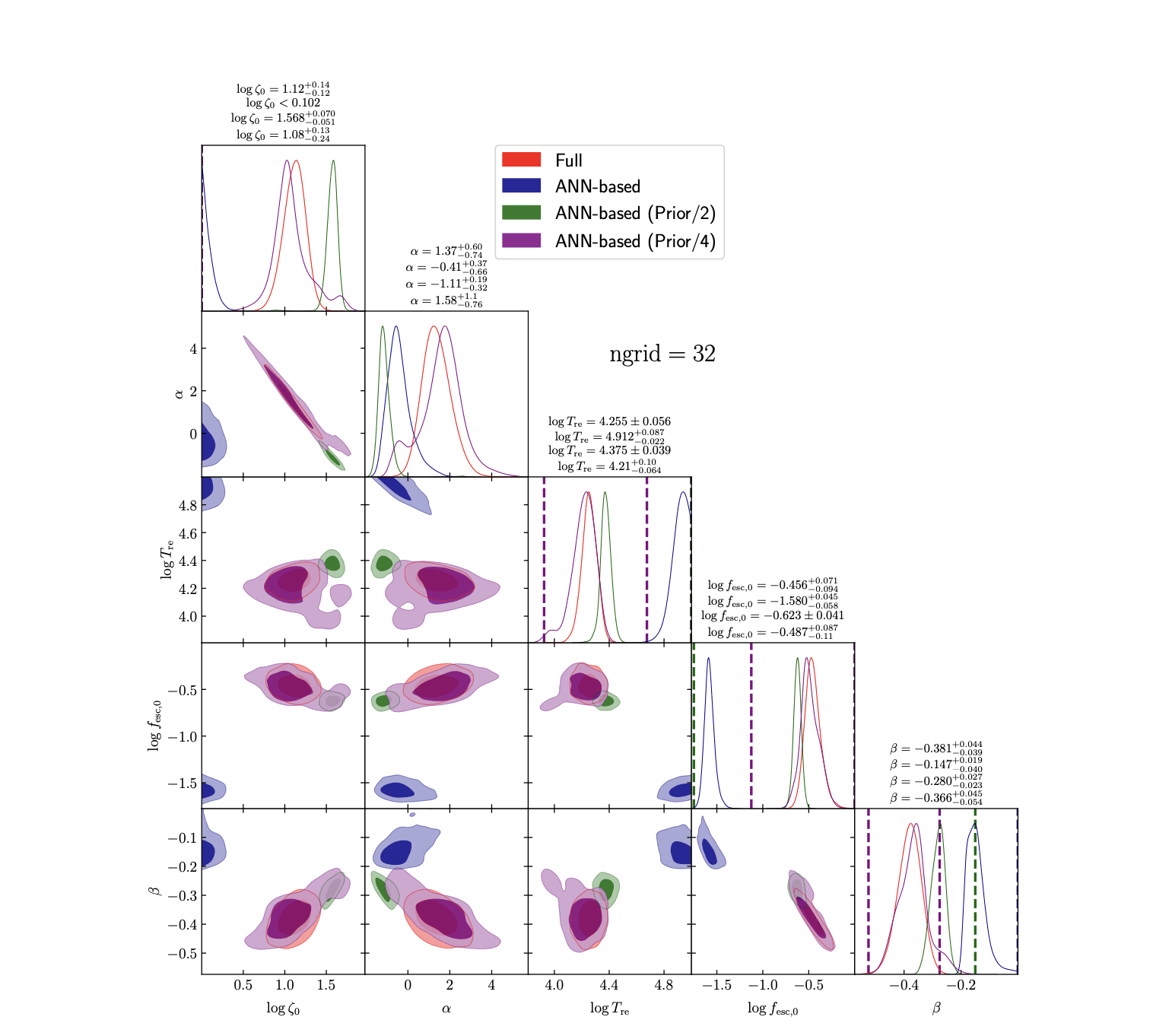
Scientists present an efficient emulator-based framework that dramatically reduces computational bottlenecks for analyzing the reionization epoch, a critical period in the history of the universe when the intergalactic medium transitions from neutrality to ionization. Their approach combines a reliable coarse-resolution Markov chain Monte Carlo (MCMC) method to identify high-likelihood regions with an adaptive and targeted sampling strategy to construct a compact, high-resolution training set for an artificial neural network-based emulator of model likelihood. With approximately 103 high-resolution simulations, the trained emulator achieves excellent prediction accuracy, exhibiting R2 values of approximately 0.97, 0.99, and reproduces the posterior distribution from a complete high-resolution simulation when embedded within the MCMC framework.
Early cosmic reionization and IGM modeling
Comprehensive research investigates the early Universe, reionization, and the physics of the Intergalactic Medium (IGM). Many studies have focused on the reionization epoch, investigating the sources of ionizing radiation, the timing of this transition, and its impact on the IGM. The researchers model star formation in high-redshift galaxies and use observations from Lyman alpha forests and quasar spectra to analyze the end of reionization. Throughout the analysis of the Lyman Alpha forest, great attention is also paid to the thermal history of the IGM, including its temperature, density, and ionization state.
Researchers also aim to investigate the formation and evolution of large-scale structures in the Universe and constrain cosmological parameters using a variety of observational probes. Numerical simulations using codes such as GADGET are important for understanding the complex physics involved, especially modeling radiative transfer. Machine learning and advanced statistical methods are increasingly being applied to cosmological data analysis. Neural networks are used for emulation, training to approximate the results of computationally expensive simulations, and inference to extract cosmological parameters from observational data.
Techniques such as density estimation using normalized flows and image generation using diffusion models are also attracting attention. Bayesian statistical methods, such as Markov chain Monte Carlo, are used for parameter estimation and model comparisons with the help of tools such as Cobaya and GetDist. Active learning efficiently selects simulations to maximize the information obtained, and fast likelihood-free cosmology methods are developed. The convergence of these fields is accelerating progress. Machine learning can help speed up simulations by replacing them with fast and accurate approximations, improve inference by processing complex data, and minimize uncertainty in astrophysical processes. Machine learning also generates realistic simulated observations to test your analysis pipeline and validate your results. This body of research demonstrates an area where machine learning is transforming traditional methods by enhancing them to provide faster, more accurate, and more robust results.
Efficiently explore the era of reionization
Scientists have developed a new framework to efficiently investigate the Epoch of Reionization, a critical period in the history of the universe when the intergalactic medium transitions from neutral to ionized. This work addresses a significant computational bottleneck in this era of analysis, which traditionally requires extensive simulations that become impractical as model complexity increases. The research team achieved a significant reduction in computational costs by combining a coarse-resolution Markov Chain Monte Carlo (MCMC) method with an artificial neural network-based emulator. Initial experiments utilized Latin hypercube sampling to generate extensive simulations, allowing researchers to identify regions of high likelihood in parameter space.
This preliminary study determined a targeted sampling strategy and built a compact, high-resolution training set for the neural network emulator. The results show that the emulator achieves excellent prediction accuracy and the performance reaches 99% fidelity when compared to a full high-resolution simulation. When integrated into the MCMC framework, the emulator reproduces posterior distributions comparable to those obtained from a complete simulation and verifies their accuracy and reliability. This approach enables tractable inference on complex models and provides a general strategy for building efficient emulators that address the constraints of next-generation reionization epochs. This advance promises to accelerate our understanding of this pivotal period in the evolution of the universe.
Neural network emulator speeds up reionization parameter estimation
This study presents a new framework for efficiently estimating the parameters governing the reionization epoch, a critical period in the evolution of the universe when the intergalactic medium transitions from neutrality to ionization. The research team developed an emulator based on artificial neural networks. This significantly reduces the computational cost of parameter inference. Parameter inference has traditionally been a slow process that requires many simulations. By combining a coarse initial search with targeted sampling to create a compact training dataset, the emulator accurately predicts simulation results with high fidelity. The results show a significant speedup, reducing the number of expensive simulations by a factor of 1,000 and reducing overall computational costs by up to a factor of 100, while maintaining statistical accuracy. Future work will focus on refining sampling strategies and exploring more advanced machine learning architectures to further improve the efficiency and accuracy of parameter inference for increasingly complex models in the reionization era.
👉 More information
🗞 Accelerating Reionization Constraints: An ANN Emulator Framework for SCRIPT Quasi-Numerical Models
🧠ArXiv: https://arxiv.org/abs/2511.16256