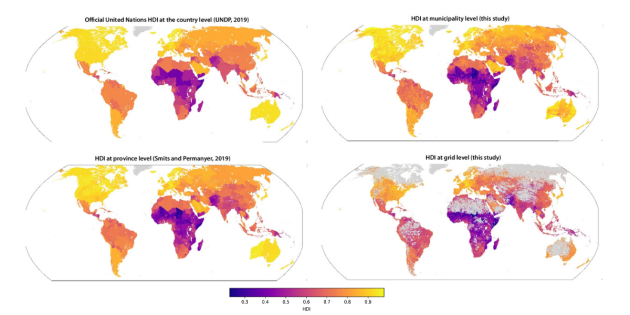
Researchers used satellite imagery and machine learning to estimate Human Development Index (HDI) scores for 61,530 municipalities and counties around the world.
The findings, published in Nature Communications, show that more than half of the world’s population lives in municipalities that differ from their nationally assigned development stage, highlighting how more granular data can change the situation within countries.
States and localities that were in the bottom two of the five development stages in the previous assessment moved about 8.5% of their residents into the top two in the new municipal-level analysis.
When the researchers extrapolated the development of a 10×10 kilometer grid tile, roughly the area of Paris, the discrepancy increased to 13%.
Although more detailed than previous estimates, the new data does not reveal information about individual households or neighborhoods. But they can help guide efforts to make aid programs more effective.
“We often target policies and programs based on these aggregate statistics, but we want to help the people who need it, not just the countries that need it,” said study co-author Solomon Shan, a professor of environmental and social sciences at the Stanford Doerr School of Sustainability.
“Multiple shocks”
“In the past, countries’ performance was often measured primarily by income and economic growth,” said study co-author Heriberto Tapia, head of research and strategic partnerships at the United Nations Development Programme’s Human Development Reporting Office.
“The human side – what’s happening to people – was often lost in policy design.”
However, even supporters of this index have long recognized the shortcomings. Relying on national averages can obscure within-country inequalities and opportunities to improve policy. Data gaps persist in the poorest countries, with only about half having conducted a census in the past decade.
Satellites generate more data every day than all social media combined, but their archives remain largely untapped, Shan said.
In 2020, Hsiang, Tapia, and their collaborators set out to determine whether this imagery could be used to improve the spatial resolution of official United Nations data.
“Our goal is that thanks to these very detailed estimates, people in different parts of the world will be able to assess what is happening to human development according to the same criteria,” Tapia said.
“We are currently in a special period in which global human development is slowing down, and we think one of the reasons for this is that there are multiple shocks occurring in different parts of the world,” Tapia added.
“Many of these shocks are related to climate change.”
computer challenge
The researchers trained their machine learning model using state and local satellite imagery, alongside national survey-based data, including the United Nations’ official HDI data.
Because the provinces are so large and have an irregular shape rather than the regular rectangles typically used in computer vision, the researchers were initially surprised that the machine learning approach worked at all, said study co-lead author Jonathan Proctor, an assistant professor of food and resource economics at the University of British Columbia.
The model learned to recognize the relationship between HDI and specific visual features in images, and the team applied it to predict HDI around the world using satellite imagery of municipalities and counties.
“Almost all the data we have around the world is collected from household surveys and then aggregated into convenient administrative fields,” said study lead author Luke Sherman, a data scientist at Stanford University’s Shan Global Policy Institute.
“We showed that using satellite imagery, it is not particularly difficult to obtain rough estimates of the same variables, such as school enrollment, educational attainment, and HDI, at higher resolution.”
In a recent preprint, the team shared preliminary results from testing the model on more than 100 variables and found that the method can accurately predict a wide range of variables, including crop yields, asset ownership such as cars and livestock, and electricity access.
This suggests that this tool has the potential to improve the resolution of other types of administrative data at relatively low cost.