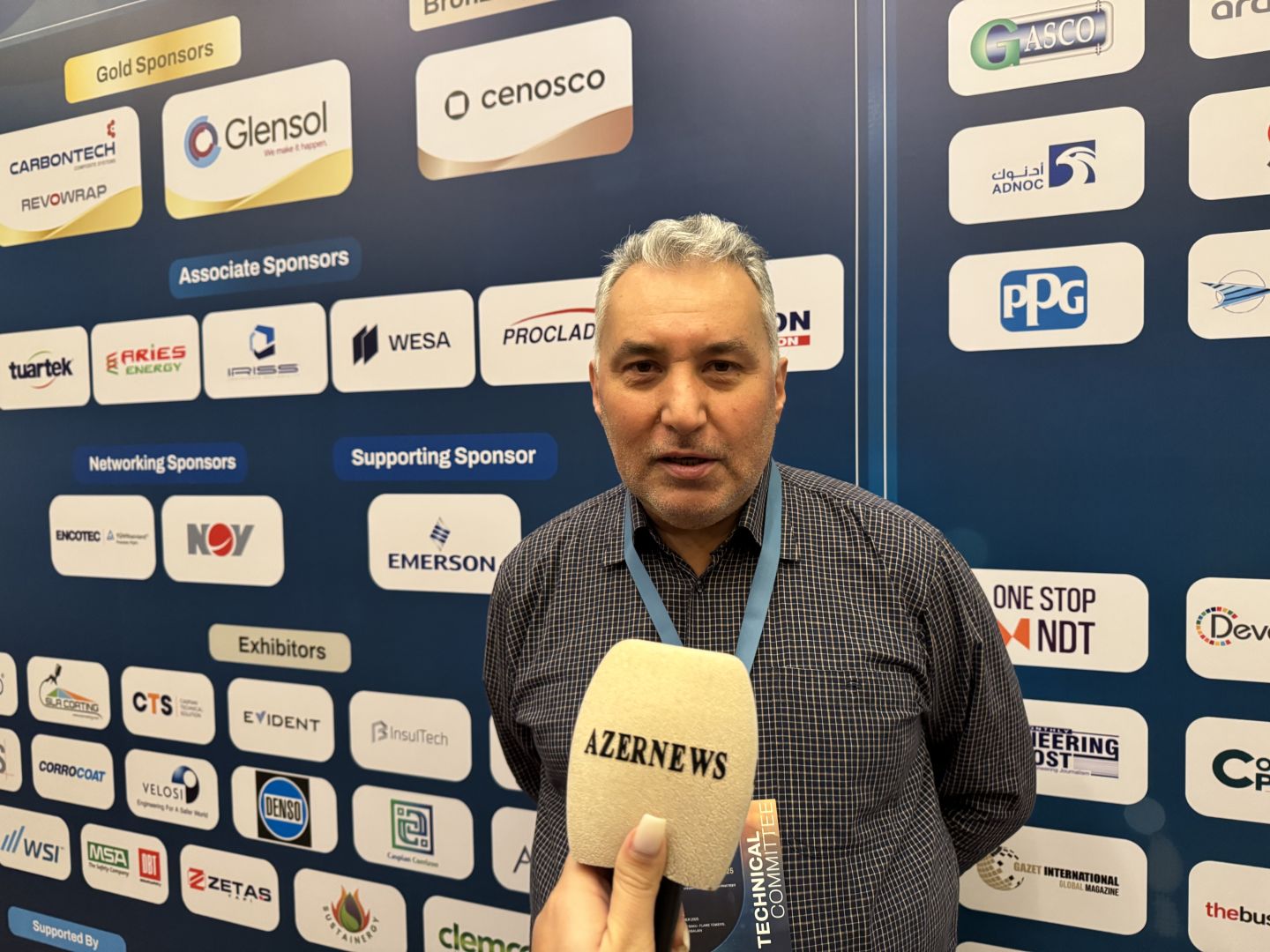

As oil and gas assets age and safety expectations increase, the industry is turning to advanced technologies to more effectively monitor corrosion. In an interview with Azel NewsAzer Valiyev, Engineering Manager at SOCAR Upstream Management International, explains how drones, robotic crawlers and artificial intelligence are transforming inspections in dangerous and confined environments, while reducing downtime and protecting personnel.
From high-risk access to remote accuracy
Valiev points out that drones and robotic crawlers are fundamentally changing corrosion inspection practices, especially in areas that were once difficult or dangerous to access. Traditionally, inspections have required setting up scaffolding, rope access teams, entering confined spaces, or even stopping the asset completely. Much of this risk has now been eliminated, he says.
“Using drones and crawlers, we can perform the same inspection without putting people at risk,” Valiyev explains. Experts say drones equipped with high-resolution cameras and thermal imaging systems can safely inspect flare stacks, tank roofs, ship hulls and offshore structures while operations continue.
Efficiency has changed dramatically, he adds, as tasks that once took days to prepare can now be completed within an hour.
Robotic crawlers offer similar benefits for internal inspection and steel surface inspection. Valiev points out that magnetic crawlers can operate on vertical vessels and pipelines, while pipe-crawling robots can move inside lines that previously required complete isolation. Importantly, these robots can be equipped with nondestructive testing (NDT) sensors, providing not only visual inspection but also subsurface corrosion data.
“The biggest transformation is a combination of improved accessibility, improved safety and significantly increased testing frequency,” he emphasizes. As a result, corrosion data is becoming more continuous, reliable, and practical for asset integrity management.

AI and advanced imaging: faster, smarter decisions
Asked about the role of artificial intelligence and advanced imaging, Valiev said these technologies offer unprecedented speed and insight.
Modern drones and robots collect large amounts of visual, thermal, LiDAR, and multispectral data during a single mission. He explains that manually reviewing such data is no longer practical, which is why AI has become essential.
“The AI model can detect early corrosion formation, pitting, coating breakdown, and even moisture intrusion in real time,” Valiev says. The system automatically flags areas of concern, assesses the severity of defects, and identifies patterns that may indicate future corrosion risk.
He also highlights the increasing use of digital twins, which are three-dimensional models built from photogrammetry and LiDAR scans. With each new inspection, updated images are overlaid onto the model, making it easy to track corrosion progression over time.
In the field of NDT, AI is also accelerating ultrasound testing and interpretation of eddy current signals. Instead of waiting for manual analysis, you can now identify wall loss trends and abnormal reactions almost instantly.
“AI brings consistency, accuracy and reproducibility,” Valiev said, adding that early detection is often the difference between preventing failures and responding to them.
Reduce downtime with smart integration
According to Valiyev, one of the biggest benefits of autonomous inspection tools is that they minimize operational downtime. Inspections can often be performed while the system is running, eliminating the need for scaffolding, isolation, and manual input.
He cited several examples, including drones that inspect active flare stacks, magnetic crawlers that scan energized pipelines without removing insulation, and internal pipe robots that perform inspections during short process stoppages rather than complete shutdowns.
From a safety perspective, this approach significantly reduces confined spaces, work at height, and exposure to hazardous atmospheres, which have long been recognized as high-risk activities.
But Valiev emphasizes that the real value lies in combining autonomous tools with traditional NDT techniques. Modern inspection workflows use drones and robots for rapid, wide-area screening to identify corrosion hotspots and anomalies. AI then analyzes the data and prioritizes important areas.
Only after this screening stage are conventional NDTs such as ultrasonic thickness measurement, eddy current testing, and magnetic particle testing applied to verify and quantify defects.
“This hybrid model provides maximum efficiency,” Valiev explains. Autonomous tools provide speed and coverage, while traditional NDT provides precision and sizing accuracy. Together, they provide a comprehensive corrosion assessment that extends the life of assets and protects personnel.