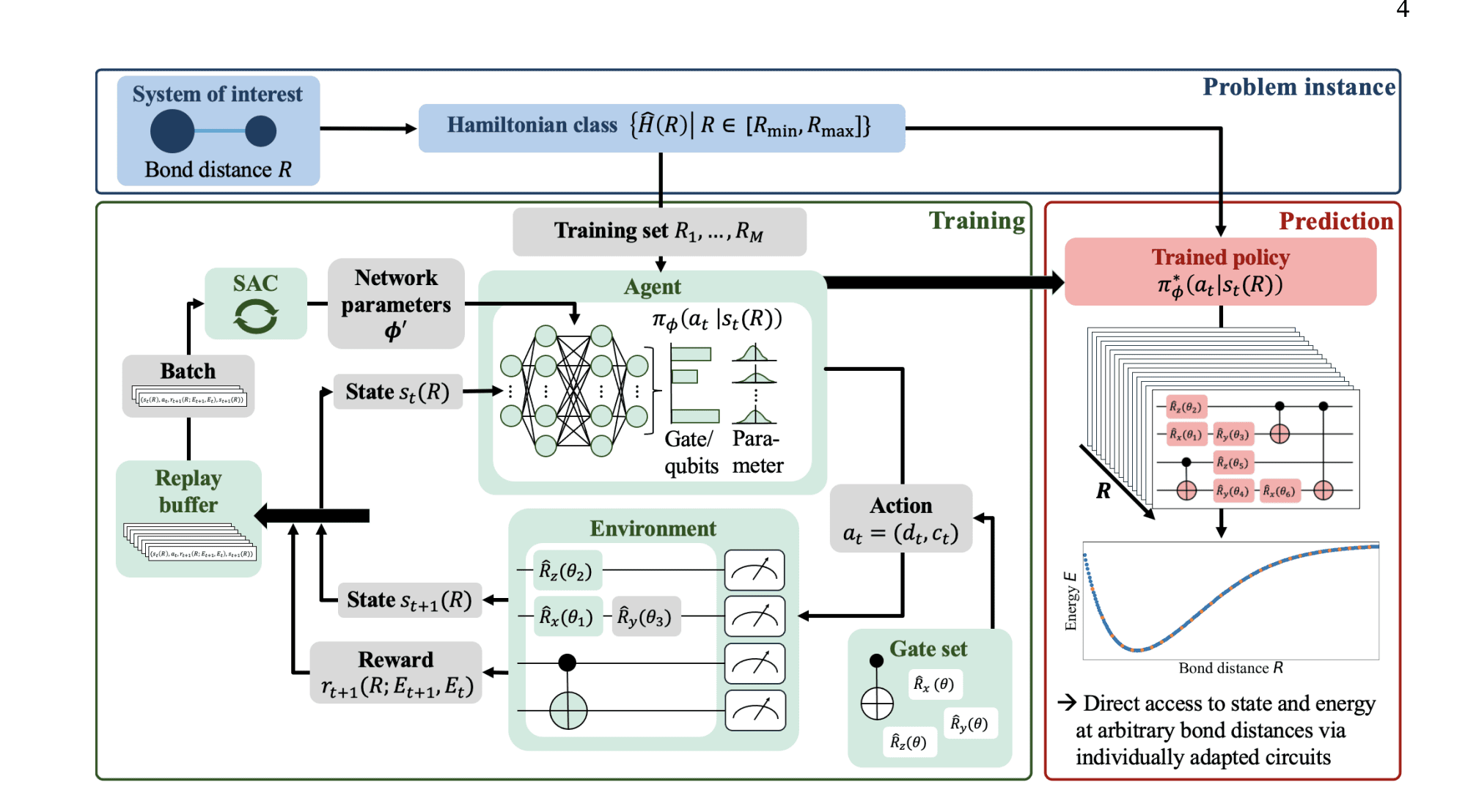
The quest to accurately simulate molecular behavior is a major challenge for modern computing, requiring increasingly sophisticated algorithms and hardware. Maureen Krumtünger, Alissa Wilms, and Paul K. Faehrmann from the Dahlem Center for Complex Quantum Systems and Porsche Digital GmbH, together with colleagues including Jens Aisert and Jakob Kottmann, have presented a new approach to designing quantum circuits specifically for computing molecular potential energy curves. Their work overcomes the limitations of existing methods by leveraging reinforcement learning to automatically generate circuits that can adapt to arbitrary molecules and bond distances, rather than relying on predefined structures. This inherently flexible system has demonstrated success with lithium hydride and hydrogen chain molecules, producing circuits that are not only effective but also physically interpretable, thereby opening exciting possibilities to simulate larger and more complex molecular systems with unprecedented accuracy.
Documentation of exact reinforcement learning parameters
This document details a comprehensive set of parameters for a research project optimizing quantum circuits using reinforcement learning that are essential for reproducibility and understanding how results are obtained. This research focuses on lithium hydride and a hydrogen molecule with four hydrogen atoms, identifying its shape, basis set, active orbital, and mapping of electrons to qubits, as well as orbital phase correction for smooth potential energy surface calculations. The most extensive appendix details all the hyperparameters used in both reinforcement learning algorithms and quantum simulations, including system settings, training settings, and specific parameters for soft actor-critical algorithms such as learning rate and batch size. This level of detail is essential for anyone trying to reproduce the results and highlights the complexity of the system and the effort required to tune it.
Designing adaptive quantum circuits using reinforcement learning
Scientists have developed a new reinforcement learning approach to generate quantum circuits tailored to specific molecular problems, going beyond circuits designed for only one instance. This research addresses a key challenge in quantum chemistry: the accurate calculation of the potential energy surface of molecules. The team’s RL framework accepts a discrete set of molecules and bond distances as input and outputs a bond distance-dependent quantum circuit that can compute energy along a potential energy curve, providing a non-greedy alternative to existing methods. The researchers implemented this approach using a variational quantum eigensolver, a promising algorithm for estimating ground state energies. To demonstrate the effectiveness of their method, the scientists applied the RL framework to 4-qubit and 6-qubit lithium hydride molecules, and to 8-qubit H4 chains. The result is an interpretable circuit, paving the way for applying RL to circuit development for larger and more complex molecular systems. This innovative approach provides a versatile route to construct quantum circuits, potentially overcoming the limitations of existing methods and advancing the field of quantum chemistry.
Quantum circuit designed by reinforcement learning
Scientists have achieved a major advance in computational chemistry by developing a new reinforcement learning framework for designing quantum circuits tailored to molecular systems. This work addresses the challenge of creating a circuit that accurately represents the ground state energy of a particular molecular configuration. The team’s approach uses reinforcement learning to map molecules and their bond distances to corresponding quantum circuits, enabling accurate energy calculations over a range of bond lengths, characterized by a non-greedy optimization strategy. Experiments demonstrate the effectiveness of this framework for 4- and 6-qubit lithium hydride molecules and 8-qubit H chains, demonstrating its ability to generate accurate potential energy curves without the need for relearning each bond distance, significantly reducing computational costs.
The resulting quantum circuits are not only accurate but also interpretable and reflect chemically meaningful structures, and the approach transfers successfully to job shop scheduling problems, highlighting its potential beyond applications in quantum chemistry. By deliberately avoiding encoding prior knowledge, the algorithm independently extracts structural patterns, paving the way for scalable circuit construction. This framework employs soft actor-critical algorithms to learn both discrete gate selection and continuous parameter optimization to maximize cumulative reward and achieve circuits that accurately represent ground state energy over a range of bond distances, providing a foundation for expanding the Ansatz design toolbox.
Quantum circuit that learns the ground state of molecules
This work presents a novel reinforcement learning approach for designing quantum circuits for computing the ground state energy of molecules, learning problem-dependent circuit mappings tailored to specific molecular systems. The research team successfully demonstrated this method on lithium hydride and hydrogen chains, producing an interpretable circuit that reveals the underlying relationship between molecular structure and quantum computation. This circuit is characterized by non-greedy algorithms, which are essential for tackling complex molecular systems. Researchers have created a powerful tool to explore the potential of quantum computers in chemistry and materials science by training neural networks to optimize circuit designs. Although the current implementation focuses on relatively small molecules, the authors acknowledge that there are limitations to extension to larger systems and suggest that future work will focus on improving computational efficiency and expanding the applicability of the method to more complex chemical scenarios.
👉 More information
🗞 Reinforcement learning of quantum circuit architectures for molecular potential energy curves
🧠ArXiv: https://arxiv.org/abs/2511.16559