
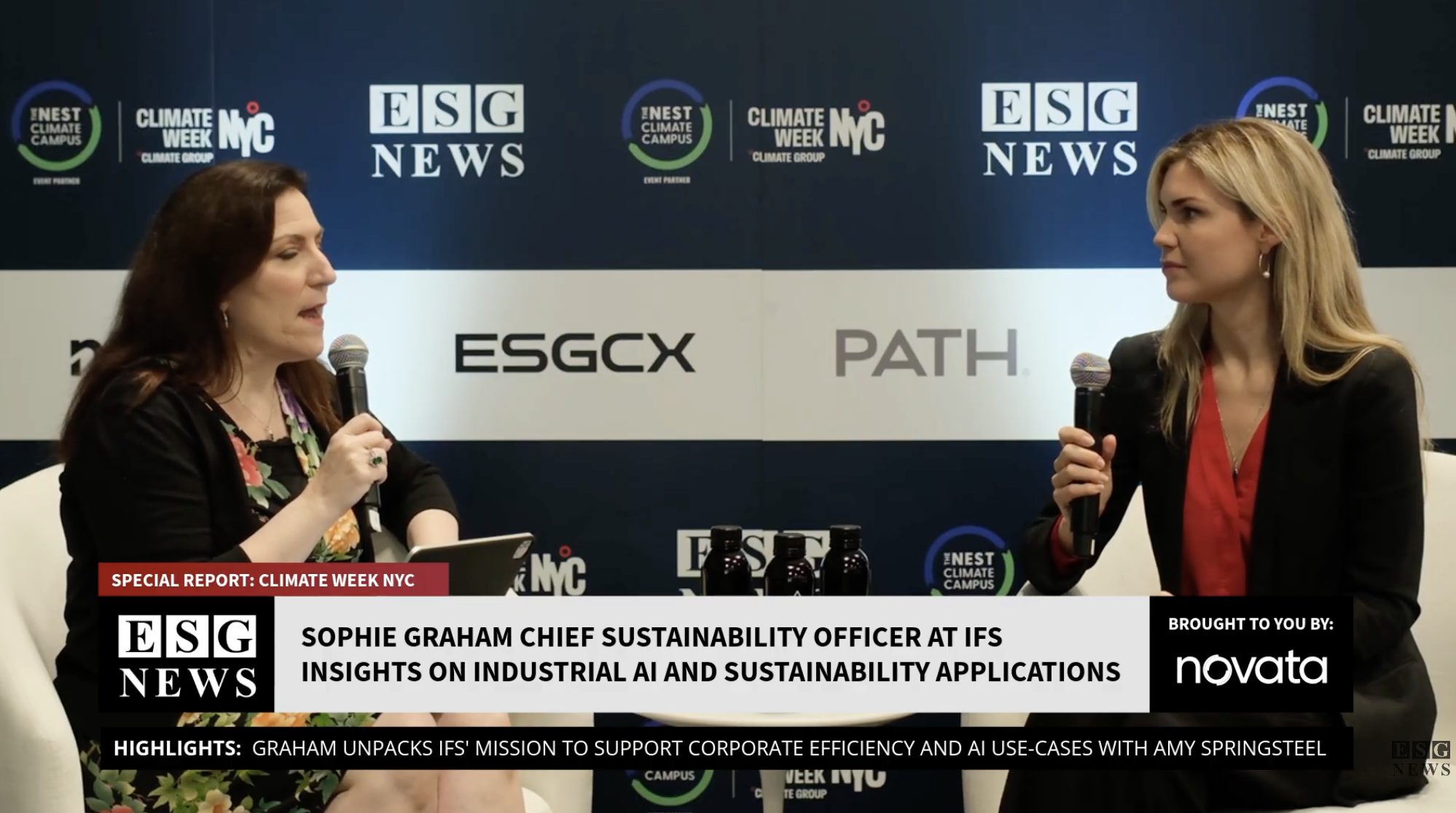
Main highlights
- Sophie Graham, Chief Sustainability Officer at IFS, points out that AI today should be seen as an enabler of the energy transition, rather than as a sustainable technology in its own right.
- Initial analysis from the IEA and LSE suggests that the potential decarbonization impact of AI could significantly exceed its own energy and water demands.
- Session moderator: Amy Springsteel, former Bloomberg Chief Sustainability Officer.
Discussions about AI and sustainability are happening in nearly every boardroom and trade show stage. When will AI catch up with sustainability? Sophie Graham, Chief Sustainability Officer at IFS, says AI is “what we choose to do” and that today AI sees sustainability and climate change as enablers of the energy transition. Graham points out that early analysis from the IEA and LSE suggests that AI’s potential decarbonization impact will significantly exceed its own energy and resource production. Here are three practical ways to proactively manage your AI and energy usage.
- Check out our AI sustainability calculator. Many tools and open source options are emerging to help organizations measure the energy, carbon, and water footprint of their AI usage, giving teams a starting point to make informed decisions rather than guesswork.
- Use AI with purpose. Not all tasks require large models. Rather than defaulting to AI for all queries, reaching for search engines and lightweight tools only when necessary for the task is itself a sustainable choice.
- Consider AI in offset planning. As the use of AI grows across your organization, your offsets and carbon reduction strategies should grow with it. Treating AI infrastructure as its own line item in emissions accounting, rather than incorporating it into the general IT footprint, provides a clearer picture of what needs to be offset.
Related articles: PWC UK and IFS partner to launch global sustainability management solution
conclusion
AI is already proving itself as a sustainability tool. The efficiency and monitoring benefits are real and often underestimated, not exaggerated. Graham’s framework is a useful starting point. AI is what we choose to make it. A natural extension of that idea is: The control is what you choose how to use it. Policy incentives, infrastructure investments, calculators, purposeful use, offset accounting – these are the means to turn AI’s potential into real sustainability outcomes.
About Sophie Graham and IFS
Sophie Graham is Chief Sustainability Officer at IFS, where she works with the executive leadership team to oversee the implementation of the company’s sustainability strategy and scale efforts across IFS’ global operations. She has a background in environmental law and has worked in the technology and finance sectors in EMEA, the Americas and the UK, including as Sustainability Strategy Manager at Santander and Responsible Business Leader at Fujitsu. Mr. Graham has led Sustainability and ESG at IFS since joining the company in 2021 and assumed his current role in 2024.
Founded in 1983 and headquartered in Linköping, Sweden, IFS is a global enterprise cloud software provider with approximately 6,000 employees and more than 6,500 customers. The company develops ERP, enterprise asset management, and field service management software for industries such as aerospace and defense, energy and utilities, construction, and manufacturing.
Editor’s note: This video footage is taken from ESG News’ interview archives and was produced at the ESG News Live pop-up studio at The Nest Campus during Climate Week NYC 2025, moderated by IFS’ Amy Springsteel and Sophie Graham. The video feature in this article highlights thought leadership from industry experts. The views expressed do not necessarily represent the views of ESG News.
The ESG News editorial team is comprised of seasoned financial journalists and sustainability analysts dedicated to providing real-time, objective reporting on global ESG regulation, climate finance, and corporate governance. Our desk monitors daily developments from the SEC, IFRS, CSRD, and international regulatory bodies to ensure our more than 1 million readers receive accurate, data-driven insights on the evolving sustainable investment landscape. Follow our ESG News editorial team for expert reporting on global sustainability standards, ESG disclosures and climate policy. Access over 10,000 research reports and real-time updates.


