


Deep neural networks like convolutional neural networks (CNNs) have revolutionized a variety of computer vision tasks, from image classification to object detection and segmentation. As the models grew larger and more complex, their accuracy skyrocketed. But deploying these resource-hungry behemoths to devices with limited computing power, such as embedded systems and edge platforms, has become increasingly difficult.


Distillation of knowledge (Figure 2) It has emerged as a potential solution to provide a compact training method. “student” The model is guided by a larger guide “teacher” model. The central idea was to transfer teacher knowledge to students and extract teacher expertise during training. But the process came with its own hurdles, including the resource-intensive training of teacher models.
Researchers have previously considered various methods to leverage the power of soft labels (probability distributions across classes that capture similarities between classes) to distill knowledge. Some have investigated the impact of very large-scale supervised models, while others have experimented with crowd-sourced soft labels and decoupled knowledge transfer. Others have attempted unsupervised knowledge distillation by manually designing regularization distributions from hard labels.


But what if we could generate high-quality soft labels without relying on large-scale supervised models or expensive crowdsourcing? This interesting question prompted the development of a new approach called . ReffAKD (Resource-efficient autoencoder-based knowledge distillation) Shown in Figure 3. In this study, the researchers harnessed the power of autoencoders, neural networks that learn by reconstructing compact data representations. By leveraging these representations, we can capture important features, compute class similarity, and effectively mimic the behavior of a teacher model without training it.
Unlike randomly generating soft labels from hard labels, ReffAKD's autoencoder is trained to encode input images into hidden representations that implicitly capture the characteristics that define each class. This learned representation becomes sensitive to the fundamental features that distinguish different classes, just as a knowledgeable teacher understands class relationships, and is rich in information about image features and their corresponding classes. encapsulate.
At the heart of ReffAKD is a carefully crafted convolutional autoencoder (CAE). The encoder consists of three convolutional layers, each with a 4×4 kernel, a padding of 1, and a stride of 2, and the number of filters gradually increases from 12 to 24 and finally to 48. The bottleneck layer generates compact feature vectors with different dimensions based on the following criteria: Values on the dataset (e.g. 768 for CIFAR-100, 3072 for Tiny Imagenet, and 48 for Fashion MNIST). The decoder mirrors the encoder's architecture and reconstructs the original input from this compressed representation.
But how does this autoencoder enable knowledge distillation? During training, the autoencoder learns to encode the input image into a hidden representation that implicitly captures the class-defining characteristics. To do. In other words, this representation is sensitive to the underlying features that distinguish different classes.
The researchers randomly selected 40 samples from each class to generate soft labels and calculated the cosine similarity between the encoded representations. This similarity score is entered into a matrix. Each row represents a class and each column corresponds to similarity to other classes. After averaging and applying softmax, we obtain a soft probability distribution that reflects the relationships between classes.
To train the student model, the researchers employed a customized loss function that combines cross-entropy loss and Kullback-Leibler divergence between the student output and the autoencoder-generated soft labels. This approach encourages students to learn the truths and complex class similarities encapsulated in soft labels.

reference: https://arxiv.org/pdf/2404.09886.pdf
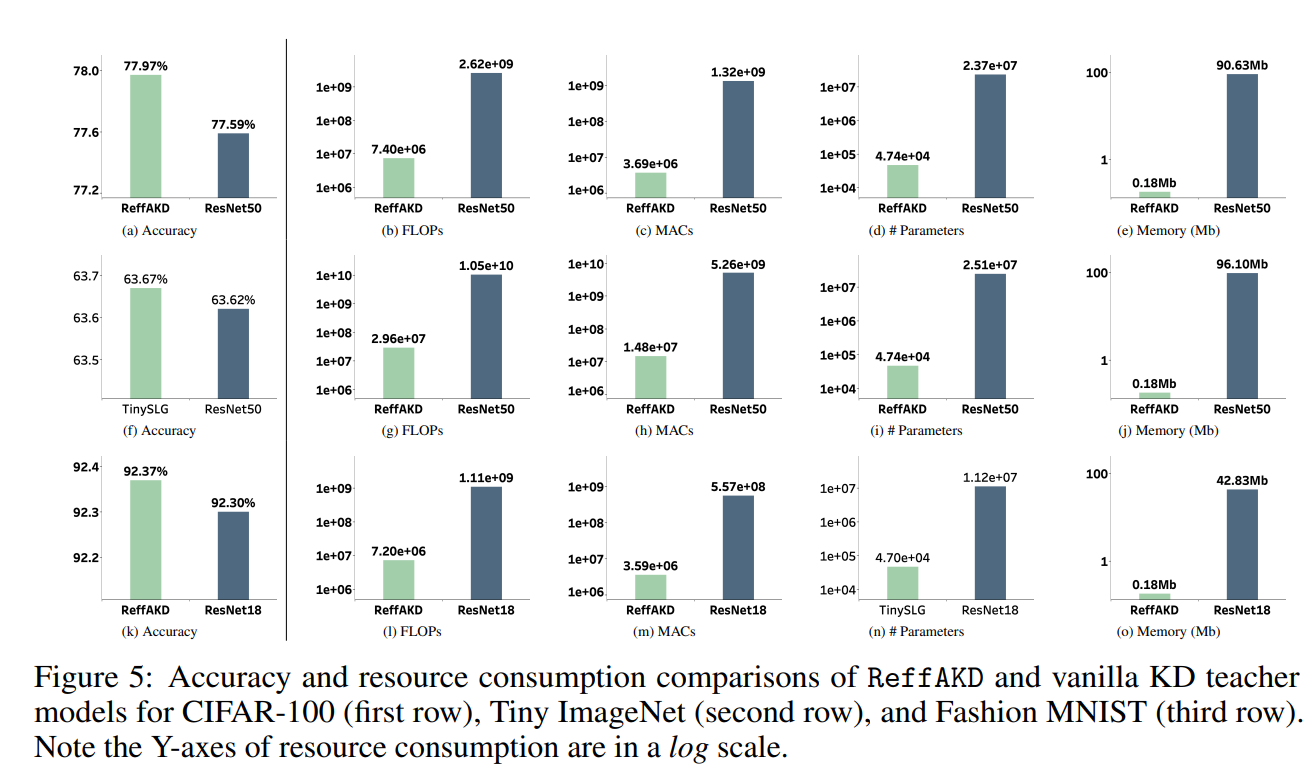
Researchers evaluated ReffAKD on three benchmark datasets: CIFAR-100, Tiny Imagenet, and Fashion MNIST. Across these diverse tasks, their approach consistently outperformed vanilla knowledge distillation and achieved top-1 accuracy. 77.97% In CIFAR-100 (77.57% in vanilla KD); 63.67% Tiny Imagenet (vs. 63.62%) yielded impressive results on the simpler Fashion MNIST dataset, as shown in Figure 5. Additionally, ReffAKD's resource efficiency is especially noticeable on complex datasets like Tiny Imagenet, consuming significantly fewer resources than a regular His KD. while delivering superior performance. ReffAKD also demonstrated seamless compatibility with existing logit-based knowledge distillation techniques, opening up possibilities for further performance improvements through hybridization.
While ReffAKD has demonstrated potential in computer vision, researchers envision its applicability extending to other areas such as natural language processing. Imagine using a small RNN-based autoencoder to derive sentence embeddings and extract compact models such as TinyBERT and other BERT variants for text classification tasks. Additionally, the researchers believe that their approach could directly monitor larger models, potentially enabling further performance improvements without relying on pre-trained teacher models. Masu.
In summary, ReffAKD provides a valuable contribution to the deep learning community by democratizing knowledge distillation. Eliminating the need for resource-intensive supervised models opens new possibilities for researchers and practitioners working in resource-constrained environments, allowing them to leverage the benefits of this powerful technique with greater efficiency. and accessibility. The potential of this method extends beyond computer vision, paving the way for the exploration of hybrid his approaches for applications and performance enhancement in a variety of areas.
Please check paper. All credit for this study goes to the researchers of this project.Don't forget to follow us twitter.Please join us telegram channel, Discord channeland linkedin groupsHmm.
If you like what we do, you'll love Newsletter..
Don't forget to join us 40,000+ ML subreddits
Learn more about content partnerships here Please fill out the form here.


Vineet Kumar is a consulting intern at MarktechPost. He is currently pursuing his bachelor's degree from the Indian Institute of Technology (IIT), Kanpur. He is a machine learning enthusiast. He is deeply passionate about research and the latest advances in learning, computer vision, and related fields.


